
Home / Reviews / Head-to-head
Kasa EC71 vs Tapo C200: Which TP-Link Pan-Tilt Camera Should You Buy?

Affiliate note: Bestindoorcam.com may earn a commission if you buy through a store link. That does not change which camera we prefer. Read how affiliate links and ads work and how we research and review cameras. As an Amazon Associate I earn from qualifying purchases.
TL;DR — Kasa EC71 vs Tapo C200 verdict
- Short answer: buy the Tapo C200 if you want the more open, flexible camera — double the local storage, RTSP/ONVIF support, a privacy mode and a siren. Buy the Kasa EC71 if you want the camera to patrol a room on its own and you prefer a black camera that disappears on a shelf. Both are 1080p pan-and-tilt cameras from TP-Link, both detect a baby crying, and on video quality they are effectively tied.
- The twist in this comparison: these are sister products from the same parent company, sold under two different smart-home brands. The EC71 lives in the Kasa Smart app with Kasa Care cloud plans; the C200 lives in the Tapo app with Tapo Care. That app split — not the hardware — is the difference you will live with every day, and it decides which of TP-Link's plugs, bulbs and sensors each camera can work alongside.
- Where the EC71 wins: Patrol Mode that cycles through up to four saved viewpoints automatically, up to 16 activity zones, a larger 1/2.9-inch sensor on paper, and the only black finish in this pairing.
- Where the C200 wins: microSD storage up to 512 GB (vs 256 GB), RTSP and ONVIF for recorders and smart-home software, a listed privacy mode with custom privacy zones, a 93 dB siren, and noise-cancelling two-way audio.
- What is identical: 1080p Full HD video at 15 fps with H.264 compression, 360°-class pan/tilt coverage with motion tracking, motion / person / baby-crying detection, black-and-white 850 nm infrared night vision rated to 30 ft, two-way audio, 2.4 GHz Wi-Fi only, and Alexa and Google Assistant support. Neither camera supports Apple HomeKit, 5 GHz Wi-Fi, or color night vision.
- How to read this: a spec-based comparison built from Kasa/TP-Link's official EC71 product page, user guide and datasheet and TP-Link/Tapo's official C200 product and specification pages, re-checked in October 2026. We did not hands-on test either camera for this article, and neither brand publishes a US MSRP for these models — so check live retailer prices before deciding.
Overview
Most camera comparisons pit two rival companies against each other. This one is stranger and, for buyers, more useful: the Kasa EC71 (sold as the Kasa Spot Pan Tilt) and the TP-Link Tapo C200 are both TP-Link products, built around the same recipe — a motorized 1080p pan-and-tilt head, infrared night vision, on-camera microSD recording, and free person and baby-crying detection — but sold under two separate smart-home brands with two separate apps, two separate cloud plans, and two separate accessory ecosystems. If you have read our Kasa EC71 review and our Tapo C200 review, you already know each camera on its own. This head-to-head exists because choosing between them is mostly not about the camera hardware at all.
On paper the hardware really is that close. Both record 1920 × 1080 at 15 fps. Both pan a full circle and follow movement automatically. Both see in the dark with a single 850 nm infrared LED rated to 30 feet, and both produce black-and-white night footage — neither has a spotlight or a starlight sensor. Both detect motion, people and a crying baby without a subscription. A buyer comparing spec sheets could reasonably conclude they are the same camera in different plastic, one black and one white.
They are not quite. Under the shared formula, each brand kept a few features for itself. Kasa gave the EC71 a Patrol Mode that sweeps saved viewpoints on a schedule and up to 16 activity zones — the more autonomous room monitor. Tapo gave the C200 the bigger storage ceiling (512 GB against 256 GB), the open-protocol support (RTSP and ONVIF) that Kasa does not list at all, a privacy mode, and a siren. And behind those deltas sits the structural one: an EC71 is set up, viewed and automated in the Kasa Smart app and stores cloud clips on Kasa Care, while a C200 lives in the Tapo app on Tapo Care. If you already own TP-Link smart plugs or bulbs, which app they belong to may settle this comparison before the hardware gets a vote. The rest of this article works through the differences in the order they actually matter.
Full spec comparison
| Specification | Kasa EC71 (Kasa Spot Pan Tilt) | TP-Link Tapo C200 |
|---|---|---|
| Maximum resolution | 1920 × 1080 (1080p Full HD) | 1920 × 1080 (1080p Full HD) |
| Image sensor | 1/2.9-inch | 1/3" progressive scan CMOS — not starlight |
| Lens | F2.4, 3.83 mm focal length | 4.0 mm, F2.0 |
| Lens field of view | Not published separately from the pan/tilt coverage figures | 88.3° diagonal / 75.2° horizontal / 40.8° vertical |
| Pan / tilt | 360° horizontal view, 113° vertical view | Pan mechanical 340° (360° coverage); tilt mechanical 70° (110.8° coverage) — marketed as 360° horizontal / 114° vertical |
| Frame rate | 15 fps | 15 fps |
| Video compression | H.264 | H.264 (3D DNR image enhancement) |
| Digital zoom | Not specified on the official product page | None listed on the current US spec table |
| Night vision | 850 nm IR LED, up to 30 ft, black-and-white only | 850 nm IR LED, black-and-white only — 30 ft / 9 m on the US spec table* |
| Color night vision / spotlight | None | None |
| AI detection | Motion, person, baby crying (plus sound detection) | Motion, person, baby crying; activity zones |
| Activity zones | Yes — up to 16 custom zones (official user guide) | Yes (works with motion detection) |
| Motion tracking | Yes | Yes |
| Patrol mode | Yes — up to 4 saved viewpoints, custom speed and interval | Not listed on the official product page or spec table |
| Privacy controls | Not listed on the official product page | Privacy mode (pause recording) and customizable privacy zones |
| Audio | Two-way audio; built-in microphone and speaker | Two-way audio with noise cancellation; built-in microphone and speaker; siren 93 dB (at 10 cm) |
| Siren | Not listed on official pages | 93 dB (measured at 10 cm) |
| Local storage | microSD up to 256 GB (card not included); 24/7 continuous recording supported | microSD up to 512 GB (card not included) |
| Cloud storage | Kasa Care (subscription; 30-day video history) | Tapo Care (subscription required) |
| RTSP / ONVIF | Not listed on any official Kasa/TP-Link page for this model | Yes / Yes |
| Wi-Fi | IEEE 802.11b/g/n, 2.4 GHz only | IEEE 802.11b/g/n, 2.4 GHz only |
| Security | 128-bit AES encryption with SSL/TLS; WEP, WPA/WPA2-PSK | On-device machine learning; 128-bit AES with SSL/TLS; WPA/WPA2-PSK |
| Voice assistants | Amazon Alexa, Google Assistant (no HomeKit) | Amazon Alexa, Google Assistant (no HomeKit) |
| App / cloud ecosystem | Kasa Smart app; Kasa Care plans | Tapo app; Tapo Care plans |
| Power | Adapter output 5.0V DC, 1.0A; 10 ft USB cable in the box | 9V DC adapter (100-240 V input; 9 V / 0.6 A output) |
| Mounting | Tabletop; mounting plate and screws included | Tabletop or ceiling-mounted |
| Dimensions | 3.2 × 3.2 × 4.4 in (82 × 82 × 112.6 mm) | Not listed on the current US specification table |
| Finish | Black | White |
Source note: all figures are from official sources only — kasasmart.com and tp-link.com for the EC71 (current product page and specification table, EC71 user guide, and the TP-Link EC71 datasheet) and tapo.com and tp-link.com for the C200 (current US product and specification pages) — checked October 2026. *The C200's night-vision range is documented inconsistently by TP-Link itself: the current US spec table says 30 ft / 9 m, while some regional tables and the camera's own retail box say 40 ft / 12 m. We treat that as a hardware-version and documentation difference, not a real-world advantage over the EC71's 30 ft rating. Two EC71 figures have changed over the model's life: the current kasasmart.com page lists microSD support up to 256 GB and a 5.0V/1.0A adapter, where the 2023 datasheet said 64 GB and 9.0V/0.6A — the table uses the current page. Neither brand publishes a US MSRP for these models, so no prices are quoted here.
Design and coverage: same shape, different uniform
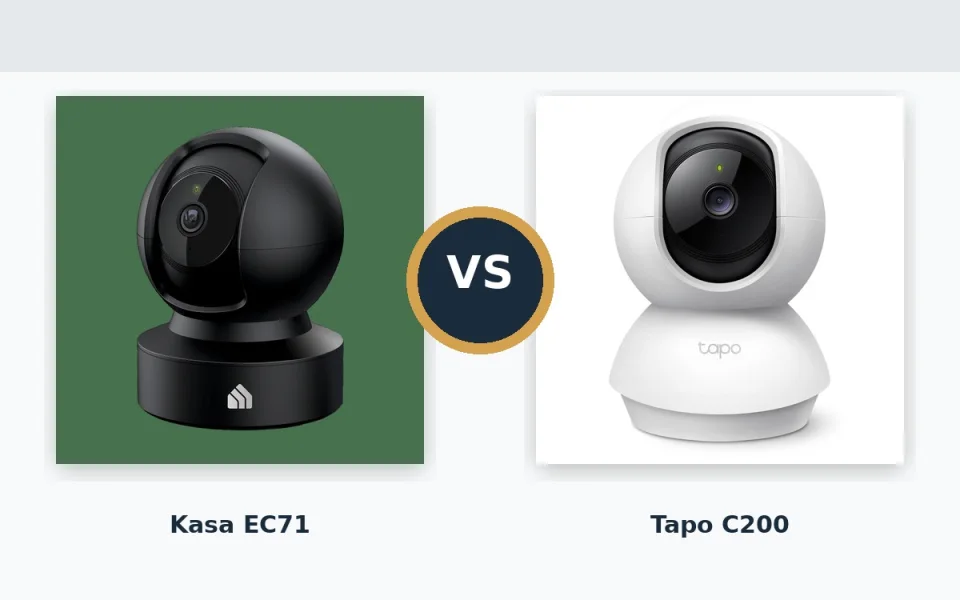
Sit the two cameras side by side and the family resemblance is obvious. Both are a motorized ball head on a short cylindrical base, small enough for a bookshelf and light enough for the included mounting hardware. The EC71 measures 3.2 × 3.2 × 4.4 inches; TP-Link's current US spec table leaves the C200's dimensions blank, but the two occupy the same footprint class and neither will dominate a shelf. The visible difference is color, and it is a genuine buying factor rather than a cosmetic footnote: the EC71 is black — TP-Link promoted it as the first all-black Kasa indoor pan-tilt — while the C200 is white. On a dark TV stand or in a shadowed nursery corner the EC71 all but disappears; on white shelving or a pale wall the C200 is the one that blends in. If the camera will sit somewhere guests see it, pick the finish that matches the furniture, because neither camera is discreet in the other one's color.
Coverage, on the published numbers, is a tie with different bookkeeping. Kasa quotes the EC71 as a 360° horizontal view with a 113° vertical view. Tapo quotes the C200's mechanics precisely — 340° of mechanical pan delivering 360° of coverage, 70° of mechanical tilt delivering 110.8° of coverage — and markets the rounded version as 360° horizontal and 114° vertical. Those are the same class of movement described two ways, and both heads can sweep a whole room from a corner. The lens in front of each head differs more than the motors do: Tapo publishes a proper field of view for the C200 (88.3° diagonal) behind a 4.0 mm F2.0 lens, while Kasa publishes the EC71's lens as f/2.4 with a 3.83 mm focal length and does not state a separate lens field of view — so we do not invent one. In practice both cameras see a wide slice of a room at rest and rely on the pan motor for the rest, which is exactly the formula our roundup of the best pan-and-tilt indoor cameras is built around.
Where coverage behavior genuinely splits is patrol. The EC71 can store up to four viewpoints and patrol between them automatically at a speed and interval you choose — crib, door, window, crib — all day, without waiting for motion to give it a reason to move. The C200 has no equivalent on its official pages: it stays where you leave it until its motion tracking takes over. For a single-purpose camera watching one cot or one door, patrol is a luxury. For one camera asked to keep an eye on a whole open-plan floor, it is the EC71's strongest single argument.
Video and night vision: a tie, honestly reported
There is no resolution winner in this comparison, and any listing that suggests otherwise is inventing a difference. Both cameras record 1920 × 1080 at 15 fps with H.264 compression. The sensor hardware behind that identical output differs slightly on paper — the EC71 uses a 1/2.9-inch sensor, the C200 a 1/3-inch progressive-scan CMOS — and the C200's spec table adds 3D noise reduction to its image processing. Sensor size alone, at the same resolution and frame rate, is not a basis for declaring one picture sharper than the other without testing, and we did not test either camera. The honest statement is narrower: on official specifications, the video pipelines of these two cameras are equivalent, and neither gives you the extra detail of the 2K class. If sharper footage is what would actually change your decision, the comparison that matters is on the Tapo side of the family — our Tapo C200 vs Tapo C210 head-to-head shows what stepping up to 3MP buys over this shared 1080p baseline.

Night vision is the same story with one documentation wrinkle. Both cameras use a single 850 nm infrared LED, both are rated to 30 feet on their current US pages, and both record black-and-white footage after dark — TP-Link's C200 spec table describes its sensor in plain words as "Not Starlight," and neither camera has a spotlight, so color night vision is off the table for this entire pairing. The wrinkle: TP-Link's own paperwork disagrees with itself about the C200's infrared range. The current US spec table says 30 ft / 9 m; some regional spec tables and the C200's retail box say 40 ft / 12 m. That is a hardware-version and regional-documentation difference that has followed this model for years, not a capability gap between individual C200 units, and it is not a reason to pick the C200 over the EC71 — on matched US documentation the two cameras are rated identically, and in a normal room either rating is more than the space needs. Buy either camera expecting clear infrared check-ins across a bedroom or living room, and neither expecting readable faces at the far end of a long, dark open-plan space.
Detection, tracking and audio
The detection sets are where the shared formula is most complete. Both cameras detect motion, people and a crying baby on the device, without a subscription — the baby-crying detection is why both models keep showing up as budget nursery monitors, and it works the same way conceptually on each: the camera listens, classifies the sound, and pushes an alert instead of making you scrub footage. Both add activity zones so a ceiling fan or a busy hallway corner stops generating alerts — Kasa publishes the more specific number, up to 16 custom zones from the EC71's official user guide, while Tapo lists activity zones on the C200 as working alongside its motion detection without publishing a count. Neither camera lists a pet-specific detection label on its official pages; a dog crossing the room is a motion (or, if the shape qualifies, person-classified) event on both, which is worth knowing if pet alerts were on your shopping list.
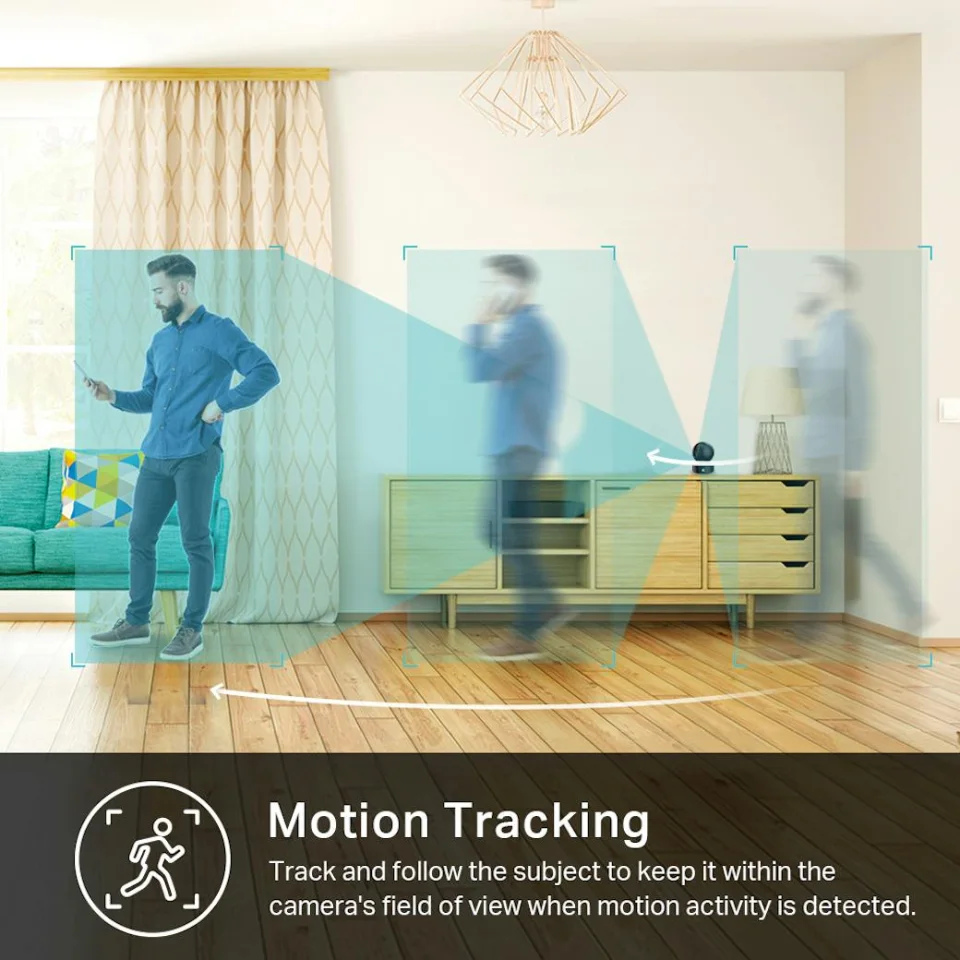
Motion tracking is likewise shared: when movement is detected, each head turns to follow the subject and keep it in frame until the activity stops. It is the feature that makes a pan-tilt camera feel like several fixed cameras, and on the spec sheets there is nothing to choose between the implementations. The EC71 then adds the patrol behavior described above — tracking reacts, patrol anticipates — and that pairing of the two is unique to the Kasa side of this comparison.
Audio is a narrow C200 win on paper. Both cameras have a built-in microphone and speaker for two-way talk. Tapo's spec table adds two specifics Kasa does not publish for the EC71: two-way audio with noise cancellation, and a siren rated at 93 dB measured at 10 cm — loud enough, at close range, to startle an intruder or shoo a pet off a counter through the app. Kasa's EC71 pages list no siren at all, so if the ability to sound an alarm from the camera matters to you, that is a real, checkable difference in the C200's favor, not marketing fog.

Storage, privacy, and the app split that decides this comparison
Both cameras record locally to microSD with no required subscription, but the ceilings differ by a factor of two: the C200 accepts cards up to 512 GB, the EC71 up to 256 GB. The EC71 counters with an explicit 24/7 continuous-recording mode to the card — Kasa markets the camera as a "24/7 Recording" model, overwriting the oldest footage when the card fills. For event-only recording, either ceiling holds weeks of clips and the difference is academic. For continuous recording, card size is quite literally how far back in time your camera can see, and the C200's ceiling doubles that horizon at the same card prices per gigabyte. One honesty note on the EC71 figure: the current kasasmart.com page says 256 GB, but the model's original 2023 TP-Link datasheet said 64 GB. We use the current page's figure — it is the live official source — but if you own an early EC71, a very large card is worth testing before you rely on it.
The C200 also wins the openness row outright. Its official spec table lists RTSP and ONVIF support, which means the camera can feed a network video recorder, a NAS, or smart-home software such as a local hub dashboard. No official Kasa page lists RTSP or ONVIF for the EC71 — retailer tables sometimes claim otherwise, but the feature appears nowhere in Kasa's or TP-Link's own EC71 documentation, so this article does not credit it. If your plan involves recording to anything other than the card in the camera or the brand's own cloud, the C200 is the only one of these two that officially plays along.
Privacy splits the other way on one side and the C200's way on the other. Tapo lists a privacy mode for the C200 — pause recording from the app — plus customizable privacy zones that block defined parts of the view from monitoring altogether. Kasa's EC71 product page lists no privacy mode and no privacy zones; its zoning is activity zones for alerts, which is a different tool. For a camera in a bedroom, the C200's ability to black out a region of the frame permanently is a meaningful, spec-sheet-verifiable advantage.

And then there is the difference that outlasts every spec above: the app. The EC71 is a Kasa device. You set it up in the Kasa Smart app, view it there, automate it there — including Kasa's Smart Actions that let it interact with other Kasa plugs, switches and bulbs — and its optional cloud history is Kasa Care, with a 30-day video history on subscription. The C200 is a Tapo device: Tapo app, Tapo automations alongside Tapo plugs, bulbs and sensors, and Tapo Care as the optional cloud plan. The two ecosystems are both TP-Link's, but they do not merge — a Kasa plug does not appear in the Tapo app, a Tapo bulb does not appear in the Kasa app, and a household that mixes the cameras will live in both apps. So the rational first question in this comparison is not about cameras at all: open the app you already use. If your smart home already runs on Kasa, the EC71 slots in and the C200 starts a second ecosystem; if it runs on Tapo, the reverse. Buyers starting from zero are free to judge the hardware rows above — and should know that whichever camera they pick is also, quietly, a vote for the ecosystem their next plug or bulb will probably come from. We compared the EC71 against a rival from outside the TP-Link family in our eufy IndoorCam C210 vs Kasa EC71 head-to-head, if you want to see how the Kasa side fares against a different app ecosystem entirely.
On the remaining rows the two are twins: both are 2.4 GHz 802.11b/g/n Wi-Fi only (no 5 GHz on either, at any hardware version we could verify), both encrypt with 128-bit AES over SSL/TLS, both stream live view to Amazon Alexa and Google Assistant displays, and neither supports Apple HomeKit. Power differs in a way that only matters if you lose the adapter: the EC71 runs from a 5.0V/1.0A adapter with a generous 10 ft USB cable in the box, the C200 from a 9V DC adapter — neither is battery-powered, and both are indoor-only cameras with no weather rating.
Pros and cons
Kasa EC71
Pros
- Patrol Mode cycles up to four saved viewpoints automatically — the C200 has no equivalent
- Up to 16 free activity zones, the most specific zoning figure in this comparison
- Black finish that disappears on dark furniture; first all-black Kasa indoor pan-tilt
- Explicit 24/7 continuous recording to microSD, with a 10 ft USB cable in the box
- Slots straight into an existing Kasa Smart home and Kasa Smart Actions
Cons
- microSD ceiling of 256 GB — half the C200's 512 GB
- No RTSP or ONVIF on any official page, and no siren or privacy mode listed
- Cloud history means Kasa Care; nothing carries over if your other gear is Tapo
- Storage and power figures changed since the 2023 datasheet (64 GB / 9V then, 256 GB / 5V now) — early-unit buyers should verify large-card support
- No HomeKit, no 5 GHz Wi-Fi, black-and-white night vision only — shared with the C200
TP-Link Tapo C200
Pros
- microSD up to 512 GB — double the EC71's local recording horizon
- RTSP and ONVIF officially supported, for NVR, NAS and smart-home software
- Privacy mode plus customizable privacy zones; 93 dB siren; noise-cancelling two-way audio
- Fully published lens data (88.3° diagonal field of view) and mechanical pan/tilt ranges
- Slots straight into an existing Tapo smart home
Cons
- No patrol mode — the camera waits for motion instead of sweeping viewpoints on a schedule
- Night-vision range is documented inconsistently by TP-Link itself (30 ft US table vs 40 ft elsewhere)
- Dimensions are blank on the current US spec table
- White finish only, and a second app if your other TP-Link gear is Kasa
- No HomeKit, no 5 GHz Wi-Fi, black-and-white night vision only — shared with the EC71
Who should buy which — and the verdict
Buy the Kasa EC71 if the camera's job is unattended whole-room coverage: a nursery it should patrol between the crib and the door, an open-plan living space, or a home where one camera must keep an eye on several spots in turn. Patrol Mode plus 16 activity zones make it the more autonomous monitor of the two, its black finish suits dark furniture, and if your plugs and switches already live in the Kasa app, the decision is not close. Our Kasa EC71 review covers the camera in full.
Buy the Tapo C200 if you record continuously and want the longest possible local history, if you run — or might run — an NVR, NAS or local smart-home hub that speaks RTSP/ONVIF, if the camera will sit in a bedroom where privacy zones matter, or if your TP-Link gear already lives in the Tapo app. Its storage ceiling, open protocols, privacy controls and siren are all checkable spec-sheet wins. Our Tapo C200 review covers where its 1080p ceiling starts to bite.
Buy neither if you need 2K detail, color night vision, a spotlight, Apple HomeKit or 5 GHz Wi-Fi — neither camera offers any of those on its official specifications. Within the Tapo line, the C210 is the first step up in resolution; across the wider market, start from the pan-tilt roundup linked above and filter for the feature you actually need.
Verdict: on hardware the C200 takes more rows — storage, protocols, privacy, siren — and it is the safer default for a buyer starting from zero. The EC71 wins the one row that changes how a room gets watched (patrol) and the ecosystem row for the large installed base of Kasa households. Decide which app your home already speaks; if the answer is "neither," decide whether you value autonomous patrol or open, longer local recording more — the cameras have already made the rest of the decision for you.
FAQ
Are the Kasa EC71 and Tapo C200 made by the same company?
Yes. Both are TP-Link brands: Kasa and Tapo are its two smart-home lines. The cameras share a 1080p pan-tilt formula, but they use different apps (Kasa Smart vs Tapo), different cloud plans (Kasa Care vs Tapo Care) and separate accessory ecosystems that do not appear in each other's apps.
Which has better video quality, the EC71 or the C200?
On official specifications, neither: both record 1920 × 1080 at 15 fps with H.264 compression and 30 ft infrared night vision. The EC71's sensor is slightly larger on paper (1/2.9-inch vs 1/3-inch) and the C200 lists 3D noise reduction, but those paper differences do not establish a winner without hands-on testing, which this comparison does not claim.
Can both cameras record without a subscription?
Yes. Both record locally to a microSD card — up to 256 GB in the EC71, up to 512 GB in the C200, cards sold separately — with motion, person and baby-crying detection included. Kasa Care and Tapo Care are optional subscriptions for cloud clip history on each side.
Does the Tapo C200 really see 40 feet at night?
TP-Link's own documents disagree: the current US specification table rates the C200's infrared night vision at 30 ft / 9 m, while some regional tables and the retail box say 40 ft / 12 m. Read it as a hardware-version and documentation difference — on the matched US tables, the C200 and the EC71 are both rated at 30 ft, in black and white only.
Do the EC71 or C200 work with HomeKit, or with an NVR?
Neither supports Apple HomeKit; both work with Amazon Alexa and Google Assistant. For recorders, only the C200 lists RTSP and ONVIF support on its official spec table, so it is the one that can feed an NVR, NAS or local smart-home software. No official Kasa page lists those protocols for the EC71.
Where to buy
Neither TP-Link brand publishes a US MSRP for these cameras and street prices move often, so compare the two on the same day before deciding — the right pick can flip with a sale, and budget for a microSD card either way, since neither box includes one.
- Kasa EC71 at Amazon — check price
- Tapo C200 at Amazon — check price
- Kasa EC71 at the official Kasa store — view product
- Tapo C200 at the official Tapo store — view product
#kasa ec71 tapo c200 tp-link pan-tilt camera indoor camera comparison
Comments
No notes yet. If you own one of these cameras, tell us what the spec sheet left out.