
Home / Reviews / Head-to-head
TP-Link Tapo C200 vs Tapo C210: Which Pan-Tilt Camera Should You Buy?

Affiliate note: Bestindoorcam.com may earn a commission if you buy through a store link. That does not change which camera we prefer. Read how affiliate links and ads work and how we review. As an Amazon Associate I earn from qualifying purchases.
TL;DR — Tapo C200 vs Tapo C210 verdict
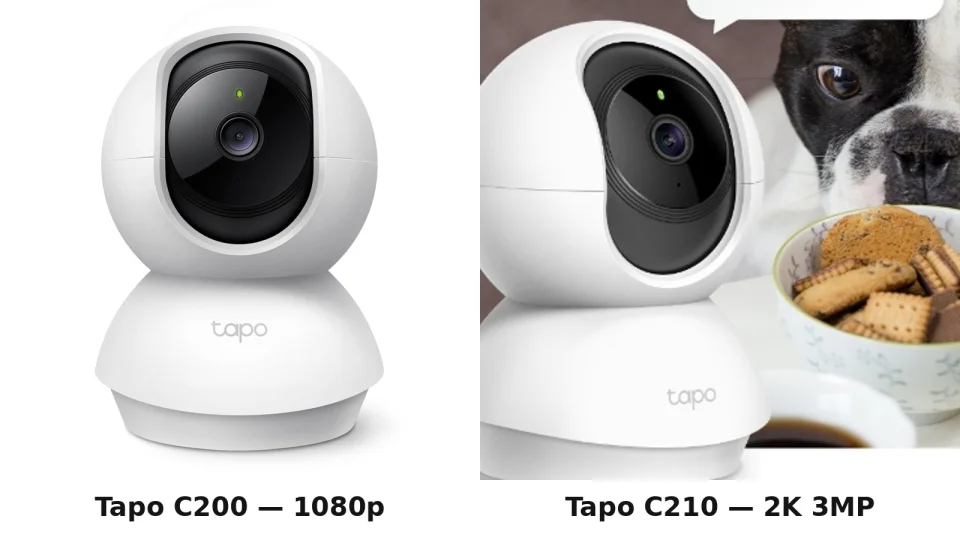
- Short answer: buy the Tapo C210 for most rooms; buy the Tapo C200 only if it is clearly cheaper and the camera will watch a small space. The C210 records 2K (2304 × 1296, 3MP) video through a wider lens, while the C200 stops at 1080p (1920 × 1080) — and almost everything else about the two cameras is the same.
- What the C210 adds: about 44% more pixels, a larger 1/2.8-inch sensor, a wider 98° diagonal field of view (vs 88.3°), up to 30 fps recording and a listed 10.8x digital zoom on its current spec table.
- What the C210 does NOT add: color night vision. Despite what some listings imply, the C210 has no spotlight and no starlight sensor — its night vision is black-and-white infrared only, exactly like the C200. TP-Link's own spec table describes both sensors as "Not Starlight."
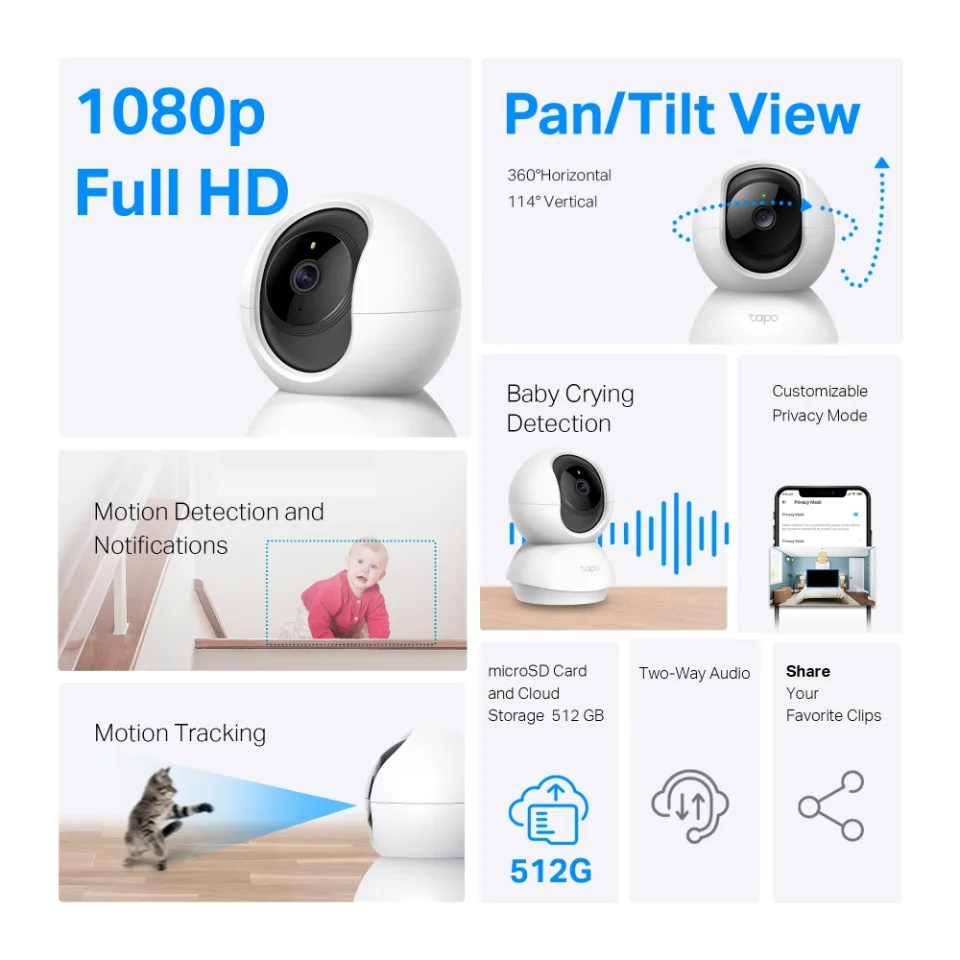
- What is identical: 360° pan / 114°-class tilt coverage with motion tracking, motion / person / baby-crying detection, two-way audio, microSD storage up to 512 GB, optional Tapo Care cloud, RTSP/ONVIF, 2.4 GHz Wi-Fi only, Alexa and Google Assistant, and 9V DC plug-in power.
- How to read this: a spec-based comparison built from TP-Link/Tapo's official C200 and C210 product and specification pages, checked in October 2026. We did not hands-on test either camera for this article, and TP-Link publishes no US MSRP for either model — so check live retailer prices before deciding how big the C210's premium really is.
Overview
The TP-Link Tapo C200 and Tapo C210 are the same idea sold at two resolutions. Both are white, plug-in, pan-and-tilt indoor cameras that sit on a shelf, sweep a whole room, follow movement automatically, and record to a microSD card so you can skip a subscription. If you have read our Tapo C200 review and our Tapo C210 review, you already know the shared formula — this comparison exists because the differences are few, specific, and easy to get wrong.
The headline difference is the sensor. The C200 is the original 1080p model. The C210 steps up to a 3MP sensor recording 2304 × 1296 — marketed as 2K — on slightly larger hardware, with a wider lens in front of it. Everything a buyer might assume also improved — night vision, smart-home support, storage, detections — did not change in any meaningful way, and one widely repeated claim about the C210 (color night vision) is simply not in TP-Link's specifications. So the real question is narrow: how much is sharper, wider video worth to you, in the room where this camera will actually sit?
Full spec comparison
| Specification | Tapo C200 | Tapo C210 |
|---|---|---|
| Maximum resolution | 1920 × 1080 (1080p Full HD) | 2304 × 1296 (2K, 3MP) |
| Image sensor | 1/3" progressive scan CMOS — not starlight | 1/2.8" progressive scan CMOS — not starlight |
| Lens | 4.0 mm, F2.0 | 4 mm, F2.0 |
| Field of view (lens) | 88.3° diagonal / 75.2° horizontal / 40.8° vertical | 98° diagonal / 83° horizontal / 45° vertical |
| Night vision | 850 nm IR LED, black-and-white only — 30 ft / 9 m (US table)* | 850 nm IR LED, black-and-white only — 30 ft / 9 m (UK table) to 40 ft / 12 m (global table)* |
| Color night vision / spotlight | None | None |
| Pan / tilt | Pan mechanical 340° (360° coverage); tilt mechanical 70° (110.8° coverage) | Pan mechanical 340° (360° coverage); tilt mechanical 70° (116.65° coverage) |
| Frame rate | 15 fps* | 15 fps default, up to 30 fps |
| Digital zoom | None listed (US table); 9x on global version* | 10.8x |
| Video compression | H.264 | H.264 |
| AI detection | Motion, person, baby crying; activity zones; motion tracking | Motion, person, baby crying; activity zones; motion tracking |
| Audio | Two-way audio with noise cancellation; built-in mic and speaker; siren 93 dB (at 10 cm) | Two-way audio with noise cancellation; built-in mic and speaker; siren 88 dB (at 10 cm) |
| Local storage | microSD up to 512 GB (card not included) | microSD up to 512 GB (card not included) |
| Cloud storage | Tapo Care (subscription required) | Tapo Care (subscription required) |
| Wi-Fi | IEEE 802.11b/g/n, 2.4 GHz only | IEEE 802.11b/g/n, 2.4 GHz only |
| RTSP / ONVIF | Yes / Yes | Yes / Yes |
| Voice assistants | Amazon Alexa, Google Assistant (no HomeKit) | Amazon Alexa, Google Assistant (no HomeKit) |
| Power | 9V DC adapter (100-240 V input, 9 V / 0.6 A output) | 9V DC adapter (100-240 V input, 9 V / 0.6 A output) |
| Mounting | Tabletop or ceiling-mounted | Tabletop or ceiling-mounted |
| Dimensions | Not listed on the current US specification table | 85.4 × 86.8 × 117.7 mm (3.36 × 3.42 × 4.63 in) |
Source note: all figures are from TP-Link/Tapo's official C200 and C210 product and specification pages (tapo.com and tp-link.com), checked October 2026. *Night-vision range, frame rate and digital zoom vary by hardware version and region on TP-Link's own tables: the C200's US table lists 30 ft / 9 m and 15 fps, while its global table lists 40 ft / 12 m, up to 30 fps and 9x zoom; the C210's UK table lists 30 ft / 9 m while its global table lists 40 ft / 12 m. Treat the ranges as version-dependent, not as a difference between the two models. TP-Link publishes no US MSRP for either camera, so no prices are quoted here.
Video quality: the one real upgrade
The C210 records 2304 × 1296 pixels against the C200's 1920 × 1080 — roughly 44% more pixels in every frame, from a physically larger 1/2.8-inch sensor instead of a 1/3-inch one. On paper that means faces, license-plate-sized details on a driveway-facing window shot, and text on a parcel label should hold up better when you pinch-zoom into a C210 recording, and its wider 98° diagonal lens takes in more of the room before the pan motor even moves. The C210's current spec table also allows up to 30 fps (15 fps by default), where the current US C200 table lists 15 fps flat, and lists a 10.8x digital zoom where the US C200 table lists none.
None of that makes the C200's 1080p bad for its job. For a nursery check-in, a pet watch, or a "did the package get moved" view of a hallway, 1080p with motion tracking is genuinely enough — which is why our Tapo C201 review covers another 1080p-class Tapo that sells on exactly that logic. The C210's extra resolution earns its keep when the camera sits farther from the action: a big living room, a shop counter, or any spot where you regularly zoom into recordings after the fact.


Night vision: identical, infrared-only — read this before you buy
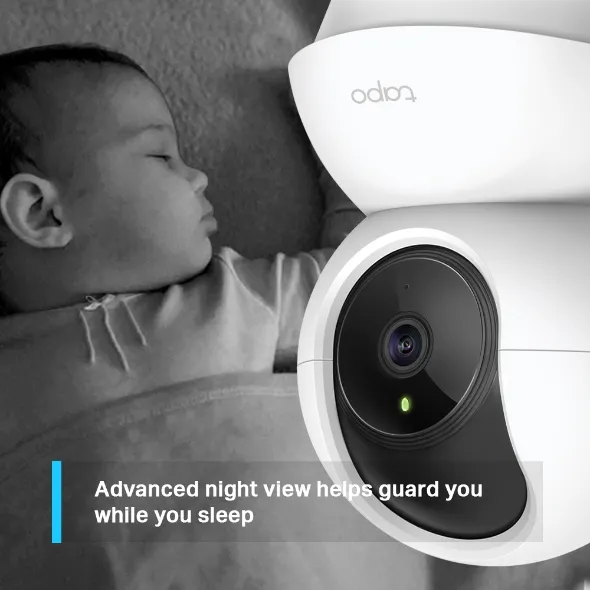
This is where the two cameras are most often mis-sold. Neither the C200 nor the C210 has color night vision. Both use a single 850 nm infrared LED, both spec tables describe the sensor in plain words as "Not Starlight," and neither camera has a spotlight. After dark, both record in black and white. If a marketplace listing or a roundup tells you the C210 sees in color at night, it is describing a different camera — the step-up models covered in our Tapo C216 review are where Tapo's indoor line starts adding richer night features.
Range claims need the same care. Depending on which official TP-Link table you open — US, UK or global — and which hardware version it describes, both cameras are rated at either 30 ft / 9 m or 40 ft / 12 m. That is a versioning difference inside each model's own documentation, not a C210 advantage: on matched tables the two are rated the same. For a normal room, either rating is more than enough; for a long garage or open-plan space, plan on infrared detail fading well before any headline number, on both models equally.
Key features (shared, unless noted)
- Pan, tilt and motion tracking: both heads pan with 360° coverage and tilt upward through roughly 114° of view, and both automatically lock onto and follow movement — the feature that makes one camera cover a whole room.
- AI detection without a subscription: motion, person and baby-crying detection, plus custom activity zones, run on both cameras. Neither offers a pet-specific detection label on its official spec table.
- Two-way audio and siren: both have a built-in microphone and speaker with noise cancellation. The C200's siren is actually the louder of the two on paper — 93 dB vs 88 dB, both measured at 10 cm.
- Storage your way: both record to microSD up to 512 GB with no required subscription, with Tapo Care cloud plans optional. Both also speak RTSP and ONVIF for recorder and smart-home software.
- Privacy controls: both offer a privacy mode that pauses recording and customizable privacy zones that block parts of the view.
- Smart home: both work with Amazon Alexa and Google Assistant. Neither supports Apple HomeKit — if that matters, the cross-brand comparison in our eufy E220 vs Tapo C210 head-to-head is the more useful read.
Pros and cons
Tapo C200
Pros
- Same pan/tilt coverage, motion tracking and AI detections as the C210 for typically less money
- 512 GB microSD ceiling and RTSP/ONVIF — no subscription needed
- Louder siren on paper (93 dB vs 88 dB)
- 1080p is enough for nurseries, pets and small rooms
Cons
- Lowest resolution in this comparison — recordings soften fast when you zoom
- Narrower lens (88.3° diagonal) sees less of the room at rest
- 15 fps on the current US spec table; no digital zoom listed there
- Black-and-white infrared night vision only, like the C210
Tapo C210
Pros
- 2K 3MP video (2304 × 1296) on a larger 1/2.8-inch sensor — visibly more detail to zoom into
- Wider 98° diagonal lens covers more of the room before panning
- Up to 30 fps and 10.8x digital zoom on the current spec table
- Everything else from the C200 carries over: tracking, detections, 512 GB local storage, RTSP/ONVIF
Cons
- Costs more than the C200, and the gap varies by retailer and week
- Still no color night vision, no spotlight, no HomeKit, no 5 GHz Wi-Fi
- Quieter siren than the C200 on paper (88 dB vs 93 dB)
- Same 2.4 GHz-only radio — no upgrade path for congested networks
Who it's for — and the verdict
Buy the Tapo C210 if the camera will watch a living room, an open-plan space, a small shop, or anywhere you expect to zoom into recordings and identify a face or an object across the room. Its resolution and wider lens are the only differences in this comparison that change what the footage can do, and they both point the same way. For the full breakdown, see our Tapo C210 review.
Buy the Tapo C200 if the camera's job is a nursery, a pet corner, a single door, or a second room where a live view and motion alerts matter more than forensic detail — and the C200 is meaningfully cheaper the day you buy. Its detections, tracking and storage are the C210's equals. Our Tapo C200 review covers where that 1080p ceiling starts to bite.
Skip both if you need color night vision, a spotlight, HomeKit, or 5 GHz Wi-Fi — neither camera offers any of those on its official specifications, at any hardware version we could verify.
Verdict: the C210 is the better camera and the default buy; the C200 is the same camera experience at 1080p for buyers whose room — and discount — make the extra pixels unnecessary.
FAQ
Is the Tapo C210 really better than the C200?
On video, yes: 2304 × 1296 (2K 3MP) against 1920 × 1080, on a larger sensor with a wider lens, plus up to 30 fps recording. On everything else — pan/tilt tracking, detections, storage, app, assistants — the official spec tables show the two as effectively equal.
Does the Tapo C210 have color night vision?
No. The C210's night vision is an 850 nm infrared LED producing black-and-white footage. TP-Link's spec table explicitly lists its sensor as "Not Starlight," and the camera has no spotlight. The C200 is infrared-only as well.
How far does the night vision reach on the C200 and C210?
TP-Link's own tables disagree by version and region: both cameras appear at 30 ft / 9 m on some official spec tables (C200 US, C210 UK) and 40 ft / 12 m on others (the global tables). Read it as "about 30-40 ft depending on hardware version" for either model — it is not a reason to choose one over the other.
Can both cameras record without a subscription?
Yes. Both record locally to a microSD card up to 512 GB (sold separately) with motion, person and baby-crying detection included. Tapo Care cloud storage is an optional subscription on both, mainly for cloud clips and richer notifications.
Do the C200 and C210 work with HomeKit, Alexa or Google Assistant?
Both work with Amazon Alexa and Google Assistant. Neither supports Apple HomeKit — HomeKit appears nowhere in either model's official specifications or smart-integration listings.
Where to buy
TP-Link publishes no US MSRP for either camera and street prices move often, so compare the two on the same day before deciding — the right pick can flip with a sale.
- Tapo C200 at Amazon — check price
- Tapo C210 at Amazon — check price
- Tapo C200 at Walmart — check price
- Tapo C210 at Walmart — check price
- Tapo C210 at Best Buy — check price
- Both models at the official Tapo US store — visit store
#tapo c200 tapo c210 tp-link tapo pan-tilt camera 2k indoor camera
Comments
No notes yet. If you own one of these cameras, tell us what the spec sheet left out.