
Home / Reviews / Head-to-head
TP-Link Tapo C110 vs Tapo C100: 2K vs 1080p, Which to Buy?

Affiliate note: Bestindoorcam.com may earn a commission if you buy through a store link. That does not change which camera we prefer. Read how affiliate links and ads work and how we review. As an Amazon Associate I earn from qualifying purchases.
TP-Link Tapo C110 vs Tapo C100: 2K vs 1080p, Which to Buy?
TL;DR
Short answer: buy the Tapo C110 for most rooms, and the Tapo C100 only if it is meaningfully cheaper for a low-stakes spot. These two fixed indoor cameras share the same body, lens, night vision, two-way audio and Tapo app. The real difference in this tapo c110 vs c100 matchup is the picture: the C110 records 3MP (2304 × 1296, sold as 2K) on a 1/2.8-inch sensor, while the C100 records 1080p (1920 × 1080) on a smaller 1/3.2-inch sensor. The C110 also lists person detection on TP-Link's current US store specifications; the C100's classic official pages list motion detection only. One honest storage warning: the C100's original datasheet capped microSD at 128 GB — TP-Link's current product page says up to 512 GB only after a firmware update, so update first and do not assume a big card works out of the box on old firmware. This comparison is based on TP-Link's official specifications; we do not claim hands-on testing.
Overview: Same Shell, Different Sensor
The Tapo C110 and Tapo C100 are TP-Link's two entry-level fixed indoor cameras. "Fixed" is the key word for both: neither pans nor tilts, neither is outdoor-rated, and neither connects on 5 GHz Wi-Fi. You point the camera at a doorway, a crib, a pet bed or a hallway, and it watches that one view on 2.4 GHz Wi-Fi through the Tapo app.
They are so similar that TP-Link reuses the same product photography for both models — the official C110 page even serves overview images named for the C100, because the chassis is identical: same 67.6 × 54.8 × 98.9 mm body, same F2.0 / 3.3 mm lens, same 850 nm infrared night vision rated to 30 feet (9 metres), same sound-and-light alarm, privacy mode, and the same 9.0 V / 0.6 A power adapter. If you have read our full Tapo C110 review, the hardware tour there describes the C100's body just as well.
So this comparison is not about features you can see on the box photo. It comes down to three things: resolution and sensor size, smart detection, and a storage detail that is easy to get wrong. We take each in turn below, after the full side-by-side table. If a wider view matters more than a sharper fixed view, neither of these is the right shape — the pan-and-tilt models covered in our Tapo C200 review and Tapo C210 review cover a room by moving instead.
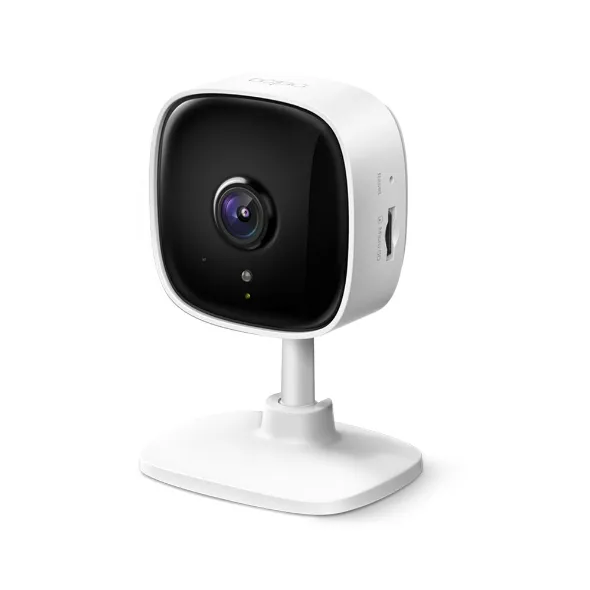
Full Spec Comparison
| Specification | Tapo C110 | Tapo C100 |
|---|---|---|
| Camera type | Fixed indoor Wi-Fi camera (no pan/tilt) | Fixed indoor Wi-Fi camera (no pan/tilt) |
| Resolution | 3MP — 2304 × 1296 (marketed as 2K) | 1080p Full HD — 1920 × 1080 |
| Image sensor | 1/2.8" | 1/3.2" |
| Lens | F2.0, 3.3 mm focal length | F2.0, 3.3 mm focal length |
| Field of view | Not listed on the classic official spec sheet checked | 105° (official spec sheet) |
| Frame rate | 15 fps | 15 fps |
| Video compression | H.264 | H.264 |
| Night vision | 850 nm IR LED, up to 30 ft / 9 m | 850 nm IR LED, up to 30 ft / 9 m |
| Audio | Two-way audio, built-in mic and speaker | Two-way audio, built-in mic and speaker |
| Detection (official pages checked) | Motion detection; person detection listed on the current official US store spec table (baby-cry also listed there — see note below) | Motion detection |
| Alarm | Sound and light alarm | Sound and light alarm |
| Local storage | microSD, up to 512 GB per current official spec table (card not included) | microSD — 128 GB on the original datasheet; current product page says up to 512 GB after updating to the latest firmware (card not included) |
| Cloud storage | Tapo Care (subscription required) | Tapo Care (subscription required) |
| Wi-Fi | 2.4 GHz only, IEEE 802.11b/g/n | 2.4 GHz only, IEEE 802.11b/g/n |
| Security | 128-bit AES encryption with SSL/TLS; WPA/WPA2-PSK | 128-bit AES encryption with SSL/TLS; WEP/WPA/WPA2-PSK |
| Voice assistants | Amazon Alexa, Google Assistant | Amazon Alexa, Google Assistant |
| Privacy mode | Yes | Yes |
| Power | 9.0 V / 0.6 A DC adapter (input 100–240V AC) | 9.0 V / 0.6 A DC adapter (input 100–240V AC) |
| Dimensions (W × D × H) | 2.7 × 2.1 × 3.9 in (67.6 × 54.8 × 98.9 mm) | 2.7 × 2.1 × 3.9 in (67.6 × 54.8 × 98.9 mm) |
| Operating temperature | 0–40 °C (32–104 °F) | 0–40 °C (32–104 °F) |
| Mounting | Tabletop or ceiling/wall with included screws and template | Tabletop or ceiling/wall with included screws and template |
Source note: specifications taken from TP-Link's official Tapo product pages (tapo.com) and the official TP-Link US store specifications for the C110, checked October 2026. Two honesty notes: (1) TP-Link's own C110 store page is internally inconsistent — its spec table says microSD up to 512 GB while its marketing text says 256 GB in places, and it lists baby-cry detection in the spec table while its FAQ implies Tapo Care adds it; we follow the spec table and flag the ambiguity rather than hide it. (2) No single stable US price for the single cameras is published on the official pages checked, so this article makes no price claims — check the retailers below for current pricing.
Key Differences That Actually Matter
1. Resolution: 2K 3MP vs 1080p
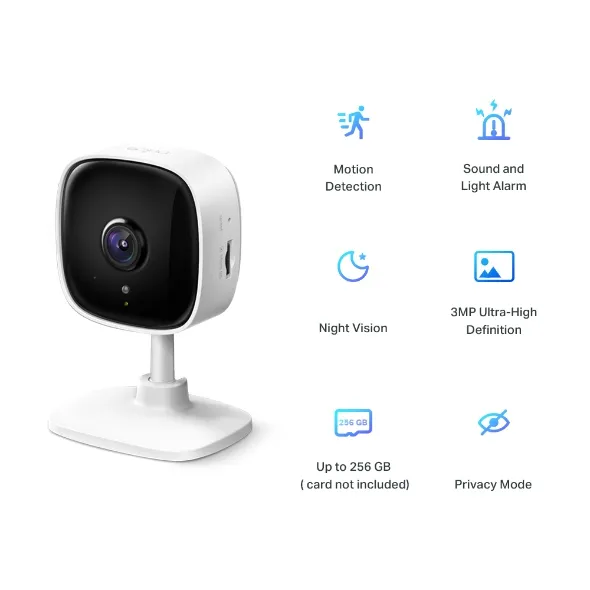
This is the whole contest. The C110's 2304 × 1296 frame carries roughly 50% more pixels than the C100's 1920 × 1080 frame, and its 1/2.8-inch sensor is physically larger than the C100's 1/3.2-inch sensor. On paper — and this is a spec-based comparison, not a hands-on test — that combination is what helps when you pinch-zoom into a clip to read a face at the far end of a room, check what a pet knocked over, or make out a label. For a camera pointed at a nearby crib or a pet bed a few feet away, 1080p is usually enough detail, which is the honest case for the cheaper camera. Our full Tapo C100 review makes that case in detail.
2. Detection: Motion Only vs Person Detection
Both cameras trigger on motion and push a notification, and both let you shape activity zones on the current Tapo software. The difference is classification: TP-Link's current US store specifications for the C110 list person detection alongside motion detection, which in practice is the feature that separates "a person walked in" from "the curtains moved." The C100's classic official pages list motion detection only. Treat the C110's baby-cry listing cautiously: it appears in the store spec table, but the same page's FAQ language ties baby-crying features to the Tapo Care subscription, so do not buy the C110 counting on free baby-cry alerts without checking the current Tapo Care terms. If smart detection is your top priority in this price class, it is also worth seeing how a rival handles it in our Eufy Indoor Cam E220 vs Tapo C110 comparison.
3. Storage: The 128 GB vs 512 GB Trap on the C100
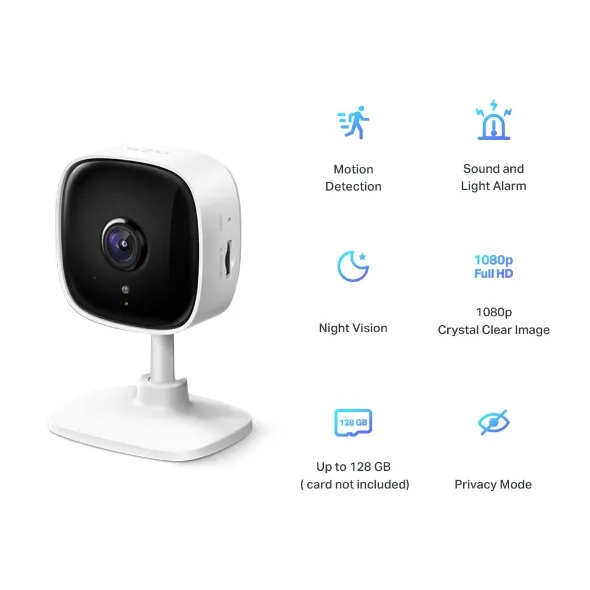
Both cameras record locally to microSD with no subscription required, and both offer optional Tapo Care cloud storage. The trap is the C100's card limit. Its original official datasheet — and the official feature graphic below — say the slot supports up to 128 GB. TP-Link's current product page now says up to 512 GB, with a footnote: that support arrives "after updating to the latest firmware." Both statements are official; they describe different firmware eras. The safe buying advice is simple: if you put a 256 GB or 512 GB card in a C100, update the firmware first and format the card in the Tapo app. The C110's current spec table lists up to 512 GB directly, though older C110 graphics still show 256 GB — another reason to trust the current spec table over box art.
4. Everything Else Is a Tie
Night vision distance, lens, frame rate (15 fps on both — neither is a smooth-video camera), two-way audio, the sound-and-light alarm, privacy mode, power, dimensions and operating temperature are the same on the official sheets. There is no weather rating on either, no 5 GHz Wi-Fi on either, and no pan/tilt on either. Anyone choosing between them on those grounds is choosing between twins.
Tapo C110 — Pros and Cons
Pros
- Sharper 3MP (2304 × 1296) video on a larger 1/2.8-inch sensor — the clearest reason to pick it for doorways and larger rooms.
- Person detection listed on TP-Link's current official US specifications, on top of motion detection and activity zones.
- microSD up to 512 GB in the current official spec table, for long local recording without a subscription.
- Same low-friction package as the C100: two-way audio, sound-and-light alarm, privacy mode, Alexa/Google Assistant viewing.
Cons
- Fixed view only — no pan/tilt, so placement has to be right the first time.
- 15 fps video and 2.4 GHz-only Wi-Fi, same limits as the cheaper model.
- TP-Link's own pages disagree on side details (256 GB vs 512 GB in older graphics; baby-cry detection vs Tapo Care wording), so verify current terms before relying on either.
- Usually the pricier of the two — check current retailer pricing, as the gap moves.
Tapo C100 — Pros and Cons
Pros
- The same body, lens, 30 ft night vision, two-way audio, alarm and Tapo app experience as the C110.
- 1080p is adequate for close-range jobs: a crib, a pet bed, a small bedroom or a desk area.
- 105° field of view is actually documented on its official spec sheet.
- Local microSD recording with no required subscription, plus optional Tapo Care.
Cons
- 1080p on a smaller 1/3.2-inch sensor gives you less to work with when you zoom into a clip.
- Motion detection only on the official pages checked — no listed person detection to filter false alerts.
- The storage trap: 128 GB on the original datasheet, 512 GB only after a firmware update per the current page — an easy detail to get wrong at checkout.
- Same fixed view, 15 fps and 2.4 GHz-only limits as the C110, so it wins on price alone, never on capability.
Who It's For — And the Verdict
Choose the Tapo C110 if the camera watches an entryway, a living room or any spot where you might need to identify someone after the fact, if person-detection alerts matter to you, or if you simply want the version you will not outgrow. It is the better default buy of the two.
Choose the Tapo C100 if the camera sits close to its subject — a nursery shelf, a pet corner, a small room — and the price gap on the day you buy is real. At the same price, there is no spec-based reason to pick it over the C110.
Choose neither if you need one camera to sweep a whole room (look at the pan-and-tilt Tapo models linked above), outdoor use, 5 GHz Wi-Fi, or frame rates above 15 fps. Within this pair, though, the verdict is clean: the C110 is the C100 with a better sensor and smarter listed detection, in the same shell.
FAQ
What is the main difference between the Tapo C110 and C100?
Resolution and sensor. The C110 records 3MP (2304 × 1296, marketed as 2K) on a 1/2.8-inch sensor; the C100 records 1080p (1920 × 1080) on a 1/3.2-inch sensor. The body, lens, night vision, audio and app are the same, and TP-Link's current US specifications also list person detection for the C110, while the C100's official pages list motion detection only.
Does the Tapo C100 really support a 512 GB microSD card?
According to TP-Link's current product page, yes — but only "after updating to the latest firmware," as its own footnote states. The C100's original datasheet specified up to 128 GB. Update the firmware and format the card in the Tapo app before relying on a 512 GB card.
Do the Tapo C110 or C100 need a subscription?
No. Both record locally to a microSD card (sold separately) with no monthly fee. Tapo Care cloud storage is optional on both and adds cloud history and extra smart features under a paid plan.
Can the Tapo C110 or C100 pan and tilt?
No. Both are fixed cameras — you aim them once by hand on their stand or mount. For motorized coverage, look at TP-Link's pan-and-tilt models such as the Tapo C200 or C210 instead.
Do these cameras work with Alexa and Google Assistant?
Yes. TP-Link lists Amazon Alexa and Google Assistant integration for both models, for viewing the live feed by voice on compatible smart displays. Both cameras connect on 2.4 GHz Wi-Fi only and are controlled through the Tapo app.
Where to buy
Prices for both models move frequently and TP-Link does not publish a single stable US price for the single cameras on the pages checked, so compare the live prices below before deciding — the right pick can flip if the C110 is on sale at C100 money.
Disclosure: specifications in this comparison come from TP-Link's official product and store pages, checked October 2026. This is a spec-based comparison — we do not claim hands-on testing of either camera.
#tapo c110 tapo c100 tp-link tapo 2k indoor camera 1080p indoor camera
Comments
No notes yet. If you own one of these cameras, tell us what the spec sheet left out.