
Home / Reviews / Head-to-head
eufy Indoor Cam E220 vs TP-Link Tapo C110: Which Should You Buy?

Affiliate note: Bestindoorcam.com may earn a commission if you buy through a store link. That does not change which camera we prefer. Read how affiliate links and ads work and how we review.
TL;DR — eufy E220 vs Tapo C110 verdict
- Short answer: buy the eufy Indoor Cam E220 to watch a whole room; buy the TP-Link Tapo C110 to watch one spot for about half the price. Both cameras record the same 2304 × 1296 (2K) resolution, detect people and crying, record locally to microSD with no required subscription, and work over 2.4 GHz Wi-Fi — the decision is coverage and ecosystem, not picture resolution.
- What the E220 adds: motorized pan (360°) and tilt (96°) with automatic human tracking, pet detection, Apple HomeKit support, and NAS recording via RTSP — for $59.99 list on eufy.com. One camera sweeps an entire room instead of staring at one corner of it.
- What the C110 adds: a wider fixed lens (129.4° diagonal vs the E220's 125°), four times the maximum local storage (microSD up to 512 GB vs 128 GB), RTSP/ONVIF support, and a typical street price around $25–$30. No moving parts, nothing to track, nothing to wear out.
- What neither gives you: 5 GHz Wi-Fi, a battery, outdoor use, or a microSD card in the box. The C110 also has no HomeKit, and its video runs at 15 fps; the E220's HomeKit stream is capped at 1080p even though the camera itself records 2K.
- How to read this: a spec-based comparison built from eufy's official E220 product page (model T8410121) and TP-Link/Tapo's official C110 pages, re-checked in October 2026. We did not hands-on test either camera for this article.
Overview
The eufy Indoor Cam E220 and the TP-Link Tapo C110 answer the same question — how do I keep an eye on a room without paying a monthly fee? — from opposite directions. The E220 is a motorized pan-and-tilt camera: it physically turns to cover the room and follows a person across it. The C110 is a fixed cube: you point it once at the door, the crib, or the pet's corner, and it never moves again. On paper they look like twins — identical 2304 × 1296 resolution, person and baby-crying detection, infrared night vision, two-way audio, local microSD recording — which is exactly why the differences that remain matter so much.
Price frames the whole comparison. The E220 lists at $59.99 on eufy.com (eufy's own on-page comparison table showed $54.99 when we checked — see the price note in the spec table). The C110 typically sells for around $25–$30 at US retailers. So the real question is narrow: is motorized whole-room coverage, pet detection, and HomeKit worth roughly double? For each camera on its own, see our eufy Indoor Cam E220 review and our TP-Link Tapo C110 review.
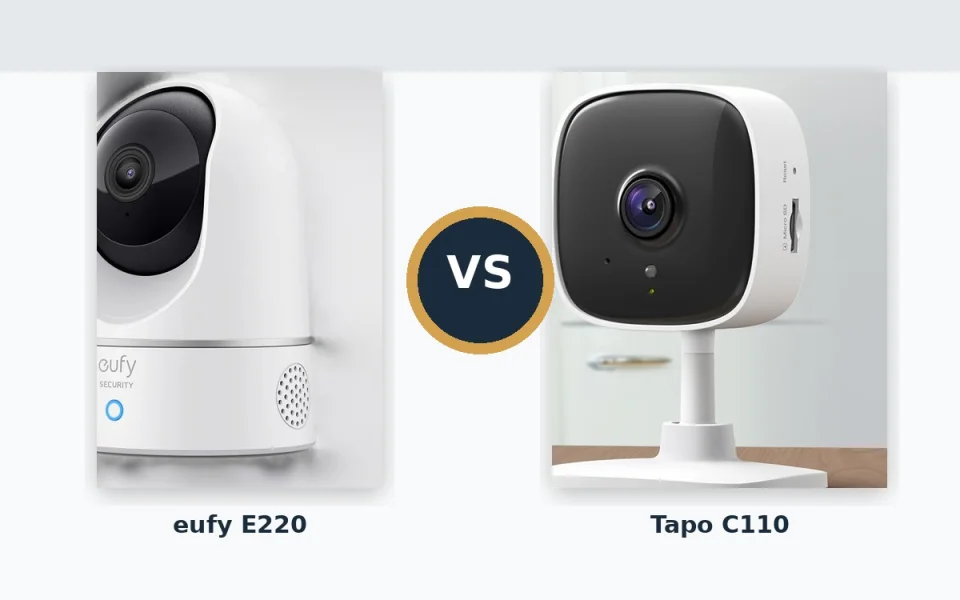
Side-by-side specifications
| Specification | eufy Indoor Cam E220 | TP-Link Tapo C110 |
|---|---|---|
| Price | $59.99 list on eufy.com (comparison table on the same page listed $54.99 at time of research) | Typically around $25–$30 at US retailers (no US list price on tapo.com; range from retailer listings at time of research) |
| Resolution | 2K (2304 × 1296) | 3MP (2304 × 1296), marketed as 2K |
| Pan / tilt | Motorized: 360° horizontal / 96° vertical, with automatic tracking | None — fixed lens |
| Field of view | 125° diagonal | 129.4° diagonal (107.6° horizontal / 57.6° vertical) |
| Frame rate / compression | Not specified on eufy's product page | 15 fps, H.264 |
| Night vision | Infrared, up to 32.8 ft (10 m) | 850 nm infrared LED, up to 30 ft (9 m) |
| AI detection | On-device human, pet, and crying detection; motion and sound detection; activity zones | Motion, person, and baby-crying detection; activity zones; privacy zones |
| Auto-tracking | Yes — eufy's comparison table lists AI tracking as human-only | No |
| Local storage | microSD up to 128 GB (card not included) | microSD up to 512 GB (card not included) |
| Cloud storage | Optional eufy cloud backup; not required for local recording | Optional Tapo Care subscription; not required for local recording |
| Recording modes | 24/7 continuous and event recording | Continuous and event recording to microSD |
| Streaming protocols | RTSP (including NAS recording) | RTSP and ONVIF |
| Wi-Fi | 2.4 GHz only; no hub required | 2.4 GHz only (802.11b/g/n); no hub required |
| Smart home | Apple HomeKit, Amazon Alexa, Google Assistant (HomeKit streaming capped at 1080p) | Amazon Alexa, Google Assistant (no HomeKit) |
| App | eufy Security | Tapo |
| Two-way audio | Yes — built-in microphone and speaker | Yes — built-in microphone and speaker, with noise cancellation; sound and light alarm |
| Power | 5V/2A USB adapter, 6.7 ft cable | 9V DC adapter, approx. 3 m cable |
| Use | Indoor only | Indoor only |
| Specs from eufy's official product page for the Indoor Cam E220 (eufy.com, model T8410121) and TP-Link/Tapo's official Tapo C110 product pages and published spec sheets (tapo.com / tp-link.com), re-checked October 2026. Prices change; the C110 figure is a typical retailer range, not a manufacturer list price. | ||
Coverage: a camera that moves vs a camera that stares
This is the comparison. The E220's lens sits in a motorized head that pans a full 360° and tilts 96°, so a single unit placed in a corner can sweep an entire living room, check the front door, then turn back to the sofa. When it detects a person, it turns to follow them — eufy's comparison table is precise that the AI tracking is human-only, even though the camera also detects pets. The C110 cannot do any of this: its 129.4° diagonal lens is slightly wider than the E220's 125° lens at rest, but the frame you choose on day one is the frame you get forever.
In practice, fixed is not automatically worse. A nursery camera aimed at a crib, or a hallway camera aimed at a door, gains nothing from a motor — and a fixed camera has no moving parts to fail, makes no tracking noise, and never gets caught looking the wrong way when something happens at the edge of the room. The E220 earns its price in open-plan rooms, pet monitoring, and any space where activity moves between two or three zones. If your room is one of those, it belongs on any shortlist of the best pan-and-tilt indoor cameras — and if you are cross-shopping inside Tapo's own range, our Tapo C210 review covers the pan-tilt sibling that splits the difference.
Video and night vision: same pixels, different motion
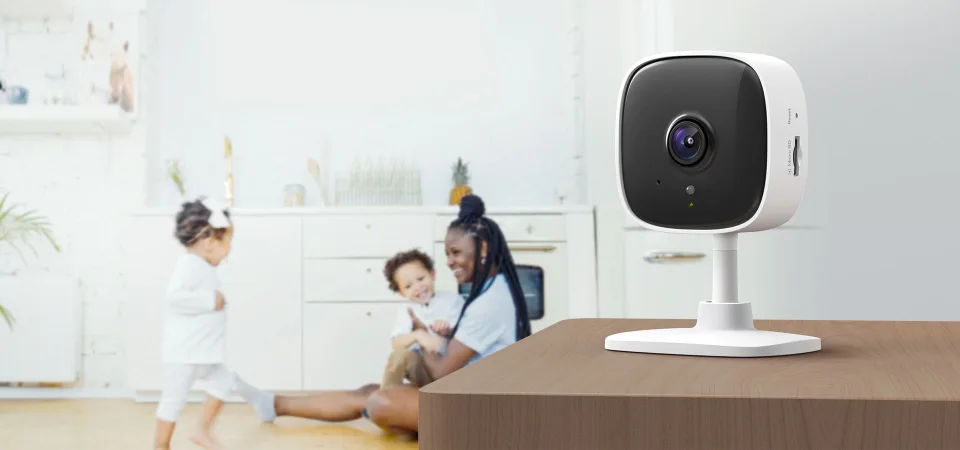
Both cameras top out at 2304 × 1296, so still-frame detail — a face at the door, a label on a parcel — should be comparable, and both are a clear step up from 1080p. Two honest differences sit underneath the headline number. First, the C110 records at 15 fps in H.264: fine for checking in and reviewing events, visibly less smooth than 30 fps cameras when someone crosses the room quickly. eufy does not publish a frame rate for the E220 on its product page, so we make no claim either way. Second, night vision is close to a tie: infrared to 32.8 ft on the E220 against 850 nm infrared to 30 ft on the C110. Both are black-and-white infrared with no spotlight or color night vision — neither camera lights up a dark room in color.
One ecosystem caveat belongs here rather than in small print: through Apple HomeKit, the E220 streams at 1080p, not 2K. eufy is explicit that this is a HomeKit platform limit and that the eufy Security app delivers the full 2K — but if you plan to live inside the Apple Home app, the E220's resolution advantage over cheaper HomeKit cameras shrinks.
AI detection: pets vs privacy zones
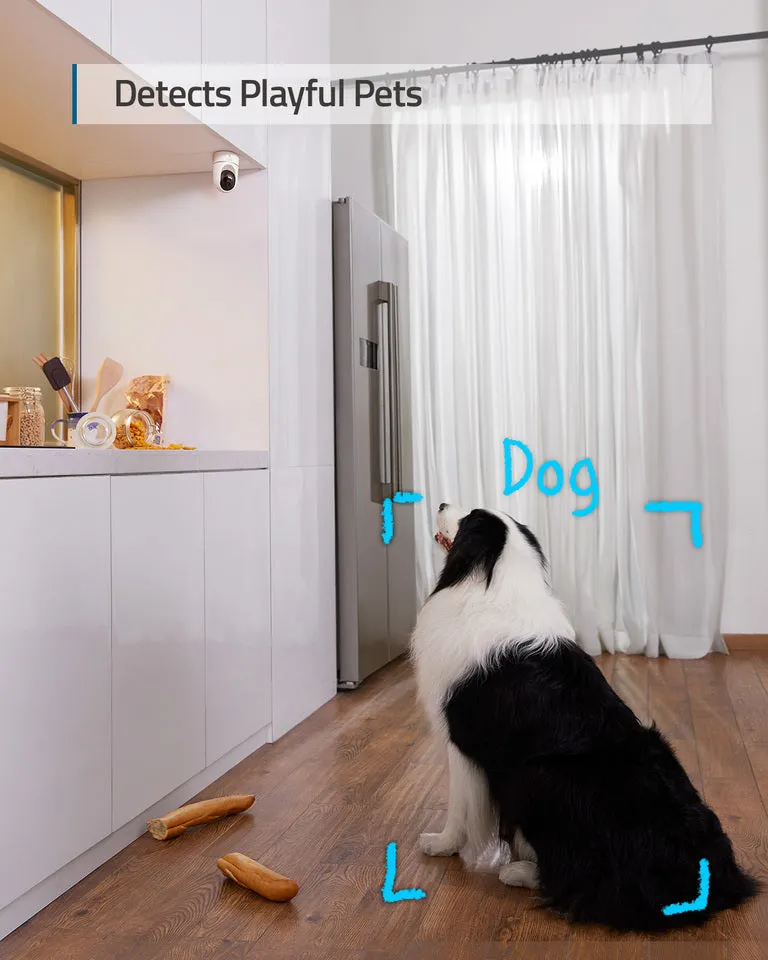
The detection lists overlap more than the marketing suggests. Both cameras identify people, both listen for a crying baby, both support activity zones, and both send motion alerts without a subscription. The E220 goes one step further with dedicated pet detection — it can tell you the dog is on the sofa rather than merely that something moved — which, paired with its tracking head, makes it the stronger pet camera of the two on paper.
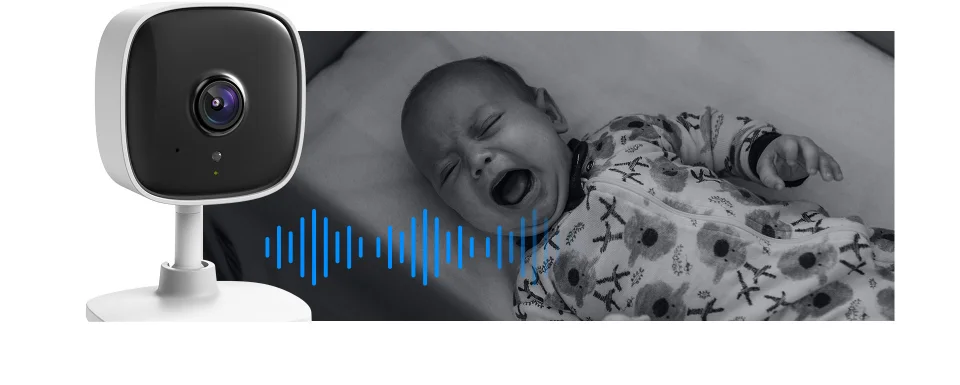
The C110 counters with privacy tooling the E220's spec sheet does not match: customizable privacy zones that black out part of the frame (a bed, a desk screen) so it is never recorded, plus a sound-and-light alarm. For a nursery, its crying detection and glow-free infrared pitch is aimed squarely at the same job as the E220's crying alerts — neither camera is a dedicated baby monitor with a parent unit, and both brands' own pages frame crying detection as an alert feature, not a medical or safety device.
Storage and subscriptions: 128 GB vs 512 GB
Neither camera needs a subscription to record locally, which is the main reason both are popular. The sizes, however, are not close: the C110 accepts microSD cards up to 512 GB, four times the E220's 128 GB ceiling. On continuous recording, that is the difference between reviewing last weekend and reviewing last month — the single clearest spec win for the cheaper camera. The E220 answers with breadth instead of depth: local card, optional cloud backup, or NAS recording over RTSP, with both 24/7 and event recording. The C110 supports RTSP too, and adds ONVIF, which makes it the easier fit for third-party NVR software; its cloud option is the Tapo Care subscription, which adds cloud clips and richer notifications after a trial.
Whichever you choose, budget for the card: neither box includes one. We compared these two brands' moving cameras directly in eufy E220 vs Tapo C210; against the fixed C110, the E220's storage ceiling looks even more like the deliberate trade it is — eufy expects the tracking head, not the archive, to be the reason you buy it.
Smart home and apps
The E220 is the only one of the two that speaks to all three ecosystems: Apple HomeKit, Amazon Alexa, and Google Assistant. The C110 works with Alexa and Google Assistant only. If your home runs on HomeKit, this section ends the comparison — the C110 cannot join it at any price. If you live in Alexa or Google Home, both cameras stream to smart displays by voice, and the choice falls back to coverage and storage.

Day to day, you will manage the E220 in the eufy Security app and the C110 in the Tapo app; both handle setup over 2.4 GHz Wi-Fi with no hub. Both cameras are 2.4 GHz-only, so a 5 GHz-only network is a deal-breaker for either. Power differs in a small practical way: the E220 runs on a common 5V/2A USB adapter with a 6.7 ft cable, while the C110 uses a 9V barrel-plug adapter with a roughly 3 m cable — the Tapo's cable is longer, the eufy's charger is easier to replace.
eufy Indoor Cam E220: pros and cons
Pros
- Whole-room coverage: 360° pan, 96° tilt, and automatic human tracking from a single camera.
- Pet detection: on-device human, pet, and crying AI — the broader detection set of the two.
- HomeKit included: works with Apple HomeKit, Alexa, and Google Assistant.
- Flexible recording: microSD, optional cloud, or NAS via RTSP; 24/7 and event modes; no fee for local recording.
- Slightly longer night range: infrared rated to 32.8 ft vs 30 ft.
Cons
- Roughly double the price: $59.99 list against the C110's typical $25–$30.
- Small card ceiling: microSD stops at 128 GB — a quarter of the C110's capacity.
- HomeKit is 1080p: full 2K only in eufy's own app.
- Tracking is human-only: per eufy's own comparison table, despite pet detection.
- 2.4 GHz only, card not included: shared with the C110, but worth restating at this price.
TP-Link Tapo C110: pros and cons
Pros
- Excellent value: the same 2304 × 1296 resolution and person/crying detection for typically $25–$30.
- Huge local storage: microSD up to 512 GB, with no subscription required.
- Wider fixed lens: 129.4° diagonal covers a broad slice of a small room.
- Power-user friendly: RTSP and ONVIF support at a budget price.
- Privacy zones and alarm: frame masking plus a sound-and-light alarm the E220 does not list.
Cons
- Fixed view: no pan, tilt, or tracking — it only ever sees where you pointed it.
- No HomeKit: Alexa and Google Assistant only.
- 15 fps video: motion is less smooth than on 30 fps rivals.
- No pet detection: people and crying only; pet movement arrives as generic motion.
- 2.4 GHz only, card not included: and cloud extras sit behind the Tapo Care subscription.
Who should buy which?
Buy the eufy E220 if one camera has to cover a whole living room, a pet roams between rooms' sightlines, or your home runs on Apple HomeKit. The tracking head is a genuine capability the C110 cannot imitate at any setting, and for open-plan spaces it can replace two fixed cameras — which quietly closes much of the price gap. Accept the 128 GB ceiling as the cost of the motor.
Buy the Tapo C110 if the camera's job is one fixed view — a crib, a front door from a hallway shelf, a pet's bed, a home-office door — and you would rather keep weeks of footage on a big card than pay for movement you do not need. At roughly half the price, buying two C110s for two fixed viewpoints is a legitimate alternative to one E220, and the 512 GB slot makes it the better long-archive camera outright. If you like the Tapo app but realize your room does need sweeping coverage, step up within the range rather than switching brands blindly.
Skip both if you need outdoor weatherproofing, battery power, 5 GHz Wi-Fi, or color night vision — neither spec sheet offers any of them.
FAQ
Is the eufy E220 or the Tapo C110 better for a nursery?
On specs, it is close. Both detect crying and both see in the dark (E220 infrared to 32.8 ft; C110 to 30 ft). The C110 adds privacy zones and is cheaper as a dedicated crib camera; the E220 can pan from the crib to the door and the rocking chair as your child grows. Neither is a dedicated baby monitor with a parent unit.
Do either of these cameras require a subscription?
No. Both record to a local microSD card with no monthly fee — up to 128 GB in the E220, up to 512 GB in the C110. eufy's cloud backup and Tapo Care are optional paid extras for cloud storage and richer notifications.
Does the Tapo C110 work with Apple HomeKit?
No. The C110 supports Amazon Alexa and Google Assistant only. The E220 supports HomeKit as well as Alexa and Google Assistant, although HomeKit streaming is capped at 1080p instead of the camera's native 2K.
Can both cameras record to a NAS or NVR?
Yes, with different protocol lists. The E220 supports RTSP, including NAS recording. The C110 supports RTSP and ONVIF, which makes it slightly more flexible with third-party NVR software.
Why does the C110 cost half as much if the resolution is the same?
Because resolution is the cheap part of this comparison. The E220's price buys the motorized pan/tilt head with tracking, pet detection, and HomeKit licensing; the C110 leaves all of that out and keeps the sensor, the AI basics, and a bigger memory-card slot.
Where to buy
Check current pricing and availability at the manufacturers' own stores — both cameras are also widely stocked by major US retailers:
- eufy Indoor Cam E220: eufy.com — Indoor Cam E220 (T8410121)
- TP-Link Tapo C110: tapo.com — Tapo C110
Prices and offers change frequently and varied even within eufy's own product page when we checked ($59.99 offer price vs $54.99 in its comparison table). The C110's $25–$30 figure is a typical US retailer range, not a TP-Link list price. Verify the current price before buying. This comparison is based on the manufacturers' published specifications, not hands-on testing.
#eufy tapo eufy e220 tapo c110 pan-tilt budget camera comparison
Comments
No notes yet. If you own one of these cameras, tell us what the spec sheet left out.