
Home / Reviews / Head-to-head
TP-Link Tapo C201 vs Tapo C200: Which Should You Buy?

Affiliate note: Bestindoorcam.com may earn a commission if you buy through a store link. That does not change which camera we prefer. Read how affiliate links and ads work and how we research and review cameras. As an Amazon Associate I earn from qualifying purchases.
TP-Link Tapo C201 vs Tapo C200: Which Should You Buy?
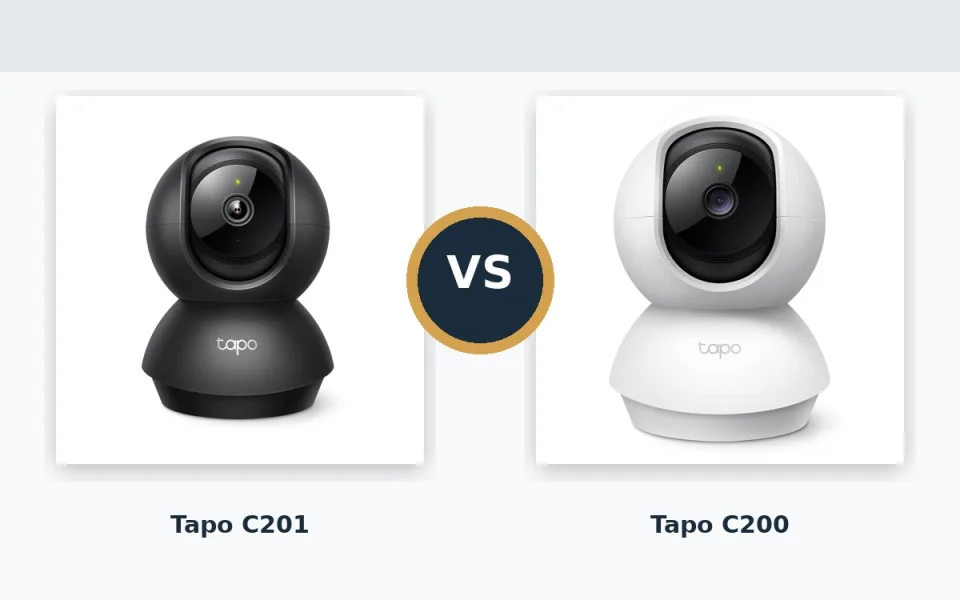
TL;DR: The Tapo C201 and Tapo C200 are, on TP-Link's own spec sheets, almost the same camera. Both record 1080p video from the same 1/3-inch sensor through the same 4mm f/2.0 lens, pan 340 degrees, tilt 70 degrees, store to microSD cards up to 512GB, and offer the same motion, person, and baby-cry detection. Two small paper differences favor the newer C201: its US spec table lists a 30 fps maximum frame rate (the C200 lists 15 fps) and a 40 ft night-vision rating (the C200's US table lists 30 ft). The C201 comes in black; the C200 is the classic white model. Neither camera has an official US list price on Tapo's site, so the honest verdict is simple: buy whichever one you find cheaper, or whichever color suits the room. If you want a genuine upgrade in picture detail, skip both and look at the 2K Tapo C210 instead.
Overview: two names, one camera concept
TP-Link's Tapo line has become the default answer for anyone who wants a cheap indoor camera that pans and tilts, records locally without a subscription, and works with Alexa and Google Assistant. The Tapo C200 is the model that built that reputation — it has been on sale in various hardware revisions for years and remains one of the best-known budget pan-tilt cameras in the US. The Tapo C201 is the newer sibling: a budget 1080p pan-tilt camera that TP-Link positions in much the same slot, this time finished in black and marketed as a "Black Edition" in some regions.
That positioning creates an obvious problem for buyers. The two cameras sit side by side in search results, their product pages use near-identical marketing language, and their names differ by a single digit. Is the C201 a meaningful upgrade, a sidegrade, or just the C200 in a different color? We compared the two spec sheets line by line against TP-Link's official US product pages for the Tapo C201 and the Tapo C200 to find out. This comparison is based entirely on those verified specifications — we do not claim hands-on testing — and where TP-Link's own documents disagree with each other, we say so.
The short version is that the hardware story here is one of continuity, not progress. If you already own a C200, the C201 is not an upgrade worth paying for. If you are buying fresh, the decision comes down to two modest spec-table differences, color, and street price. The sections below walk through each area so you can see exactly where the cameras match and where they genuinely diverge.
Full specification comparison
| Specification | Tapo C201 | Tapo C200 |
|---|---|---|
| Maximum resolution | 1080p HD (1920 x 1080) | 1080p HD (1920 x 1080) |
| Image sensor | 1/3" Progressive Scan CMOS (not starlight) | 1/3" Progressive Scan CMOS (not starlight) |
| Lens | 4.0mm, f/2.0 | 4.0mm, f/2.0 |
| Field of view | 88.3° diagonal, 75.2° horizontal, 40.8° vertical | 88.3° diagonal, 75.2° horizontal, 40.8° vertical |
| Pan range | 340° mechanical (360° coverage) | 340° mechanical (360° coverage) |
| Tilt range | 70° mechanical (110.8° coverage) | 70° mechanical (110.8° coverage) |
| Frame rate | 15 fps default, 30 fps maximum | 15 fps |
| Night vision | 850 nm IR LED, up to 40 ft / 12 m | 850 nm IR LED, up to 30 ft / 9 m (US table — see note) |
| Digital zoom | None | None |
| Video compression | H.264 | H.264 |
| Image enhancement | 3D DNR | 3D DNR |
| Audio | Built-in mic and speaker, two-way audio with noise cancellation | Built-in mic and speaker, two-way audio with noise cancellation |
| Siren | 93 dB (measured at 10 cm) | 93 dB (measured at 10 cm) |
| AI detection | Motion, person, baby-cry | Motion, person, baby-cry |
| Activity zones | Yes (motion detection only) | Yes (motion detection only) |
| Local storage | microSD slot, up to 512GB | microSD slot, up to 512GB |
| Cloud storage | Tapo Care (subscription required) | Tapo Care (subscription required) |
| Wi-Fi | 802.11b/g/n, 2.4 GHz only | 802.11b/g/n, 2.4 GHz only |
| RTSP / ONVIF | Yes / Yes | Yes / Yes |
| Security | On-device machine learning, 128-bit AES with SSL/TLS, WPA/WPA2-PSK | On-device machine learning, 128-bit AES with SSL/TLS, WPA/WPA2-PSK |
| Voice assistants | Amazon Alexa, Google Assistant | Amazon Alexa, Google Assistant |
| Power | 9V DC adapter (9V, 0.6A) | 9V DC adapter (9V, 0.6A) |
| Mounting | Tabletop, ceiling-mounted | Tabletop, ceiling-mounted |
| Dimensions | 3.36 x 3.42 x 4.63 in (85.4 x 86.8 x 117.7 mm) | Not listed on current US table; original datasheet lists the same 85.4 x 86.8 x 117.7 mm |
| Color | Black | White |
| Operating temperature | 0°C to 40°C | 0°C to 40°C |
Source note: all values taken from TP-Link/Tapo's official US product and specification pages for the Tapo C201 and Tapo C200 (tapo.com), checked October 2026. One discrepancy deserves flagging: TP-Link's current US table rates the C200's night vision at 30 ft, but the C200's own retail packaging and some regional TP-Link tables rate it at 40 ft — the same figure the C201 carries everywhere. Treat the night-vision gap as a documentation difference between hardware versions and regions, not as proven extra range for the C201.
Video quality: identical on paper
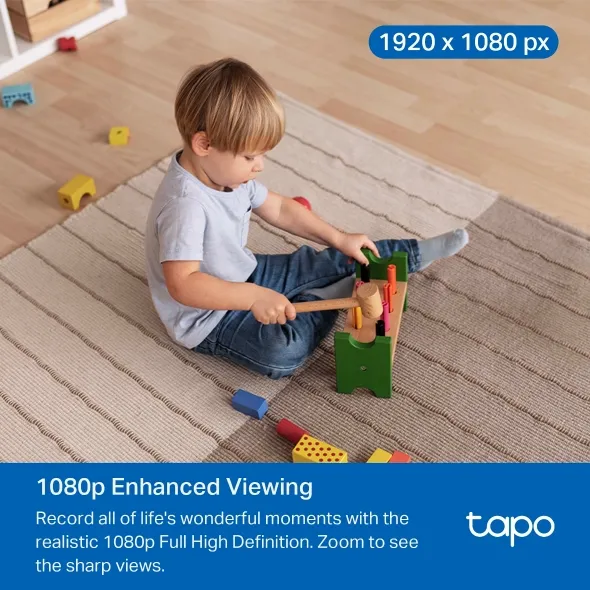
Start with the thing most buyers care about most, because here there is genuinely nothing to choose between them. Both cameras use a 1/3-inch progressive-scan CMOS sensor that TP-Link explicitly describes as "not starlight," behind an identical 4.0mm f/2.0 lens with an identical field of view: 88.3 degrees diagonal, 75.2 horizontal, 40.8 vertical. Both top out at 1920 x 1080, both compress with H.264, and both apply the same 3D digital noise reduction. Neither offers any digital zoom on its spec sheet. In plain terms, the raw ingredients of the picture — resolution, sensor size, lens, and processing — are a complete match. Anyone hoping the newer model quietly improved image quality will not find that improvement in the official numbers.
The one video difference is frame rate. The C201's US spec table reads "supports 15 fps by default, 30 fps maximum," while the C200's current US table lists a flat 15 fps. A 30 fps option, where available, makes moving subjects — a toddler crossing the room, a pet darting past — look smoother and gives you cleaner individual frames to scrub through. It is a real, if modest, advantage for the C201, and it is the single most concrete spec win in this entire comparison. It is not, however, the kind of difference that changes what a camera is for. Both remain 1080p cameras with 1080p limits: fine for checking who is in the room and what they are doing, not for reading a license plate or identifying a stranger at distance.
If picture detail is your priority, neither of these is the ceiling of the Tapo range. As we found when we compared the Tapo C200 against the 2K Tapo C210, stepping up to the C210's 3MP sensor is the move that actually buys you sharper footage. Between the C201 and C200, detail is a tie.
Pan, tilt, and coverage: the same motorized head
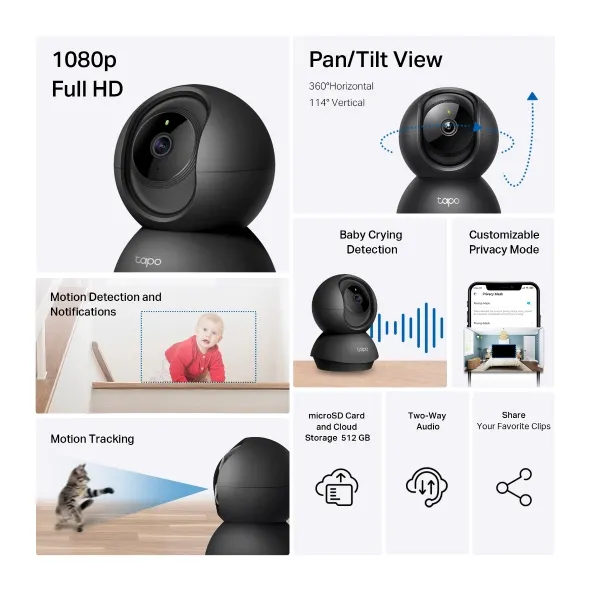
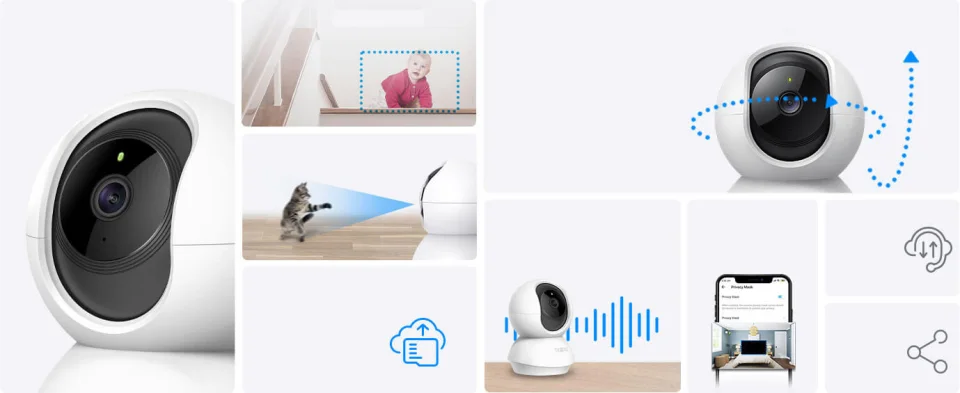
Both cameras sit on the same motorized pan-tilt design. TP-Link lists a 340-degree mechanical pan range that delivers 360 degrees of coverage once the lens's own field of view is included, and a 70-degree mechanical tilt range for 110.8 degrees of vertical coverage. Tapo's marketing describes this as 360-degree horizontal and roughly 114-degree vertical viewing, and both models support motion tracking, so the camera can lock onto movement and follow it across the room. In practice that means a single unit placed in a corner can cover an entire living room, nursery, or small shop floor without blind spots — the core reason this camera family sells.
Because the numbers are identical, placement advice is identical too: put either camera high in a corner for maximum sweep, or on a shelf at seated height for a nursery or pet room. Both support tabletop use and ceiling mounting, both ship with the same mounting hardware — screws, anchors, template, and camera base — and both measure the same, so they occupy the same footprint. There is no coverage reason to pick one over the other. If you are weighing this pair against fixed cameras or rival brands, our roundup of the best pan-and-tilt indoor cameras puts the whole category in context.
Night vision: the 30 ft vs 40 ft question
Night vision is where TP-Link's paperwork gets messy, and it deserves an honest explanation rather than a tidy claim. Both cameras use an 850 nm infrared LED for black-and-white night viewing — there is no color night vision and no spotlight on either model. The C201's US spec table rates that IR range at up to 40 ft (12 m). The C200's current US spec table rates it at up to 30 ft (9 m). Read at face value, that is a 10-foot win for the C201.
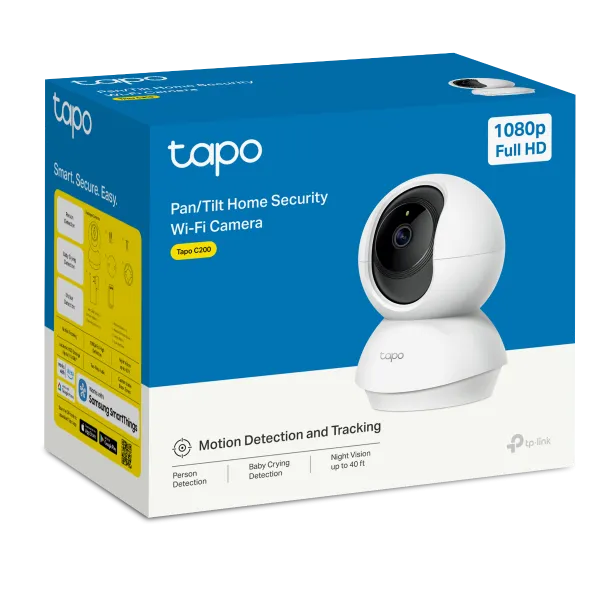
The complication: the C200's own retail box — an official Tapo asset — prints "Night Vision up to 40 ft," and several regional TP-Link spec tables for the C200 also list 40 ft. TP-Link has sold the C200 in multiple hardware versions over several years, and its documentation has never been perfectly consistent about this number. So the accurate summary is this: on the current US tables the C201 is rated 40 ft and the C200 is rated 30 ft, but TP-Link's own materials elsewhere credit the C200 with 40 ft as well. Do not pay a premium for the C201 expecting dramatically better night range on the strength of that line alone. For a typical bedroom, nursery, or living room — all well inside 30 ft — either camera's infrared will cover the space.
Detection, audio, and the siren: a complete tie
Smart detection is identical. Both cameras run on-device machine learning and offer the same three AI detection types in the Tapo app: motion detection, person detection, and baby-cry detection. Both let you draw activity zones (which work with motion detection), and both send plain system notifications for free, with snapshot and clip notifications reserved for the paid Tapo Care cloud service. For nursery use, baby-cry alerts plus person detection are the features that matter, and neither camera gives you more of them than the other. Neither lists pet-specific detection — motion tracking will follow a cat or dog, but there is no dedicated pet AI category on either spec sheet.
Audio is also matched spec for spec: a built-in microphone and speaker, two-way audio with noise cancellation, and a siren rated at 93 dB measured at a 10 cm distance. That siren figure sounds dramatic, but note the measurement distance — it is loud at the camera itself, useful as a startling deterrent or an attention-getter in the same room, not a whole-house alarm. Both cameras also support privacy features in the app, including privacy mode and customizable privacy masking, so you can pause monitoring or block sensitive areas of the frame from view.
Storage, connectivity, and smart home
Storage is one of the Tapo line's strongest selling points, and it is identical here. Both cameras have a microSD card slot on the camera body and accept cards up to 512GB — generous headroom for continuous or motion-based local recording with no subscription required. Both also offer Tapo Care cloud storage as an optional paid extra. If you record locally, there is no functional difference in how long either camera can retain footage on the same card.
Connectivity is equally matched, including its limits. Both cameras connect over 2.4 GHz Wi-Fi only (802.11b/g/n) — neither supports 5 GHz, so both need a 2.4 GHz network or a dual-band router with that band enabled. Both support RTSP and ONVIF, which matters if you want to pull the stream into a recorder or third-party software, and both use the same security stack: 128-bit AES encryption with SSL/TLS and WPA/WPA2-PSK. Both work with Amazon Alexa and Google Assistant for voice control and smart-display viewing. Neither supports Apple HomeKit, neither is battery powered, and neither carries any outdoor weather rating — these are indoor, plug-in cameras, both powered by the same 9V DC adapter. Setup and day-to-day control happen in the same Tapo app for both models.
Design and color: black vs white
The most visible difference is the one you can see in the photos. The C200 is the original white model — a white ball-and-base design that blends into light walls and ceilings. The C201 is finished in black, sold in the UK as the "Black Edition," and it is the easier fit for a TV stand, a dark shelf, or a room where a white camera would stand out. Under the finish, the hardware is the same size and shape: TP-Link lists the C201 at 3.36 x 3.42 x 4.63 inches (85.4 x 86.8 x 117.7 mm), and the C200's original datasheet lists exactly the same dimensions, even though the current US C200 table leaves the dimension row blank. Pick on looks with confidence — you are not choosing between two different sizes of camera.
Price and availability: no official US price for either
We need to be plain about price, because it is where comparison articles most often mislead. TP-Link does not publish an official US list price for the Tapo C201, and it does not publish one for the Tapo C200 either — both US product pages simply route you to retailers with a "Buy Now" link. Street prices for both cameras move frequently with sales and bundles, and the C201 is also sold in multi-packs through Tapo's UK store. So this comparison deliberately gives no prices: check the live price of each on the day you buy. Given how close the spec sheets are, the cheaper of the two on that day is usually the right answer. Availability follows the same pattern — the C200 has the longer retail history and the wider trail of listings, while the C201 is the newer listing and may appear in fewer stores or in pack configurations first.
Pros and cons
Tapo C201 — pros
- 30 fps maximum frame rate on the official US spec table, for smoother motion than the C200's listed 15 fps
- 40 ft / 12 m night-vision rating on the US spec table
- Black finish that disappears on dark furniture and TV stands
- Same generous 512GB microSD local storage, RTSP, and ONVIF support as the C200
- Motion, person, and baby-cry detection with no subscription required for basic alerts
Tapo C201 — cons
- No official US list price — street price only, and it varies
- Still 1080p from a non-starlight sensor; no image-quality jump over the C200
- 2.4 GHz Wi-Fi only, no HomeKit, no color night vision
- Newer listing, so a thinner retail and review track record than the C200
Tapo C200 — pros
- Years of retail history and a huge installed base — accessories, guides, and troubleshooting help are everywhere
- Identical core hardware: same sensor, lens, pan-tilt range, storage ceiling, detection set, and siren as the C201
- 512GB microSD local recording with no required subscription
- Frequently discounted precisely because it is the long-running model
Tapo C200 — cons
- Current US spec table lists 15 fps only — no 30 fps option on paper
- Current US spec table lists 30 ft night vision, even though TP-Link's own box and regional tables say 40 ft
- White finish only, which stands out on dark furniture
- Same platform limits: 2.4 GHz only, no HomeKit, IR-only night vision
Who should buy which?
Buy the Tapo C201 if the two are priced within a few dollars of each other, if you want the black finish, or if the 30 fps maximum matters to you — for a busy playroom or a pet that moves fast, smoother motion is the one tangible upgrade on offer. Our full Tapo C201 review covers the model on its own terms.
Buy the Tapo C200 if you find it cheaper — which, given its longer history and frequent discounts, will be true on many sale days — or if you prefer the white finish for a light-colored room. You give up nothing in resolution, coverage, detection, or storage. Our full Tapo C200 review has the complete breakdown.
Buy neither if what you actually want is sharper footage. Both cameras share the same 1080p sensor, so switching between them buys no detail. The meaningful step up inside the same family is the Tapo C210 review subject — a 2K 3MP camera on the same pan-tilt platform. Decide first whether 1080p is enough for your room; if it is, let price and color settle C201 vs C200.
FAQ
Is the Tapo C201 better than the Tapo C200?
Only slightly, and only on paper. The C201's US spec table lists a 30 fps maximum frame rate and a 40 ft night-vision rating, versus 15 fps and 30 ft on the C200's current US table. Everything else — sensor, lens, resolution, pan-tilt range, detection, storage, and audio — is identical. That makes the C201 the marginally better spec sheet, not a different class of camera.
Do the Tapo C201 and C200 use the same app?
Yes. Both are set up and managed in the Tapo app, both support activity zones and privacy features there, and both can be viewed through Amazon Alexa and Google Assistant. If you already run other Tapo devices, either camera drops into the same app and account.
Can both cameras record without a subscription?
Yes. Both have a microSD card slot supporting cards up to 512GB for local recording, which does not require a subscription. The optional Tapo Care cloud service adds cloud storage and richer notifications (snapshots and clips), but it is an extra, not a requirement, on either model.
Why does the C200 box say 40 ft night vision when the spec table says 30 ft?
Because TP-Link's own documentation is inconsistent. The C200 has been sold in multiple hardware versions and regions: the current US spec table lists 30 ft (9 m), while the retail box graphic and some regional tables list 40 ft (12 m). We report the US table figure as the headline number and flag the discrepancy rather than picking the larger number silently.
Which one should I buy for a nursery?
Either — both offer the two nursery features that matter, baby-cry detection and person detection, plus two-way audio and infrared night vision that will not flood the room with visible light. Choose the C201 if you value its 30 fps option for smoother video of a moving toddler, or the C200 if it is cheaper on the day. Placement and a 2.4 GHz Wi-Fi signal in the nursery will matter more than the badge on the front.
Where to buy
Check the official product pages for current retailer links and availability:
Neither camera has an official US list price published by TP-Link, and street prices change often — compare both listings before you buy, and remember that on specs alone, the cheaper camera is usually the right one.
#tapo c201 tapo c200 tp-link tapo pan-tilt camera indoor camera comparison
Comments
No notes yet. If you own one of these cameras, tell us what the spec sheet left out.