
Home / Reviews / Head-to-head
TP-Link Tapo C225 vs Tapo C216: Which Should You Buy?

Affiliate note: Bestindoorcam.com may earn a commission if you buy through a store link. That does not change which camera we prefer. Read how affiliate links and ads work and how we research and review cameras. As an Amazon Associate I earn from qualifying purchases.
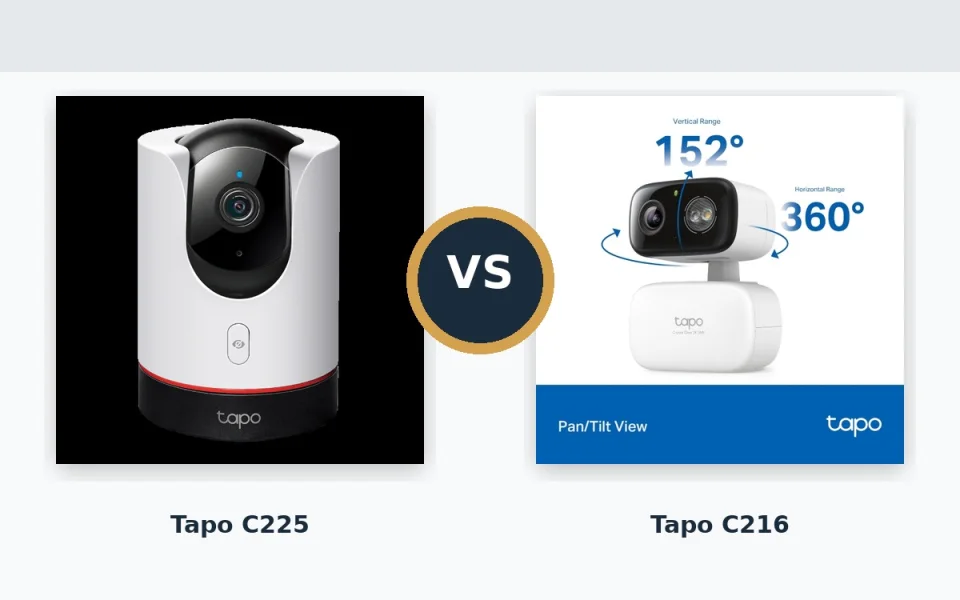
TL;DR — Tapo C225 vs Tapo C216: These two TP-Link pan-and-tilt cameras split on one question: where will the camera live, and how private must it be? The Tapo C225 is the indoor specialist — a sharper 2K QHD 4MP sensor (2688 × 1520) behind an f/1.6 lens, a Starlight sensor, a physical privacy mode that turns the lens down into its own housing, Apple HomeKit on top of Alexa and Google Assistant, and the deepest AI detection list in this price class. The Tapo C216 is the flexible one — a 2K 3MP sensor (2304 × 1296), full-color night vision from built-in spotlights, and an IP65 rating that lets the same camera work in a nursery or under a porch eave. Both pan 360°, record to a microSD card up to 512 GB with no subscription required, and sit within about ten dollars of each other at TP-Link's official US store. Buy the C225 for a bedroom, nursery, or HomeKit home. Buy the C216 if the camera might ever go outdoors. This is a specs-based comparison verified against TP-Link's official product and specification pages — we have not hands-on tested either unit for this article.
Overview
TP-Link's Tapo line has grown dense enough that two of its own cameras now compete for the same shelf space and nearly the same money. The Tapo C225 arrived first as the line's indoor flagship: a tall white cylinder built around privacy and low-light performance. The Tapo C216 is the newer design — a compact two-part body with a separate lens-and-spotlight head on a motorized base — built around flexibility instead. On a store shelf they look like siblings. On the spec sheet they are answers to different questions, and this comparison exists to keep you from buying the wrong answer.
Start with what they share, because it is a lot. Both are plug-in Wi-Fi pan-and-tilt cameras with a full 360° horizontal range, automatic motion tracking, two-way audio with noise cancellation, a sound-and-light alarm, customizable activity zones, and local recording to a microSD card up to 512 GB — plus optional Tapo Care cloud storage. Both run in the same Tapo app, both list RTSP and ONVIF support in TP-Link's specification tables, and both detect people and crying babies on-device without a subscription. If those shared features are all you need, either camera works; the rest of this article covers the differences that should actually decide the purchase.
Those differences are substantial. The C225 records at a higher resolution through a larger, faster lens, hides its lens physically when you want privacy, speaks to Apple HomeKit, and recognizes far more event types — pets, vehicles, line-crossing, even barking and glass breaking. The C216 counters with the one thing the C225 cannot do at all: survive weather. Its IP65 rating, wider temperature range, and spotlight color night vision make it a genuine indoor/outdoor camera, while the C225 is indoor-only. For the full single-camera picture, see our full Tapo C225 review and our full Tapo C216 review.
Tapo C225 vs Tapo C216: full spec comparison
| Spec | Tapo C225 | Tapo C216 |
|---|---|---|
| Max. resolution | 2K QHD 4MP — 2688 × 1520 px | 2K 3MP — 2304 × 1296 px |
| Frame rate | 15/20/25/30 fps (default 15 fps) | 30 fps |
| Image sensor | 1/2.9″ progressive scan CMOS Starlight sensor | 1/3″ progressive scan CMOS Starlight sensor |
| Lens | 4.3 mm, f/1.6 aperture | 4 mm, f/2.0 aperture |
| Field of view | 100° diagonal / 83° horizontal / 43° vertical | 98° diagonal / 83° horizontal / 47° vertical |
| Pan / tilt range | 360° horizontal / 149° vertical | 360° horizontal / 152° vertical |
| Motion tracking | Yes — up to 120°/s | Yes (no speed published) |
| Night vision | Starlight sensor for color in low light; 850 nm IR LED and 940 nm invisible IR LED, both rated 30 ft / 9 m; no spotlight | Full-color night vision via built-in spotlights; color and infrared night vision both rated 49 ft / 15 m in the current spec table; IR-cut filter with auto-switching |
| Privacy | Physical privacy mode — lens turns down and is blocked by the housing; dedicated privacy button on the camera; activity/privacy zones | Software privacy zones only — areas excluded from live view and recordings; no physical shutter |
| AI detection (on-device) | Motion, person, pet, vehicle, line-crossing, camera tampering, baby crying, bark, meow, glass-break | Motion, person, baby crying, camera tampering |
| Audio | Two-way audio with noise cancellation; 98 dB siren (measured at 10 cm) | Two-way audio with noise cancellation; sound-and-light alarm |
| Storage | microSD up to 512 GB; Tapo Care cloud (subscription) | microSD up to 512 GB; Tapo Care cloud (subscription); Tapo H500 hub support (up to 16 TB) |
| Wi-Fi | 2.4 GHz only — 802.11b/g/n/ax | 2.4 GHz only — 802.11b/g/n |
| Smart integrations | Apple HomeKit, Amazon Alexa, Google Assistant | Amazon Alexa, Google Assistant, Samsung SmartThings |
| Matter | Not listed | Not listed |
| Streaming protocols | RTSP: Yes; ONVIF: Yes | RTSP: Yes; ONVIF: Yes |
| Weather rating | None — indoor only | IP65 — indoor or outdoor |
| Operating temperature | 0 °C to 40 °C | −20 °C to 50 °C (−4 °F to 122 °F) |
| Power | 12 V DC adapter | 5 V DC via USB-C; 2 m cable; ~2.3 W typical / 5 W max |
| Mounting | Tabletop, ceiling | Tabletop, wall, ceiling, pole |
| Dimensions | 80 × 80 × 112 mm | 105.3 × 77.8 × 69.8 mm; 220 g |
| US price (official Tapo store, checked Oct 2026) | $49.99 list; shown at $41.99 on sale (marked sold out at check time) | $39.99 list; store page showed $34.99 at check time |
Source note: all specifications above are taken from TP-Link's official specification tables for the Tapo C225 and Tapo C216 (tp-link.com product specification pages) and the official Tapo product and US store pages (tapo.com, us.store.tapo.com), checked October 2026. Where TP-Link's own pages disagree — and they do, in a few places detailed in the sections below — the specification table figure is the one shown, and the discrepancy is flagged in the text. Prices move with sales; confirm on the store page before buying.
Key differences
Resolution and lens: the C225 sees more, through a faster lens
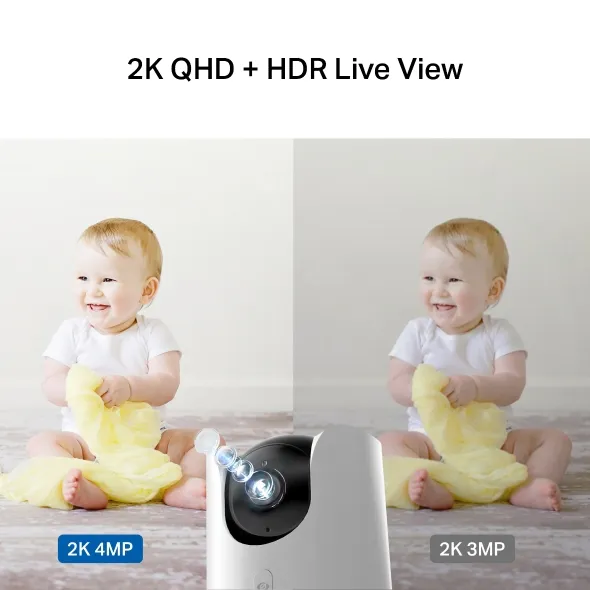
Both cameras wear a "2K" badge, but they are not the same 2K. The C225 records at 2688 × 1520 (4MP), the C216 at 2304 × 1296 (3MP). That is roughly 35% more pixels on the C225, and TP-Link pairs them with meaningfully different optics: a 1/2.9″ Starlight sensor and an f/1.6 lens on the C225, against a smaller 1/3″ sensor and an f/2.0 lens on the C216. A larger sensor with a wider aperture gathers more light per pixel, which is the hardware foundation for the C225's low-light claims. One honest wrinkle: TP-Link's own marketing is inconsistent about the C225's resolution — some TP-Link pages and retailer spec blocks describe it as 2560 × 1440, and the official store's FAQ even defines "2K QHD" as 2304 × 1296. The figure in our table, 2688 × 1520, is what TP-Link's current specification table lists as the maximum resolution, and it is the number to hold the camera to.
Frame rate cuts the other way, at least on defaults. The C216 is listed at a flat 30 fps. The C225 supports 15, 20, 25, and 30 fps but ships defaulted to 15 fps per the spec table — you can raise it in settings, but out of the box the cheaper camera's motion will look smoother until you do. Field of view is nearly a tie: both cover 83° horizontally, with the C225 a touch wider diagonally (100° vs 98°) and the C216 a touch taller vertically (47° vs 43°). In a real room, placement and the pan/tilt range will matter more than any of those three numbers.
Night vision: two different philosophies
This is the most interesting technical split in the comparison. The C216 takes the spotlight route: built-in spotlights switch on at night so the camera records full-color footage instead of black-and-white infrared. TP-Link's current C216 specification table rates both its color night vision and its infrared night vision at 49 ft (15 m). Note that older TP-Link C216 material — including the camera's original datasheet — described an 850 nm IR LED rated at 40 ft (12 m), so TP-Link's own published range for this camera has changed between documents; the 15 m figure is from the current spec table. Either way, the trade-off of spotlight color is visible light: the camera lights up the scene, which deters intruders at a porch but can disturb a sleeping room.
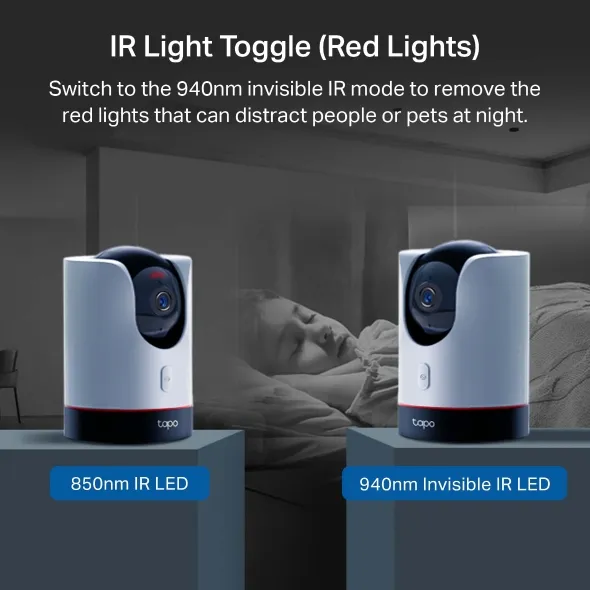
The C225 refuses that trade. It has no spotlight at all — TP-Link's spec table lists its lighting as none — and instead leans on the Starlight sensor and f/1.6 lens to hold color in low light without adding light, backed by two infrared options: a standard 850 nm IR LED and a 940 nm invisible IR LED, both rated to 30 ft (9 m). The 940 nm mode produces no red glow, which is exactly what you want over a crib. So the verdict is situational: the C216 reaches farther on paper and guarantees color by making its own light; the C225 is the discreet one, built for rooms where the camera should never announce itself. See also how the C225's approach stacks up in our Reolink E1 Zoom vs Tapo C225 comparison, where optical zoom enters the same conversation.
Privacy: a physical shutter vs software zones
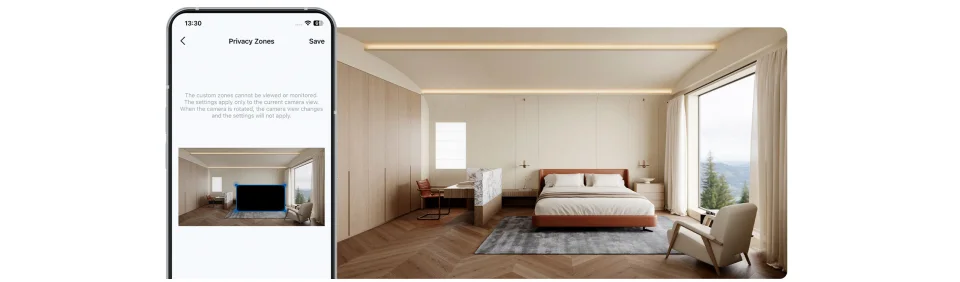
If the camera will live in a bedroom, this section may decide the purchase on its own. The C225 has a true physical privacy mode: press the button on the camera body — there is a dedicated privacy button in its interface list, alongside the reset button — or tap in the app, and the lens assembly rotates down so the lens is blocked by the camera's own housing. Privacy you can verify from across the room, with no trust in software required. The C216 offers privacy zones instead: you draw areas in the Tapo app and those areas are excluded from the live view and from recordings. That is a genuinely useful feature — mask the bed, keep the doorway — but the lens stays open and the camera stays powered; it is a recording rule, not a shutter. For a living room or a porch, zones are enough. For a bedroom or a home office where you take calls, the C225's physical mode is the stronger answer, and it is one of the main reasons the C225 anchors our roundup of the best pan-and-tilt indoor cameras for privacy-sensitive rooms.
Placement: the C216 goes outdoors, the C225 does not
The C216's IP65 rating is not a footnote — it reorganizes where the camera can work. Dust-tight and protected against water jets, rated from −20 °C to 50 °C, and mountable on a table, wall, ceiling, or pole, it can cover a nursery this month and a covered porch, garage, or driveway next month. Its 5 V USB-C power (2 m cable included) is also the more convenient standard. The C225, by contrast, lists no weather resistance at all, an operating range of 0 °C to 40 °C, tabletop and ceiling mounting, and a 12 V DC adapter. It is an indoor camera, full stop. If there is any chance your camera will end up outside — even under an eave — the comparison ends here and the C216 wins by default. That indoor/outdoor flexibility is also what made the C216 such a close rival to Wyze's outdoor-leaning pan camera in our Wyze Cam Pan v4 vs Tapo C216 head-to-head.
AI detection: the C225 recognizes far more
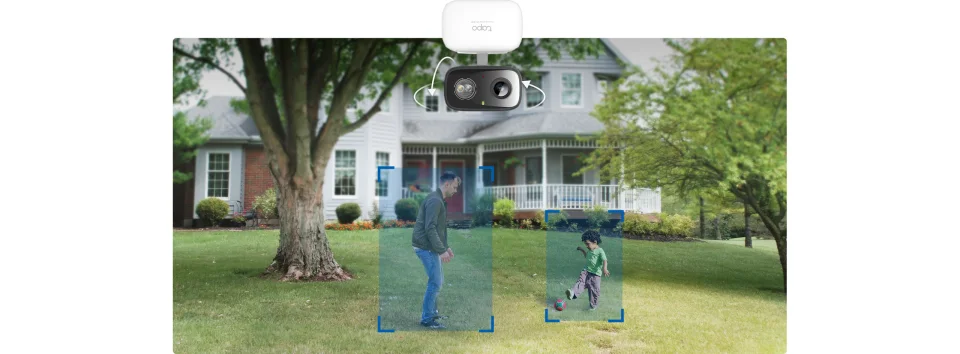
Both cameras detect motion, people, and crying babies on-device for free, and both add camera-tampering alerts. That is where the C216's list ends. The C225's specification table adds pet detection, vehicle detection, line-crossing detection, and sound recognition for barking, meowing, and glass breaking. In practice that means fewer, better alerts indoors: a C225 can tell you the dog is on the couch, someone crossed the hallway line, or a window broke, while the C216 will mostly tell you a person moved or the baby cried. Neither camera charges for its detection — the lists above are camera features in TP-Link's tables, not Tapo Care subscription features — so the C225's longer list is a straight hardware-generation advantage. Both cameras support activity zones (the C225's footnote limits zones to motion detection; the C216's extends them to person detection as well) and both can trigger a sound-and-light alarm; the C225's siren is rated at 98 dB measured at 10 cm.
Smart home: HomeKit is the C225's trump card
The integration lists do not overlap completely, and the difference matters. The C225 works with Apple HomeKit, Amazon Alexa, and Google Assistant — TP-Link's US store leads with its "Full Apple HomeKit Integration," including Siri control and viewing in the Apple Home app. The C216 works with Amazon Alexa, Google Assistant, and Samsung SmartThings — and not HomeKit. (One smaller inconsistency: the C216's US store page names Samsung Bixby as its third integration, while the specification table names Samsung SmartThings; neither document lists HomeKit or Matter for the C216.) Neither camera lists Matter in its specification table, so Matter households should not buy either on that promise. Short version: Apple households buy the C225, SmartThings households buy the C216, and Alexa/Google households can buy either.
Shared ground: tracking, storage, and the app
Everything else is close enough to call shared. Pan/tilt coverage is 360° horizontal on both, with tilt at 149° (C225) vs 152° (C216) — a 3° difference you will never notice. Both auto-track moving subjects; only the C225 publishes a tracking speed (up to 120°/s). Both record locally to microSD up to 512 GB and offer Tapo Care cloud storage by subscription. The C216 adds one storage trick the C225 lacks: support for the Tapo H500 hub, up to 16 TB. Both list RTSP and ONVIF as supported in their current spec tables — a correction worth making for the C216, whose RTSP/ONVIF support was not documented on its earliest official pages. And both are 2.4 GHz-only; the C225's radio adds the 802.11ax (Wi-Fi 6) standard on that band while the C216 stops at 802.11n — rarely decisive at camera bitrates, but it may help the C225 on congested Wi-Fi 6 networks.
Tapo C225: pros and cons
Pros
- Sharper 2K QHD 4MP video (2688 × 1520) with a larger 1/2.9″ Starlight sensor and fast f/1.6 lens
- Physical privacy mode with a dedicated button — the lens is mechanically blocked by the housing
- Apple HomeKit plus Alexa and Google Assistant — the broadest assistant coverage of the two
- Deepest free AI detection here: pet, vehicle, line-crossing, bark, meow, and glass-break on top of person and baby-cry
- Discreet night monitoring: Starlight color in low light plus a 940 nm invisible-IR mode with no red glow
- Published 120°/s motion-tracking speed; Wi-Fi 6 (802.11ax) radio on 2.4 GHz
Cons
- Indoor only — no weather rating, 0 °C minimum operating temperature
- No spotlight, so no guaranteed full-color night footage in a truly dark room; IR range (30 ft) is shorter than the C216's rated range
- Default frame rate is 15 fps per the spec table — you must raise it manually for 30 fps
- 12 V DC barrel power instead of USB-C; tabletop/ceiling mounting only
- Higher list price ($49.99) and frequently shown sold out at the official store
Tapo C216: pros and cons
Pros
- IP65 indoor/outdoor rating with a −20 °C to 50 °C operating range — usable where the C225 cannot go
- Full-color night vision from built-in spotlights, with color and IR range rated at 49 ft in the current spec table
- Flat 30 fps recording and a slightly taller vertical field of view
- Cheaper: $39.99 list, and the official store showed $34.99 at check time
- USB-C power with a 2 m cable; table, wall, ceiling, and pole mounting; Tapo H500 hub storage support
- Person and baby-cry detection, tracking, and activity zones all free, no subscription required
Cons
- Lower resolution (2K 3MP, 2304 × 1296) through a smaller sensor and slower f/2.0 lens
- No Apple HomeKit and no Matter listed — Alexa, Google Assistant, and SmartThings only
- Privacy is software zones only; there is no physical lens shutter
- Much shorter AI list — no pet, vehicle, or line-crossing detection
- Spotlight color night vision lights the room, which can disturb light sleepers
Who should buy which?
Buy the Tapo C225 if the camera will live indoors in a room where privacy and quiet matter — a nursery, bedroom, or home office. The physical privacy mode, invisible-IR night option, and Starlight sensor are a combination the C216 simply does not offer, and the sharper 4MP image, deeper AI detection, and HomeKit support make it the better long-term indoor camera if your budget stretches to its $49.99 list price (it is worth checking the official store, which has shown it at $41.99 on sale). Apple households, in particular, have no real choice here: the C225 is the only one of the two that speaks HomeKit.
Buy the Tapo C216 if placement flexibility matters more than maximum detail. It is the pick for a covered porch, garage, driveway, or any room that might later become an outdoor post, and its spotlight color night vision is the better tool for identifying people and clothing colors in a dark entryway. It is also the value pick: at $39.99 list — and less on sale — it undercuts the C225 while keeping the same 360° coverage, the same 512 GB local storage, and the same subscription-free person and baby-cry alerts. Samsung SmartThings households should also land here, since the C225 does not list SmartThings at all.
Buy neither if you need 5 GHz Wi-Fi, a battery camera, or Matter support — neither specification table offers them. And if you are still deciding whether pan-and-tilt is even the right format, start with our Tapo C225 review for the indoor flagship's full picture before circling back to this verdict.
FAQ
Is the Tapo C225 better than the Tapo C216?
For indoor use, on specs, yes: the C225 records at a higher resolution (2K QHD 4MP vs 2K 3MP), has a larger sensor and faster f/1.6 lens, a physical privacy mode, Apple HomeKit, and far more AI detection types. The C216 is better the moment the camera needs to go outdoors — it has an IP65 rating and spotlight color night vision — and it costs less. "Better" depends entirely on placement.
Can the Tapo C216 be used outdoors?
Yes. TP-Link rates the C216 IP65 for water and dust resistance, with an operating temperature range of −20 °C to 50 °C, and lists wall, ceiling, and pole mounting among its options. It is still a wired camera (5 V USB-C, 2 m cable), so it needs a nearby outlet, and sheltered spots such as under an eave suit it best. The C225 has no weather rating and is indoor-only.
Does the Tapo C225 or C216 work with Apple HomeKit or Matter?
The C225 works with Apple HomeKit, alongside Amazon Alexa and Google Assistant, per TP-Link's specification table and US store page. The C216 does not list HomeKit; its integrations are Alexa, Google Assistant, and Samsung SmartThings. Neither camera lists Matter support in its official specification table.
Do either of these cameras require a subscription?
No. Both record locally to a microSD card up to 512 GB, and their listed AI detection — person and baby-cry on the C216; a much longer list on the C225 — runs on-device without a plan. Tapo Care cloud storage is an optional subscription on both for off-site backup and snapshot notifications.
Which camera is better for a nursery?
On specs, the C225. Its 940 nm invisible-IR mode watches without the red LED glow that can distract a sleeping baby, its Starlight sensor holds color in low light without switching on a spotlight, both cameras detect crying, and its physical privacy mode lets you block the lens completely when the room is in use. The C216's spotlight-based color night vision is brighter and more colorful, but the light itself is the trade-off in a nursery.
Where to buy
Buy from the official Tapo store or a major retailer, confirm the exact model name on the listing (Tapo C225 and Tapo C216 are easy to mistype into other Tapo models), and re-check the price — both cameras are discounted often. At our October 2026 check, the official US store listed the C225 at $49.99 (shown at $41.99 on sale, marked sold out) and the C216 at $39.99 (store page showing $34.99).
Links above are plain retailer links with affiliate slots marked in comments for later; no affiliate tags are attached yet.
#tapo c225 tapo c216 tp-link tapo pan-tilt camera homekit camera
Comments
No notes yet. If you own one of these cameras, tell us what the spec sheet left out.