
Home / Reviews / Head-to-head
TP-Link Tapo C210 vs Tapo C216: Which Should You Buy?

Affiliate note: Bestindoorcam.com may earn a commission if you buy through a store link. That does not change which camera we prefer. Read how affiliate links and ads work and how we research and review cameras. As an Amazon Associate I earn from qualifying purchases.
TP-Link Tapo C210 vs Tapo C216: Which Should You Buy?
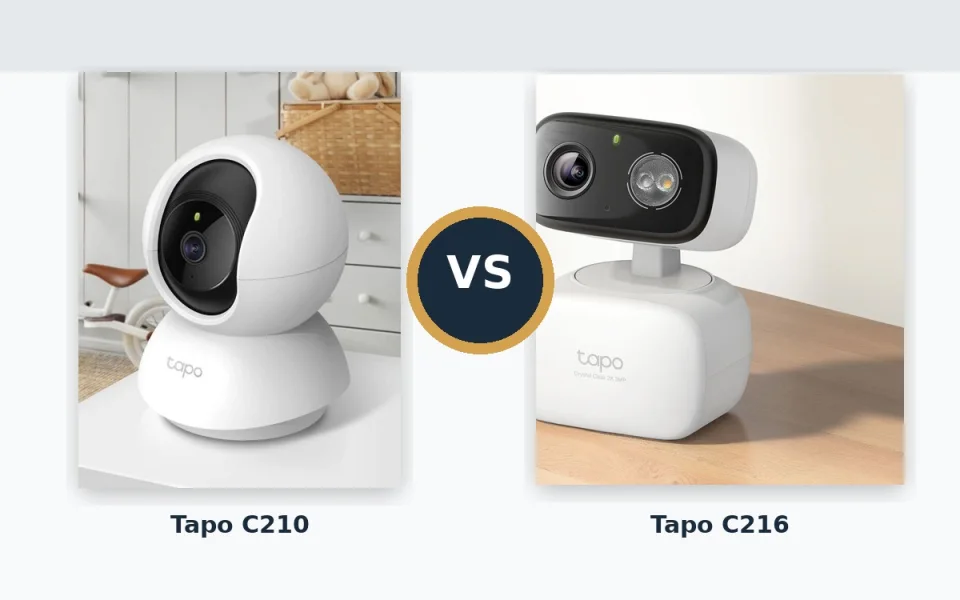
TL;DR: The Tapo C210 and Tapo C216 record the exact same headline video — 2K 3MP (2304 × 1296) — and share Tapo's subscription-free person and baby-cry detection, motion tracking, two-way audio and 512 GB microSD storage. They split on where the camera can live and what it sees after dark. The Tapo C216 adds full-color night vision with built-in spotlights, an IP65 weatherproof body rated for indoor and outdoor use, a much wider 152° tilt range, USB-C power and Samsung SmartThings support. The Tapo C210 is the simpler, indoor-only ball camera: infrared black-and-white night vision, a 9V barrel adapter, and Alexa/Google Assistant only. TP-Link publishes no US price for the C210; the C216 was $34.99 on TP-Link's official US store when we checked on October 19, 2026. Buy the C216 unless the camera will only ever sit in one indoor room and the C210 is meaningfully cheaper at checkout. This comparison is based on TP-Link's published specifications — we have not hands-on tested either camera.
Overview: two branches of the same Tapo family tree
If you are shopping TP-Link's budget pan-and-tilt range, the Tapo C210 and the Tapo C216 are the two names that keep colliding — and on paper they look almost like the same camera wearing two different bodies. Both are 2K 3MP pan-tilt Wi-Fi cameras that record at 2304 × 1296, compress with H.264, connect over 2.4 GHz Wi-Fi only, store footage on a microSD card of up to 512 GB, and run their person and baby-cry detection on the device itself, with no subscription required. Both talk back through a built-in microphone and speaker, follow movement with smart motion tracking, and work with the same Tapo app.
The differences are real, though — they are just concentrated in a few decisive places rather than spread across the whole spec sheet. The C210 is the established indoor model: the familiar white ball-on-a-base design that has anchored Tapo's nursery and living-room line for years. We covered it on its own in our full Tapo C210 review, where its appeal is simplicity — a proven indoor camera with sharp 2K video and no outdoor ambitions at all. The C216 is the newer "HybridCam" branch: a shorter, wider horizontal-bar body built to work on a nursery shelf one day and under a porch roof the next. Our full Tapo C216 review goes through that indoor/outdoor pitch in detail.
So this head-to-head is not really about which camera is "better" in the abstract. It is about three questions. First: do you need color at night, or is crisp black-and-white infrared enough? Second: will the camera ever live outdoors, on a covered patio, in a garage, or anywhere cold? Third: how much do the smaller upgrades — wider tilt, USB-C power, an extra smart-home platform — matter to you? Answer those, and the winner picks itself. The sections below work through each difference against TP-Link's official specifications, including the places where TP-Link's own tables disagree with each other.
One quick orientation note before the table: if you are also looking at the model below the C210, our Tapo C200 vs Tapo C210 comparison covers the 1080p-versus-2K step-up. Everything here is about the two 2K cameras.
Full spec comparison
| Specification | Tapo C210 | Tapo C216 |
|---|---|---|
| Maximum resolution | 2304 × 1296 px (2K, 3MP) | 2304 × 1296 px (2K, 3MP) |
| Frame rate | 15/20/25/30 fps (current datasheet) | 30 fps |
| Video compression | H.264 | H.264 |
| Image sensor | 1/2.8" Progressive Scan CMOS — "Not Starlight Sensor" | 1/3" Progressive Scan CMOS Starlight Sensor |
| Lens | 4 mm, F2.0 | 4 mm (±5%), F2.0 (±5%) |
| Field of view (static) | 98° diagonal / 83° horizontal / 45° vertical | 98° diagonal / 83° horizontal / 47° vertical |
| Pan / tilt coverage | 360° horizontal / about 114° vertical (340° / 70° mechanical) | 360° horizontal / 152° vertical |
| Night vision | 850 nm IR LED, black-and-white only — no spotlight, no color night vision | 850 nm IR LED (40 ft / 12 m) plus full-color night vision via built-in spotlights |
| Night-vision range | 30-40 ft depending on the official table (see note) | 40 ft / 12 m |
| Digital zoom | Conflicting official figures — see note | Not published |
| AI detection (on-device) | Motion, person, baby crying; motion tracking; activity zones | Motion, person, baby crying, camera tampering; motion tracking; activity zones |
| Audio | Two-way audio, built-in mic + speaker; siren 88 dB at 10 cm | Two-way audio with noise cancellation, built-in mic + speaker; sound & light alarm; siren 99 dB at 10 cm (datasheet) |
| Local storage | microSD slot, up to 512 GB (card not included) | microSD slot, up to 512 GB (card not included); Tapo H500 hub support up to 16 TB |
| Cloud storage | Tapo Care (subscription, optional) | Tapo Care (subscription, optional) |
| Wi-Fi | 802.11b/g/n, 2.4 GHz only; no Ethernet port | 802.11b/g/n, 2.4 GHz only; no Ethernet port |
| RTSP / ONVIF | Yes / Yes (official spec tables) | Yes / Yes (official datasheet) |
| Smart assistants | Amazon Alexa, Google Assistant | Amazon Alexa, Google Assistant, Samsung SmartThings |
| Weather resistance | None — indoor use only | IP65 — indoor and outdoor use |
| Operating temperature | 0 °C to 40 °C (32 °F to 104 °F) | -20 °C to 50 °C (-4 °F to 122 °F) |
| Power | 9V DC barrel adapter (9.0 V / 0.6 A) | 5V DC USB-C adapter (5.0 V / 1.0 A), 2 m cable; typical 2.3 W, max 5 W |
| Mounting | Tabletop, ceiling | Tabletop, wall, ceiling, pole |
| Dimensions | 85.4 × 86.8 × 117.7 mm (3.36 × 3.42 × 4.63 in) | 105.3 × 77.8 × 69.8 mm (4.15 × 3.06 × 2.75 in); 220 g |
| US price | No MSRP published by TP-Link — check retailers | $34.99 on TP-Link's official US store (checked Oct 19, 2026) |
Source note: all figures are from TP-Link/Tapo's official product pages, specification tables and datasheets for the Tapo C210 and Tapo C216 (tapo.com, tp-link.com, us.store.tp-link.com), checked October 19, 2026. TP-Link's own tables disagree in a few places, and we flag those rather than hide them: the C210's night-vision range appears as 40 ft / 12 m in the current datasheet and global spec table but as 30 ft in US product-page copy and the UK table; its digital zoom is listed as "None" in the current datasheet but as 10.8x in the global spec table, so we make no zoom claim for it; and its tilt coverage is 114° on US pages versus 116.65° in the global table. Prices change — the C216 was $39.99 on the same official store three days earlier.
Key differences, section by section
Design and placement: indoor-only ball vs IP65 indoor/outdoor bar
The most obvious difference is the body. The C210 is Tapo's classic pan-tilt silhouette: a glossy white ball carrying the lens, sitting on a rounded base with the Tapo logo, 117.7 mm tall. It is designed to sit on a shelf or screw to a ceiling inside the house — full stop. TP-Link publishes no ingress-protection rating for it, and its operating range of 0 °C to 40 °C is an indoor range. Rain, porch humidity and a freezing garage are all outside its brief.
The C216 throws that brief away. Its horizontal-bar head sits on a compact rectangular base — wider (105.3 mm) but much shorter (69.8 mm) than the C210 — and the whole unit carries an IP65 rating for dust and water resistance, with an operating range of -20 °C to 50 °C. TP-Link explicitly markets it for both worlds: the nursery and the backyard, the front door and the driveway. The mounting list grows accordingly: tabletop, wall, ceiling and pole mounting, against the C210's tabletop and ceiling options. If there is any chance your "indoor" camera ends up watching a porch, a garage, a workshop or a covered patio, this single line of the spec table settles the comparison — the C210 was never built for it, and no firmware update will change that.
Night vision: the biggest functional gap
Both cameras carry an 850 nm infrared LED with an auto-switching IR-cut filter, and both quote night reach in the same 30-40 ft class. That is where the similarity ends. The C210's sensor is a 1/2.8" CMOS that TP-Link's own datasheet describes, in so many words, as a "Not Starlight Sensor," and the camera has no spotlight hardware at all. After dark, the C210 shows you the world in black-and-white infrared. That footage is genuinely useful — faces, movement and a crying baby are all perfectly visible in IR — but clothing colors, car colors and package details wash out into shades of grey.
The C216 pairs a 1/3" Starlight sensor with built-in spotlights, and its headline night feature is full-color recording after dark: instead of switching straight to infrared, it can light the scene and keep recording in color, falling back to the 850 nm IR mode (rated to 40 ft / 12 m) when you prefer discretion. For a camera watching a front step or a driveway, color is often the detail that matters — the color of a jacket or a car is exactly what black-and-white footage throws away. For a nursery, the calculus flips: a spotlight coming on in a dark bedroom is a real disturbance, and many parents will run the C216 in its IR mode indoors anyway. The honest summary is that the C216 gives you a choice the C210 simply does not have. Shoppers comparing across brands will find the same pattern in our Wyze Cam Pan v4 vs Tapo C216 comparison, where spotlight color night vision is also a headline dividing line.
Pan, tilt and field of view
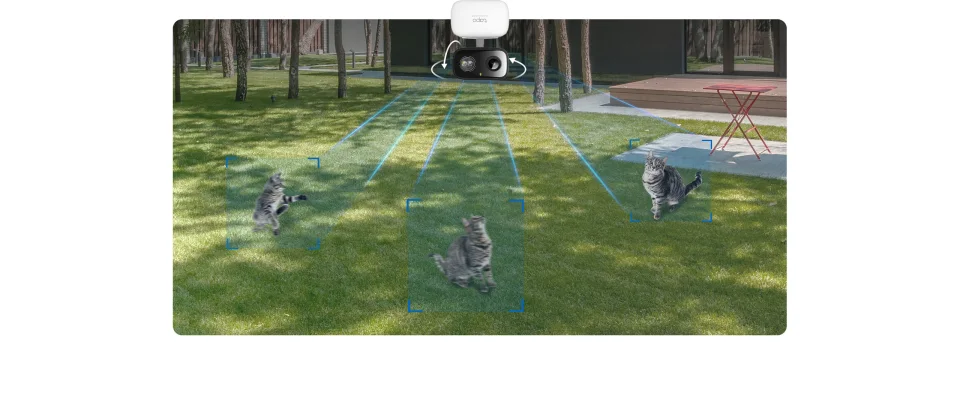
Pan coverage ties: both heads rotate through a full 360° of horizontal coverage (340° of mechanical pan travel on the C210's table). Tilt is where the C216 pulls ahead — 152° of vertical coverage against about 114° on the C210. That extra travel matters most in two common setups: a ceiling-mounted camera that needs to look steeply down at a door or crib, and any mount in a tall room where the interesting action happens well below the camera. On a normal shelf at eye level, you will rarely feel the difference.
Before either head moves, the static lenses are near-twins: both are 4 mm F2.0 lenses framing 98° diagonally and 83° horizontally. The C216's vertical field of view is a touch taller (47° versus 45°), a difference you would struggle to spot side by side. In other words, placement and tilt range — not the lens — decide which camera covers your room better, and both cover a typical room from a corner with room to spare. For a wider shortlist of rotating cameras, see our guide to the best pan-and-tilt indoor cameras.
Detection, tracking and audio
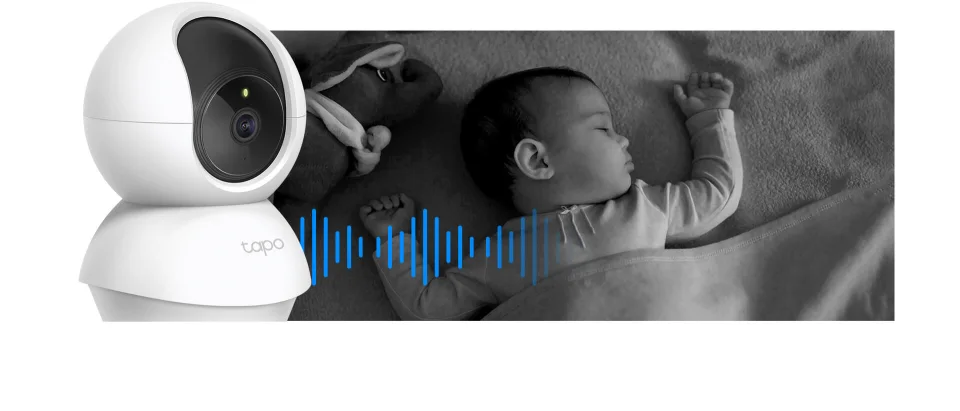
The smart core is shared, and it is the strongest part of both cameras' value: on-device motion detection, person detection and baby-crying detection, all without a subscription, plus customizable activity zones so a busy hallway does not ping you all day. Both cameras also track motion — when something moves, the head follows it to keep it in frame — and both offer privacy zones that exclude areas from recording and live view. The C216 adds one extra detection type to the official list: camera-tampering alerts, a sensible addition for a camera that might live within reach outdoors.
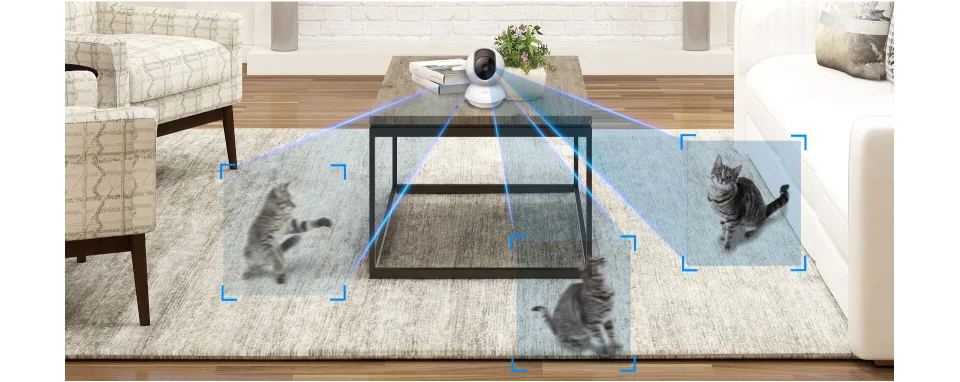
Audio is two-way on both, through a built-in microphone and speaker; the C216's specification explicitly lists noise cancellation on that two-way audio, and its sound-and-light alarm pairs the siren with its spotlights. On the datasheet figures, the C216's siren is also the louder of the two (99 dB at 10 cm, against the C210's 88 dB at 10 cm) — both are measured at point-blank range, so treat them as attention-getters rather than house-shaking alarms. Neither camera, on any official page, lists a pet-specific detection type: the tracking will follow a dog or cat as motion, and Tapo's own copy describes the C216 following "people and pets," but do not buy either camera expecting the labeled pet alerts some rival brands sell.
Storage, app and smart-home fit
Recording works the same way on both: continuous or event recording to a microSD card of up to 512 GB that you supply, with Tapo Care cloud storage as an optional subscription on top — not a requirement for the detection features above. The C216 adds one storage trick the C210 does not list: support for TP-Link's Tapo H500 hub, which the official US store page credits with up to 16 TB of local storage. If you are building a multi-camera Tapo system around a hub, that is a genuine point in the C216's favor; for a single camera, the microSD ceiling is identical and this row will never matter.
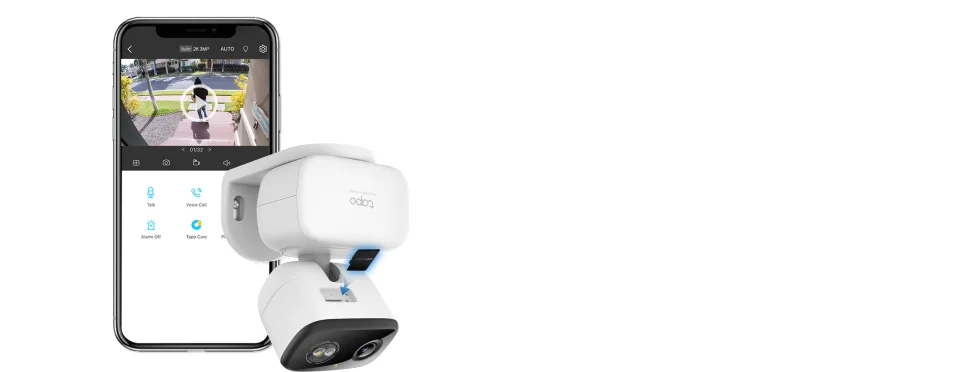
Both cameras live in the Tapo app, and both expose RTSP and ONVIF streams according to TP-Link's official spec tables — good news if you run a NAS or NVR, though as always with budget cameras it is worth confirming the current firmware behavior before building a system around it. Voice control is where the C210 falls a step behind: it lists Amazon Alexa and Google Assistant, and that is all. The C216 keeps both and adds Samsung SmartThings in its datasheet (TP-Link's US store page also names Samsung Bixby). Neither camera supports Apple HomeKit on any official page — if your home is built on HomeKit, both of these are the wrong shelf to be shopping on.
Power and installation
A small row with outsized practical effect: the C210 runs on a 9V DC barrel adapter, while the C216 runs on 5V USB-C (5.0 V / 1.0 A) with a 2 m cable in the box and a typical draw of just 2.3 W. USB-C means replacement cables and extensions are cheap and everywhere, and the adapter is the same species as the ones already in your drawer. The C216 also onboards over Bluetooth in the Tapo app, per the official store page, which makes first setup a little less fiddly. Both cameras are wired, always-on devices — neither has a battery — so both need an outlet within cable reach of the mounting spot, and both are 2.4 GHz Wi-Fi only: if your router's 2.4 GHz band is weak where the camera will live, neither model offers a 5 GHz or Ethernet escape hatch.
Tapo C210: pros and cons
Pros
- Same 2K 3MP (2304 × 1296) video as the C216 — you give up nothing on headline resolution.
- Subscription-free on-device person and baby-cry detection, motion tracking and activity zones.
- Large 512 GB microSD ceiling for local recording, plus RTSP/ONVIF support on the official spec tables.
- Proven, simple indoor design with a slightly larger 1/2.8" sensor; widely discounted at retailers because it is the older model.
Cons
- Infrared-only night vision: black-and-white after dark, with no spotlight and no color night mode.
- Indoor only — no weather rating and a 0-40 °C operating range.
- Narrower tilt coverage (about 114°) and no pole or wall mounting on the official list.
- Alexa and Google Assistant only — no SmartThings; 9V barrel adapter instead of USB-C.
- TP-Link's own C210 tables conflict on night range (30 vs 40 ft) and digital zoom, so buy on the verified core specs, not the trimmings.
Tapo C216: pros and cons
Pros
- Full-color night vision with built-in spotlights, on top of standard 40 ft infrared — your choice per placement.
- IP65 weatherproofing and a -20 °C to 50 °C operating range: one camera for the nursery, porch, garage or driveway.
- Wider 152° tilt coverage and four mounting options, including pole mount.
- Everything the C210 does smart — person/baby-cry detection, tracking, zones — plus camera-tampering detection and SmartThings support.
- USB-C power (5V, 2 m cable, 2.3 W typical), Bluetooth onboarding, and Tapo H500 hub support up to 16 TB on the official store page.
Cons
- Costs more than the C210's typical street price — TP-Link publishes no C210 MSRP, but the C210 is routinely the cheaper camera at retailers.
- Spotlight color night vision can disturb sleepers, so nursery use often means running it in IR mode anyway.
- Still 2.4 GHz Wi-Fi only, still wired, still no HomeKit — the platform limits of the C210 carry over unchanged.
- No published digital-zoom figure and no spotlight brightness rating, so low-light reach beyond the 12 m IR figure is unquantified by TP-Link.
Who should buy which?
Buy the Tapo C216 if the camera will ever watch anything beyond a single climate-controlled room: a front porch, covered patio, garage, workshop or driveway; if identifying colors at night matters to you; if you ceiling-mount and need the extra tilt travel; or if your smart home runs on Samsung SmartThings. At $34.99 on TP-Link's official US store when we checked, it is also the safer long-term buy for anyone who might repurpose the camera later — a nursery camera today can become a porch camera next year, and the C210 cannot make that trip.
Buy the Tapo C210 if the job is fixed and indoor: a nursery, a living room, a home office, a pet corner. In that role you get the identical 2K resolution, the same free detection and tracking, and the same storage story, and the things you give up — color night vision, weatherproofing, tilt range — are things that placement never asked for. Because TP-Link publishes no US price for the C210, shop it on live retailer pricing: the bigger the gap below the C216's price on the day you buy, the stronger the C210's case. If the gap shrinks to a few dollars, take the C216 and its options.
Skip both if you need 5 GHz Wi-Fi, Ethernet, battery power or Apple HomeKit — none of those appear anywhere in either camera's official specifications, and no accessory adds them.
FAQ
What is the main difference between the Tapo C210 and Tapo C216?
Video resolution is identical (2K 3MP, 2304 × 1296) and both share Tapo's free person/baby-cry detection, motion tracking and 512 GB microSD storage. The C216 adds full-color night vision with built-in spotlights, an IP65 indoor/outdoor body with a -20 °C to 50 °C operating range, wider 152° tilt coverage (vs about 114°), USB-C power and Samsung SmartThings support. The C210 is indoor-only with infrared-only night vision.
Does the Tapo C210 have color night vision?
No. The C210 uses a single 850 nm infrared LED, its sensor is listed by TP-Link as a "Not Starlight Sensor," and it has no spotlight — night footage is black-and-white. Color night vision with spotlights is a C216 feature (the C225 offers it too). Any listing claiming color night vision for the C210 contradicts TP-Link's official specifications.
Can the Tapo C216 be used outdoors? Can the C210?
The C216, yes: it is IP65-rated for dust and water resistance, rated from -20 °C to 50 °C, and supports wall, ceiling and pole mounting — though it is a wired camera, so it still needs an outlet within reach of its 2 m cable. The C210 has no weather rating and a 0-40 °C operating range; TP-Link positions it for indoor use only.
Do the Tapo C210 or C216 require a subscription?
No. On both cameras, person detection, baby-crying detection, motion tracking, activity zones and local recording to a microSD card (up to 512 GB) work without any subscription. Tapo Care cloud storage is an optional paid extra on both, not a requirement.
Which is the better baby monitor, the C210 or the C216?
For a dedicated nursery camera, the C210 covers the essentials — baby-cry detection, two-way audio, motion tracking and infrared night vision that will not light up the room — usually for less money. The C216 matches those features and adds color night vision and outdoor flexibility, but its spotlight is a feature most parents will leave off in a nursery, so you are paying for versatility rather than a better baby monitor.
Where to buy
Tapo C216 — official TP-Link store: Tapo C216 at the TP-Link US store — listed at $34.99 when we checked on October 19, 2026; check the live price before buying.
Tapo C210 — official product page: Tapo C210 on tp-link.com — TP-Link publishes no US price for this model; use the page's retailer links to compare live prices.
Tapo C216 — official product page: Tapo C216 on tapo.com — full specifications and regional buying links.
Amazon: Search Tapo C210 on Amazon · Search Tapo C216 on Amazon — compare the street-price gap between the two on the day you buy; that gap, more than any spec, is the C210's argument.
#tapo c210 #tapo c216 #TP-Link Tapo #pan tilt camera #2k indoor camera
Comments
No notes yet. If you own one of these cameras, tell us what the spec sheet left out.