
Home / Reviews / Head-to-head
Reolink E1 Pro vs Tapo C210: Which Should You Buy?

Affiliate note: Bestindoorcam.com may earn a commission if you buy through a store link. That does not change which camera we prefer. Read how affiliate links and ads work and how we research and review cameras. As an Amazon Associate I earn from qualifying purchases.
TL;DR — Reolink E1 Pro vs Tapo C210 verdict
- Short answer: buy the Reolink E1 Pro if image detail, pets or a busy Wi-Fi network matter — it records sharper 5MP video through a brighter F1.6 lens, adds a dedicated pet detection type, connects on both 2.4 GHz and 5 GHz Wi-Fi, and can fall back to a wired Ethernet connection. Buy the Tapo C210 if you want the wider up-and-down view on a budget — its roughly 114° of vertical coverage beats the E1 Pro's 50° tilt, and it keeps the same 512 GB local storage, baby-crying detection and motion tracking with no subscription required on either camera.
- What the two cameras share: pan-and-tilt room coverage, infrared black-and-white night vision, motion, person and baby-crying detection, motion tracking, two-way audio, microSD recording up to 512 GB with no subscription required, RTSP and ONVIF support, Alexa and Google Assistant support, and indoor-only, corded designs.
- Where the E1 Pro wins: 2880 × 1616 (5MP) against 2304 × 1296 (3MP), a 1/2.7-inch sensor and F1.6 lens against a 1/2.8-inch sensor and F2.0 lens, pet detection (the C210 lists no pet-specific type), dual-band Wi-Fi, an Ethernet port, and Reolink NVR, Home Hub and FTP/NAS recording options.
- Where the C210 wins: vertical coverage — about 114° against the E1 Pro's 50° tilt, which matters for ceiling mounts and tall rooms — plus a published field of view (98° diagonal) and a lower typical street price. TP-Link publishes no US list price for the C210 on its official pages, so check the live retailer price on the day.
- Price check: the E1 Pro was $59.49 on Reolink's official US product page when checked on October 23, 2026 (Reolink discounts frequently). One warning: an older 4MP version of the E1 Pro still circulates at retailers — check the listing says 2880 × 1616 and Φ84 × 118 mm before you pay.
- How to read this: a spec-based comparison built from Reolink's and TP-Link/Tapo's official product pages and spec tables, checked in October 2026. We did not hands-on test either camera for this article.
Overview
The Reolink E1 Pro and the TP-Link Tapo C210 are the two names that come up most often when a buyer wants one pan-and-tilt camera to watch a whole room, record to its own memory card, and never ask for a monthly fee. If you have read our Reolink E1 Pro review and our Tapo C210 review, you already know each camera on its own — this head-to-head exists because the spec sheets split in a way the headline prices do not explain: the Reolink is the sharper, better-connected camera, while the Tapo sees more of the room vertically and usually costs less.
Both cameras detect a crying baby as well as a person, both follow movement, and both top out at the same 512 GB of local storage. So the decision is not about subscriptions or storage — it is about three practical questions. How much detail do you need when you zoom into a face or a license-plate-sized detail across the room? How crowded is your Wi-Fi, and how far is the camera from the router? And will the camera sit on a shelf, where tilt hardly matters, or up high, where the C210's wider tilt earns its keep? The sections below work through those questions row by row.
Full spec comparison
| Specification | Reolink E1 Pro | TP-Link Tapo C210 |
|---|---|---|
| Maximum resolution | 2880 × 1616 (5MP, 3K) at 20 fps | 2304 × 1296 (3MP, 2K), H.264; up to 30 fps on the current datasheet |
| Image sensor | 1/2.7-inch CMOS | 1/2.8-inch progressive-scan CMOS — TP-Link labels it "Not Starlight" |
| Lens | f=4.0 mm, F1.6 | 4 mm, F2.0 (current datasheet) |
| Field of view | Not published in the current US spec tab — not quoted here | 98° diagonal / 83° horizontal / 45° vertical |
| Night vision | Infrared to 12 m (40 ft), 850 nm, auto-switching IR-cut; black-and-white at night | Infrared only, 850 nm, auto-switching IR-cut; black-and-white at night — no color night vision, no spotlight (see source note on range) |
| Pan / tilt | 355° pan / 50° tilt; 1 guard position + up to 64 presets | 340° mechanical pan (360° coverage) / 70° mechanical tilt (about 114° vertical coverage) |
| Motion tracking | Yes — auto-tracking, pan only | Yes — precise/smart motion tracking |
| Smart detection | Motion, human, pet and crying detection | Motion, person and baby-crying detection — no pet-specific type listed |
| Audio | Two-way audio; built-in microphone and speaker | Two-way audio with noise cancellation; built-in microphone and speaker; 88 dB siren (at 10 cm, global spec table) |
| Local storage | microSD up to 512 GB (card not included) | microSD up to 512 GB (card not included) |
| Recorder / network options | RTSP, ONVIF, Reolink NVR, Home Hub and FTP/NAS listed | RTSP and ONVIF listed; Tapo Care cloud (subscription, optional) |
| Wi-Fi | Dual-band 2.4/5 GHz, 802.11ac | 2.4 GHz only, 802.11b/g/n |
| Ethernet | Yes — 1 × RJ45 (data only, no PoE) | No — TP-Link's datasheet states this explicitly |
| Privacy features | Privacy Mode listed | Privacy Mode and customizable privacy (block) zones listed |
| Voice assistants | Google Assistant, Amazon Alexa | Amazon Alexa, Google Assistant |
| Power | DC 5V/1A, corded | 9V DC adapter (0.6 A), barrel plug, corded |
| Dimensions | Φ84 × 118 mm; 235 g | 85.4 × 86.8 × 117.7 mm |
| Environment | Indoor only | Indoor only (0–40 °C; no IP rating published) |
| Warranty | 2-year limited | See TP-Link's regional warranty terms |
| Official price | $59.49 on Reolink's US product page, checked October 23, 2026 | No US list price published on TP-Link/Tapo's official pages — retailer prices vary |
Source note: all figures are from Reolink's official US product page for the E1 Pro and TP-Link/Tapo's official C210 product pages and current datasheet, checked October 2026. Three honesty flags: Reolink does not publish a field of view for the current E1 Pro in its US spec tab, so none is quoted — figures attached to the older 4MP E1 Pro belong to a different model. TP-Link's own C210 material disagrees on night-vision range — 40 ft / 12 m on the current datasheet and global table, 30 ft / 9 m in the US page's nursery copy and the UK table — so this comparison does not use range as a buying argument. And TP-Link's current C210 datasheet lists digital zoom as "None" while its global table lists 10.8×, so no zoom claim is made for the C210 here.
Design, size and coverage: the tilt gap is real
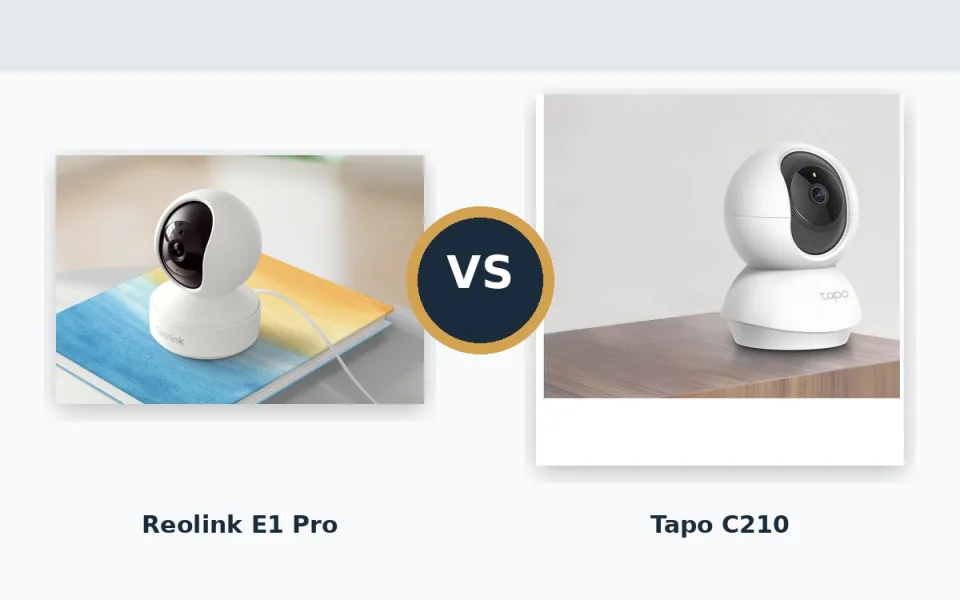
Both cameras are the same idea in plastic: a white ball head with a black lens face, on a short base, about 118 mm tall. The E1 Pro is a plain cylinder-based ball (Φ84 × 118 mm, 235 g); the C210 sits on Tapo's wider, bell-shaped base (85.4 × 86.8 × 117.7 mm) with the Tapo logo on the front. Neither looks out of place on a shelf, and both can mount on a wall or ceiling. On static field of view, only one side can be scored: the C210 publishes 98° diagonal / 83° horizontal / 45° vertical, while Reolink publishes no field of view for the current E1 Pro — a gap we flag rather than fill.

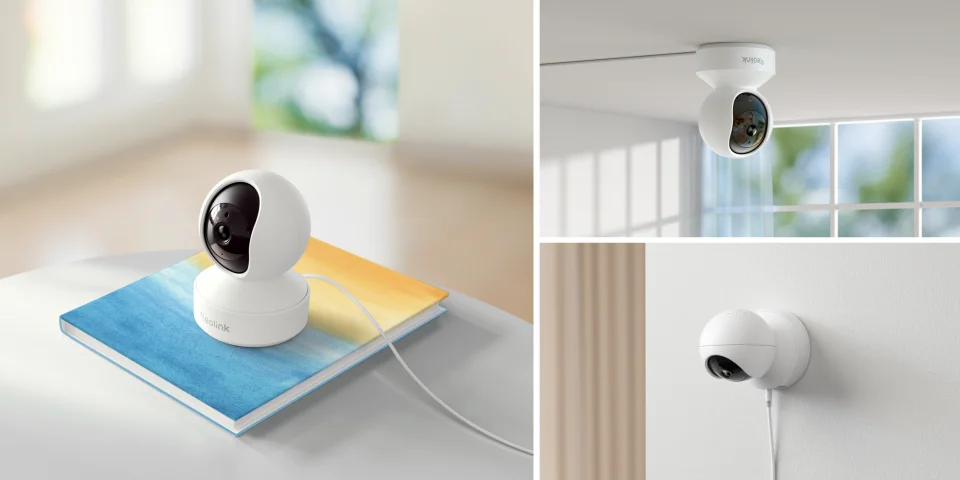
Movement is where the two genuinely diverge. Across the room, they are near-identical: the E1 Pro pans 355°, the C210 pans 340° mechanically for 360° of coverage — either way, one camera per room. Up and down, they are not close. The C210 tilts 70° mechanically for about 114° of vertical coverage; the E1 Pro tilts 50°. On a low shelf aimed slightly down at a play area, you will never notice. Mounted high — on top of a bookcase, or on a ceiling — the C210 can look down at the floor below it far more easily, while the E1 Pro needs a more careful mounting angle. Both models sit in our roundup of the best pan-and-tilt indoor cameras, and this tilt difference is the main reason the C210 stays competitive there despite its older sensor.
Video and night vision: 5MP and a brighter lens vs 3MP
This is the E1 Pro's home turf. Its 2880 × 1616 frame carries about 55% more pixels than the C210's 2304 × 1296 — Reolink's own framing of the gap over 3MP cameras — and those pixels sit behind the better lens: a 1/2.7-inch sensor at F1.6 against a 1/2.8-inch sensor at F2.0. Reolink says the F1.6 aperture draws in roughly twice the light of a standard F2.0 lens (a brand claim, attributed as such), which is the combination you want for the two hard indoor jobs: reading detail across a large room, and keeping faces clean in dim evening light before the infrared takes over. The C210 counters with frame rate on paper — its current datasheet lists up to 30 fps against the E1 Pro's 20 fps — which smooths motion but does not add detail. If you are still deciding whether the Pro premium makes sense inside the Reolink line itself, our Reolink E1 Pro vs Reolink E1 comparison works through that step-down.
At night, the contest levels out: both cameras are infrared-only, black-and-white, with auto-switching IR-cut filters, and neither has a spotlight or color night vision. If color at night is a must-have, neither of these is your camera — look at spotlight models instead. Between the two, the E1 Pro's brighter lens helps most in the in-between light at dusk; once both switch to infrared, expect similar monochrome pictures, and treat TP-Link's conflicting 30 ft vs 40 ft C210 range figures (see the source note) as a wash against Reolink's 40 ft rating.
Detection and tracking: pets separate them
Both cameras run their detection on-device and both cover the family basics: motion, person and baby-crying alerts, plus motion tracking that turns the head to follow the action — pan-only auto-tracking on the E1 Pro, and what Tapo calls precise motion tracking on the C210. Both offer activity zones, and the C210 adds customizable privacy (block) zones on top of its Privacy Mode, while the E1 Pro lists a Privacy Mode of its own.
The clean separator is pets. The E1 Pro lists a dedicated pet detection type alongside human and crying detection; the C210's official detection list stops at motion, person and baby-crying — there is no pet-specific label on any official C210 page, so this comparison does not credit it with one. The C210 will still alert you when your dog crosses the room, but it will file that alert as motion or person, not as a pet event. For a nursery-first camera, call it even. For a pet-first camera, the E1 Pro's labelled pet alerts — and the fewer irrelevant notifications that come with them — are a real, spec-sheet advantage.
Wi-Fi, Ethernet and connections: the Pro is built for harder networks
If the camera will live far from the router, this section decides the comparison. The E1 Pro connects on both 2.4 GHz and 5 GHz Wi-Fi (802.11ac), so it can move off the crowded 2.4 GHz band that microwaves, neighbors and a houseful of smart bulbs all share. The C210 is 2.4 GHz only (802.11b/g/n) — fine near the router, and the band with the longer reach, but with no second option when the band is congested. The E1 Pro also carries a wired escape hatch the C210 simply does not have: an RJ45 Ethernet port (data only — Reolink's FAQ is explicit that the camera does not support PoE, so it still needs its 5V power adapter). TP-Link's datasheet is equally explicit in the other direction: no Ethernet port on the C210.

Power differs too, in a small way that matters when a cable is lost or chewed: the E1 Pro runs on a common DC 5V/1A adapter, while the C210 uses a 9V barrel-plug adapter — neither is better electrically, but the Reolink's is the easier supply to replace. Both cameras speak Alexa and Google Assistant, and both list RTSP and ONVIF, which is more than most cameras at this level offer and keeps either one usable outside its own app.
Audio, storage and everyday use: a tie, with different escape routes
Everyday features are closely matched. Both cameras give you two-way audio through a built-in microphone and speaker — the C210 adds noise cancellation and an 88 dB siren (measured at 10 cm, per TP-Link's global spec table) — and both record to a microSD card up to 512 GB that you supply yourself. Neither camera requires a subscription for that local recording, which is why both anchor our guide to the best indoor cameras with no monthly fee.
Where they part is what happens beyond the card. The C210's beyond-the-card option is Tapo Care, TP-Link's paid cloud plan — simple, and a subscription. The E1 Pro instead lists Reolink NVR and Home Hub recording plus FTP/NAS upload alongside its card slot: more setup, but the footage stays on hardware you own, and a recorder keeps capturing even if someone takes the camera. Neither route is wrong; they suit different owners, and the spec table above keeps the two lists separate so you can see exactly which options belong to which camera.
Pros and cons
Reolink E1 Pro — pros
- Sharper 5MP (2880 × 1616) video on a larger 1/2.7-inch sensor with a brighter F1.6 lens
- Dedicated pet detection alongside human and crying detection
- Dual-band 2.4/5 GHz Wi-Fi plus an Ethernet port — two answers to a weak connection
- Recorder options beyond the card: Reolink NVR, Home Hub and FTP/NAS, plus RTSP/ONVIF
- 64 preset positions and a guard position for one-tap room checks
Reolink E1 Pro — cons
- Only 50° of tilt — high mounts need careful aiming compared with the C210
- No field of view published in the current US spec tab
- Infrared black-and-white night vision only — no color option
- Costs more, and an older 4MP E1 Pro still circulates — verify 2880 × 1616 before buying
Tapo C210 — pros
- About 114° of vertical coverage — the better high-mount and ceiling-mount view
- Same 512 GB microSD ceiling, baby-crying detection and motion tracking for less money
- Published field of view (98° diagonal) and up to 30 fps on the current datasheet
- Privacy zones as well as a Privacy Mode; 88 dB siren
Tapo C210 — cons
- 3MP sensor behind an F2.0 lens — visibly less detail to crop into than the E1 Pro
- No pet-specific detection type on TP-Link's official list
- 2.4 GHz Wi-Fi only and no Ethernet — no fallback on a congested network
- No US list price on official pages, and TP-Link's own tables conflict on night-vision range and digital zoom
Who should buy which?
Buy the Reolink E1 Pro if: this is your main living-room camera; you have a dog or cat and want alerts labelled as pet events; your 2.4 GHz band is crowded or the camera sits two rooms from the router; or you want recordings on an NVR, Home Hub or NAS you control. It is the better camera in absolute terms, and its $59.49 official-page price (checked October 23, 2026) is a fair premium for the sensor, lens and connectivity it buys.
Buy the Tapo C210 if: the camera will live up high — ceiling, tall shelf, above a doorway — where its roughly 114° vertical coverage does work the E1 Pro's 50° tilt cannot; if it is a nursery or second-room camera close to the router; or if you are already in the Tapo app with other Tapo devices and value that more than the extra resolution. Check its live retailer price on the day — TP-Link publishes no US list price, and the C210's street price is a large part of its appeal.
Skip both if: you need color night vision (both are infrared-only), outdoor weatherproofing (both are indoor-only), or battery power (both are corded). Those needs point to spotlight, outdoor or battery models instead.
FAQ
Which camera has the better picture, the Reolink E1 Pro or the Tapo C210?
On specifications, the E1 Pro: 2880 × 1616 (5MP) against 2304 × 1296 (3MP), a larger 1/2.7-inch sensor against 1/2.8-inch, and an F1.6 lens against F2.0. Expect more usable detail when you zoom into E1 Pro footage and cleaner images in dim light. The C210's counter is a higher maximum frame rate (30 fps on its current datasheet, against 20 fps), which smooths motion without adding detail. We did not hands-on test either camera; this is a spec-based judgement.
Can both cameras record without a subscription?
Yes. Both record to a microSD card up to 512 GB (card not included) with no subscription required. The C210's optional extra is Tapo Care cloud storage, which is a paid plan. The E1 Pro's optional extras are local: a Reolink NVR or Home Hub, or FTP/NAS upload. Neither camera needs any of those extras to record and alert.
Which is better for watching pets?
The E1 Pro, on the spec sheet: it lists a dedicated pet detection type next to human and crying detection, so pet movement can alert separately from everything else. The C210's official detection list is motion, person and baby-crying — it will still notify you when a pet moves (as a motion or person event), but it does not label pet events. Both cameras track motion and offer two-way audio for talking to the animal.
Which camera works better far from the router?
The E1 Pro. It supports both 2.4 GHz and 5 GHz Wi-Fi, so it can use the less crowded 5 GHz band near the router or 2.4 GHz at range, and it adds an Ethernet port for a fully wired connection (data only — it still needs its power adapter; there is no PoE). The C210 is 2.4 GHz Wi-Fi only, with no Ethernet port, so placement and band congestion matter more.
Is the Tapo C210's night vision better than the Reolink E1 Pro's?
Neither has color night vision — both are infrared, black-and-white designs with no spotlight. On range, Reolink rates the E1 Pro to 40 ft. TP-Link's own C210 material conflicts (40 ft / 12 m on the current datasheet and global table; 30 ft / 9 m in its US nursery copy and UK table), so we do not score night range for either side. In dim light before the infrared switches on, the E1 Pro's brighter F1.6 lens is the more meaningful difference.
Where to buy
Buy the E1 Pro from Reolink's official store first — it is the surest way to get the current 5MP model rather than the older 4MP version still circulating, and its page price was $59.49 when checked on October 23, 2026. For the C210, compare the official Tapo store listing with the big retailers on the day, since TP-Link publishes no US list price.
Reolink E1 Pro at Reolink's official US store
Reolink E1 Pro on Amazon (search results)
Comments
No notes yet. If you own one of these cameras, tell us what the spec sheet left out.