
Home / Reviews / Head-to-head
Reolink E1 Pro vs Reolink E1: Which Should You Buy?

Affiliate note: Bestindoorcam.com may earn a commission if you buy through a store link. That does not change which camera we prefer. Read how affiliate links and ads work and how we research and review cameras. As an Amazon Associate I earn from qualifying purchases.
TL;DR — Reolink E1 Pro vs Reolink E1 verdict
- Short answer: buy the Reolink E1 Pro if this is your main-room camera — it is sharper (5MP vs 4MP), sees better in low light through a brighter F1.6 lens, connects on both 2.4 GHz and 5 GHz Wi-Fi, can fall back to a wired Ethernet connection, and follows movement with auto-tracking. Buy the Reolink E1 if it is a second camera, a nursery camera on a budget, or sits close to your router — it keeps the same pan and tilt, the same smart detection and the same 512 GB local storage for roughly $29 less at Reolink's US store.
- What the two cameras share: the same white ball-on-base body family, the same 355° pan and 50° tilt, infrared night vision rated to 40 ft, motion, human, pet and crying detection, two-way audio, microSD recording up to 512 GB with no subscription required, Alexa and Google Assistant support, and a 2-year limited warranty.
- Where the E1 Pro wins: 2880 × 1616 resolution against 2560 × 1440, a larger 1/2.7-inch sensor and F1.6 lens against a 1/3-inch sensor and F2.0 lens, dual-band Wi-Fi, an Ethernet port, pan auto-tracking, a listed Privacy Mode, and Reolink's listed RTSP/ONVIF, NVR, Home Hub and FTP/NAS options.
- Where the E1 wins: price — $36.33 against $65.09 on Reolink's official US store when checked on October 22, 2026 (list prices $45.99 and $69.99; Reolink discounts frequently). It is also smaller and lighter (Φ73 × 106 mm, 158 g against Φ84 × 118 mm, 235 g), publishes a real field of view (84° horizontal / 45° vertical), and powers over USB-C.
- One warning: an older 4MP version of the E1 Pro still circulates at retailers. If you buy the Pro, check the listing says 2880 × 1616 and Φ84 × 118 mm before you pay — those two numbers separate the current 3K model from the old one.
- How to read this: a spec-based comparison built from Reolink's official US product pages for both cameras, checked in October 2026. We did not hands-on test either camera for this article.
Overview
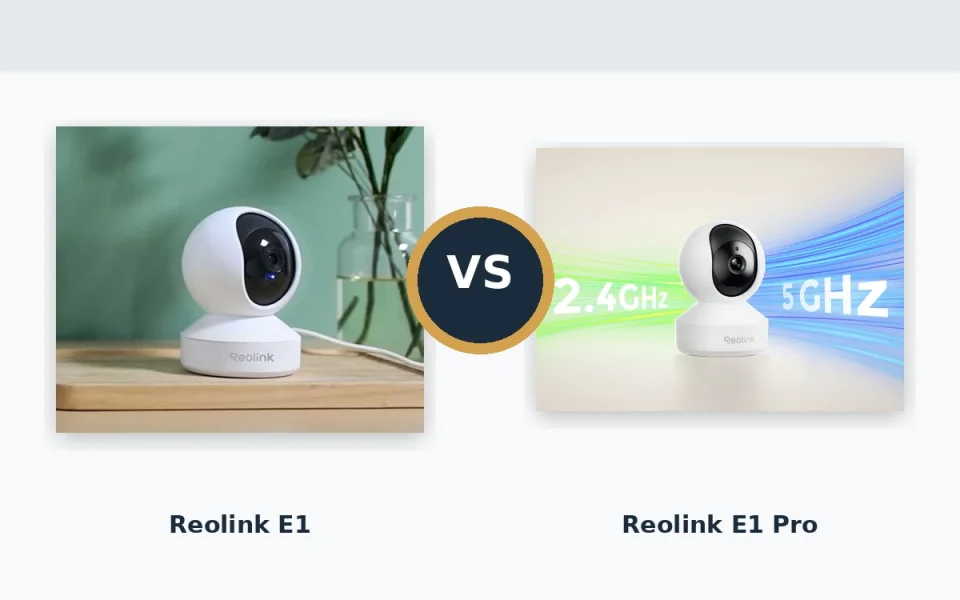
The Reolink E1 Pro and the Reolink E1 are the same idea at two prices: a small white pan-and-tilt ball camera that watches a room, turns to cover 355°, listens for a crying baby as well as watching for people and pets, and records to its own memory card so no subscription is involved. If you have read our Reolink E1 review and our Reolink E1 Pro review, you already know each camera separately — this head-to-head exists because Reolink's own E1 Pro FAQ reduces the choice to one line (the Pro is the 5MP, dual-band model; the E1 is 4MP and 2.4 GHz only), and the real decision needs a little more than that line.
Reolink prices the gap at about $29 on its US store at the time of writing, and the honest question is what that $29 buys. It buys four concrete things: a sharper sensor behind a brighter lens, a second Wi-Fi band plus a wired Ethernet option, auto-tracking, and a wider set of recorder and network options. It does not buy more movement, more detection types, or more storage — those are identical. So the verdict splits cleanly by placement: a main living-area camera that has to work hard on a busy network earns the Pro; a second room or a nursery near the router does not need it. The rest of this article works through the differences row by row.
Full spec comparison
| Specification | Reolink E1 Pro | Reolink E1 |
|---|---|---|
| Maximum resolution | 2880 × 1616 (5MP, 3K) at 20 fps | 2560 × 1440 (4MP) — main stream up to 20 fps, 15 fps default |
| Image sensor | 1/2.7-inch CMOS | 1/3-inch CMOS |
| Lens | f=4.0 mm, F1.6 | f=4.0 mm, F2.0 |
| Field of view | Not published in the current US spec tab — not quoted here | 84° horizontal / 45° vertical |
| Night vision | Infrared to 12 m (40 ft), 850 nm, auto-switching IR-cut | 8 × 850 nm IR LEDs, to 40 ft, auto-switching IR-cut |
| Pan / tilt | 355° pan / 50° tilt | 355° pan / 50° tilt |
| Auto-tracking | Yes — pan only | Not listed in its official spec table — treat movement as app-steered and preset-based |
| Smart detection | Motion, human, pet and crying detection | Motion, human, pet and crying detection |
| Audio | Two-way audio; built-in microphone and speaker | Two-way audio; built-in microphone and speaker |
| Local storage | microSD up to 512 GB (card not included) | microSD up to 512 GB (card not included) |
| Recorder / network options | RTSP, ONVIF, Reolink NVR, Home Hub and FTP/NAS listed | Not listed in the E1's official spec table — no RTSP/ONVIF/NVR claim is made for it here |
| Wi-Fi | Dual-band 2.4/5 GHz, 802.11ac | 2.4 GHz only, 802.11ax/b/g/n |
| Ethernet | Yes — 1 × RJ45 (data only, no PoE) | No |
| Privacy Mode | Yes, listed | Not listed in the E1 specifications checked for this article |
| Voice assistants | Google Assistant, Amazon Alexa | Amazon Alexa, Google Assistant |
| Power | DC 5V/1A, corded | DC 5V/1A, USB-C power port, corded |
| Dimensions / weight | Φ84 × 118 mm; 235 g | Φ73 × 106 mm; 158 g |
| Environment | Indoor only | Indoor only |
| Warranty | 2-year limited | 2-year limited |
| Official US store price | $65.09 (list $69.99), checked October 22, 2026 | $36.33 (list $45.99), checked October 22, 2026 |
Source note: all figures are from Reolink's official US product pages for the E1 Pro and the E1 (product and specifications tabs), checked October 2026. Store prices are the offers shown on those pages on October 22, 2026; Reolink discounts frequently, so treat them as prices at time of writing, not permanent MSRPs. Two honesty flags: Reolink does not publish a field of view for the current E1 Pro in its US spec tab, so none is quoted — figures attached to the older 4MP E1 Pro belong to a different model. And while the E1's product-page navigation uses an auto-tracking label, its spec table does not list auto-tracking, so this comparison does not credit the E1 with it.
Design, size and coverage: same ball, two sizes
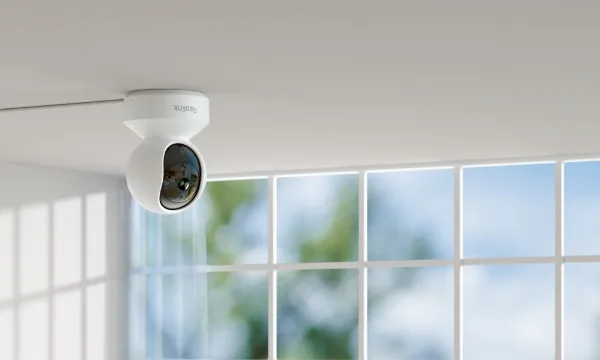
Side by side, the two cameras are easy to confuse at a glance and easy to separate with a tape measure. Both are a white ball head carrying a black lens face, sitting on a short Reolink-branded base that can stand on a shelf or mount upside down. The E1 Pro is simply the bigger unit: Φ84 × 118 mm and 235 g against the E1's Φ73 × 106 mm and 158 g. That size difference matters beyond shelf space — it is also the fastest physical check that a camera sold as an E1 Pro is the current model, because the older 4MP E1 Pro was smaller.
Coverage, on paper, is identical where it counts. Both heads pan 355° and tilt 50°, which in practice means one camera per room, placed in a corner or high on a shelf, with presets for the spots that matter — door, crib, sofa. That shared movement is a large part of why both models sit in our roundup of the best pan-and-tilt indoor cameras: in this price class, the pan-and-tilt itself is the feature, and neither Reolink asks you to pay extra for it.
The one coverage figure that separates them runs in the cheaper camera's favor. Reolink publishes a field of view for the E1 — 84° horizontal and 45° vertical — and does not publish one for the current E1 Pro in its US spec tab. We do not fill that gap with the older model's numbers. What can be said from the published specs is that both use a 4.0 mm fixed lens, and the meaningful optical differences are the sensor size and aperture covered in the next section, not a verified wider view on either side.
Video and night vision: the Pro's clearest win
This is the section the extra $29 is mostly paying for. The E1 Pro records 2880 × 1616 (5MP) through a 1/2.7-inch CMOS sensor; the E1 records 2560 × 1440 (4MP) through a smaller 1/3-inch sensor. In a still frame both are comfortably past the point where faces and license-plate-sized details in a living room are recognizable, but the Pro keeps more detail when you zoom into a recording — a face across a large room, a pet in the far corner — because it starts with roughly 30 percent more pixels on a larger sensor.
The lens widens the gap after dark. The Pro's F1.6 aperture admits noticeably more light than the E1's F2.0 before the infrared takes over — Reolink describes the F1.6 as letting in about twice the light of a standard F2.0 lens, and whatever the exact multiple, the direction is not in doubt: in dim rooms the Pro leans on its sensor longer, and in full darkness both cameras fall back on infrared rated to the same 40 ft, recording in black and white. Neither camera has a spotlight or color night vision, so after-dark color is not something the extra money buys here. If night color or a zoom lens is what would actually change your decision, the step up within the family is a different model entirely — see our Reolink E1 Zoom review for what the zoom version adds over both of these fixed-lens cameras.
Frame rate is a smaller Pro edge worth stating precisely: Reolink lists the E1 Pro at 20 fps at full resolution, while the E1's main stream runs up to 20 fps with a 15 fps default. In ordinary indoor use — people walking, pets moving, a baby in a crib — that difference is minor next to the resolution and lens gap, and it should not drive the decision on its own.
Wi-Fi, Ethernet and connections: the practical split
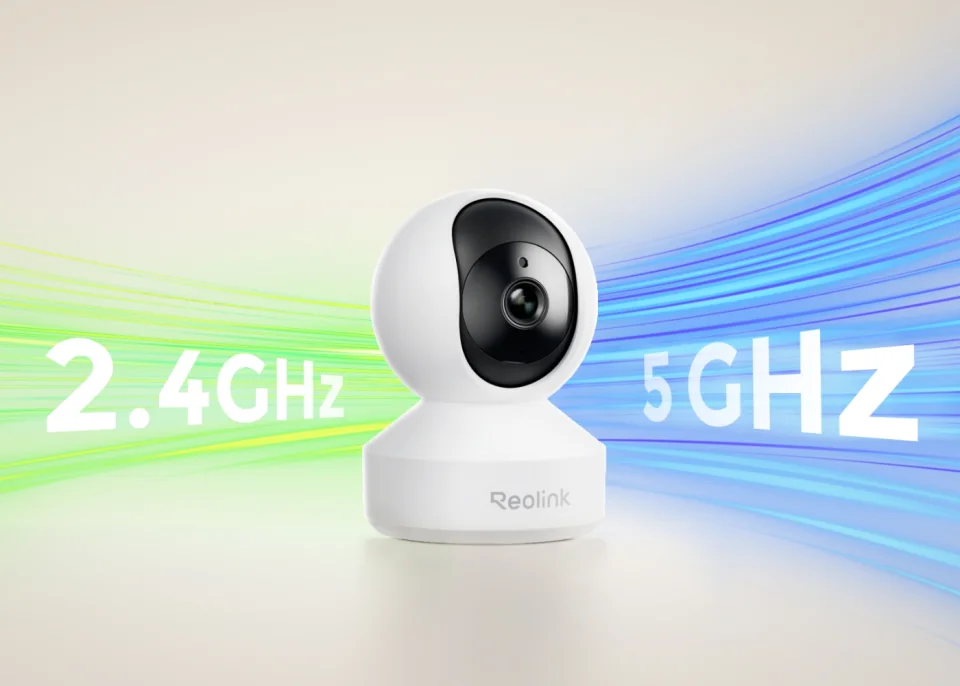
For many homes this section, not the video section, is the one that decides it. The E1 Pro is dual-band: it can join either a 2.4 GHz or a 5 GHz network (802.11ac). The E1 is 2.4 GHz only (802.11ax on that band). The 2.4 GHz band travels farther through walls, so a distant nursery camera may actually sit happier on the band both cameras share — but a camera in the same room as a busy router often gets a cleaner, less congested connection on 5 GHz, and the Pro is the only one of the two that can choose. If your 2.4 GHz band is crowded with smart-home devices, that choice is worth real money; if your router is close and your network is quiet, it is worth almost nothing, which is exactly the E1's case for existing.
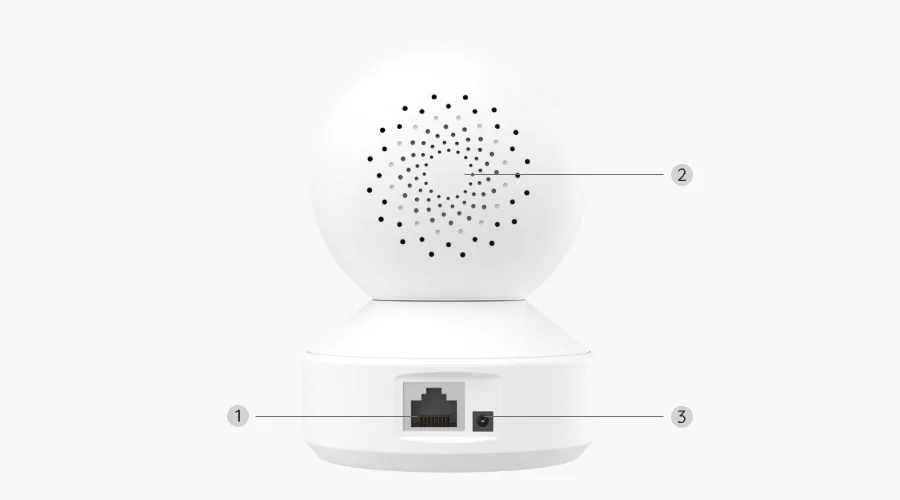
The Pro also carries the family's wired fallback: an RJ45 Ethernet port on the back of the base (data only — Reolink's FAQ is clear there is no Power over Ethernet, so the 5V adapter is still required). A wired run removes Wi-Fi from the reliability equation entirely for a camera that never moves, and it is simply absent from the E1, whose rear carries its USB-C power port and nothing else. The same pattern continues in the software connections: Reolink lists RTSP and ONVIF, its own NVRs, the Home Hub series and FTP/NAS recording for the E1 Pro, while the E1's official spec table lists none of those — so buyers planning to feed a recorder or a NAS should treat the Pro as the only verified option of the two, and not rely on retailer tables that credit the base E1 with protocols Reolink does not publish for it.
Detection and tracking: same alerts, one follows you
The alert set is identical, and that is the E1's strongest argument. Both cameras detect motion, people, pets and crying, and both do it as camera features — neither model puts person, pet or baby-crying alerts behind a subscription, which is why both also appear in our guide to the best indoor cameras with no monthly fee. A nursery camera that charges monthly to tell you the baby is crying would be a poor deal at any price; neither of these does.
What the Pro adds is follow-through. Its spec table lists auto-tracking — pan only — so when a person or pet crosses the room, the camera turns to keep them in frame instead of recording them walking out of it. The E1's spec table does not list auto-tracking, so plan on steering it from the app or cycling it through saved viewpoints: effective for checking a room, less effective for keeping a wandering toddler centered while you are watching live. Reolink also lists a Privacy Mode for the E1 Pro, a quick way to stand the camera down when the room is occupied; no equivalent is listed in the E1 specifications checked for this article. If tracking is the feature you came for, the comparison is already over — it is a Pro-only row in this pairing.
Audio, storage and everyday use: a genuine tie
Two-way audio is standard on both cameras — built-in microphone and speaker, talk back from the Reolink app — and so is the storage deal, which is the same to the gigabyte: a microSD slot accepting cards up to 512 GB, motion-triggered, scheduled or continuous recording, and no subscription required for any of it. The card is not included with either camera, so budget for one either way. Both work with Google Assistant and Amazon Alexa for voice control and smart-display viewing, both run on a 5V/1A adapter (the E1 through a USB-C port), and both carry Reolink's 2-year limited warranty. Both are indoor cameras with no weather rating.

In other words, the everyday experience — check the room, get a person or crying alert, talk back, look at last night's recording — is the same product on both sides of this comparison. The $29 does not buy a better app, better alerts or more storage. It buys the sharper, better-connected, tracking camera underneath that experience, which is why placement and network, not features, should make the call.
Pros and cons
Reolink E1 Pro
Pros
- Sharper 5MP (2880 × 1616) video on a larger 1/2.7-inch sensor, with a brighter F1.6 lens for low light
- Dual-band 2.4/5 GHz Wi-Fi plus an Ethernet port — three ways to get a reliable connection
- Auto-tracking (pan) listed in its official specs, plus a listed Privacy Mode
- Recorder-friendly: RTSP, ONVIF, NVR, Home Hub and FTP/NAS options listed by Reolink
- Same 512 GB subscription-free local storage and full detection set as the E1
Cons
- Roughly $29 more than the E1 at Reolink's US store for the same movement, detection and storage
- No field of view published in the current US spec tab
- Bigger and heavier (Φ84 × 118 mm, 235 g) — and an older 4MP namesake still circulates at retailers
- No PoE despite the Ethernet port; the 5V adapter is still required
- Indoor only, no spotlight and no color night vision — shared with the E1
Reolink E1
Pros
- Same 355°/50° pan and tilt, same human, pet and crying detection, same 512 GB local storage — for $36.33 at Reolink's US store
- Still a genuine 4MP camera with 40 ft infrared night vision, not a cut-down 1080p model
- Smaller and lighter (Φ73 × 106 mm, 158 g), with a published 84°/45° field of view
- USB-C power and 2.4 GHz Wi-Fi that reaches farther through walls than 5 GHz
- No subscription needed for its smart alerts or local recording
Cons
- 2.4 GHz Wi-Fi only — no 5 GHz option and no Ethernet fallback if the connection struggles
- No auto-tracking in its official spec table; movement is app-steered or preset-based
- Smaller 1/3-inch sensor and slower F2.0 lens — less detail and less low-light headroom than the Pro
- No RTSP, ONVIF or NVR support listed in its official specifications
- Indoor only, and the microSD card is sold separately — shared with the Pro
Who should buy which — and the verdict
Buy the Reolink E1 Pro if this camera is the main eye on a living area, an entry hall or a pet's room: the 5MP detail, the F1.6 lens, auto-tracking and the choice of 5 GHz or a wired Ethernet run make it the camera that keeps working when the room is large, the light is low or the network is busy. It is also the only verified choice of the two for anyone feeding an NVR, a Home Hub or a NAS. Our Reolink E1 Pro review covers the current 3K version in full, including the older-model warning in detail.
Buy the Reolink E1 if the camera is a second eye — a nursery near the router, a child's room, a hallway — where its identical detection, movement and storage do the whole job and its weaker rows never get tested. Saving the $29 here and spending it on a large microSD card is a perfectly rational build. Our Reolink E1 review covers where its 4MP ceiling starts to show.
Buy neither if you need color night vision, a spotlight, optical zoom, outdoor use or Apple HomeKit — neither camera offers any of those on its official specifications.
Verdict: the E1 Pro is the better camera and the E1 is the better value, and unusually, both statements are easy to defend from the same spec sheet. Everything a casual buyer touches daily — movement, alerts, storage, app — is shared. Everything the Pro adds is infrastructure: resolution headroom, light headroom, connection headroom, tracking. Put the camera somewhere that infrastructure gets used and the Pro earns its $29; put it somewhere it does not and the E1 is the same experience for less.
FAQ
What is the main difference between the Reolink E1 Pro and the Reolink E1?
Resolution and connectivity. The current E1 Pro records 2880 × 1616 (5MP) through an F1.6 lens, connects on dual-band 2.4/5 GHz Wi-Fi or Ethernet, and adds pan auto-tracking. The E1 records 2560 × 1440 (4MP) through an F2.0 lens and connects on 2.4 GHz Wi-Fi only. Pan, tilt, detection types and the 512 GB microSD ceiling are the same on both — Reolink's own E1 Pro FAQ summarizes it as 5MP plus dual-band versus 4MP plus 2.4 GHz.
Does the Reolink E1 have auto-tracking?
It is not listed in the E1's official spec table, so this comparison does not credit it with auto-tracking: plan on steering the E1 from the app or using saved viewpoints. The E1 Pro's spec table lists auto-tracking explicitly — pan only — which is one of the concrete things its higher price buys.
Do either of these cameras need a subscription?
No. Both record to a microSD card up to 512 GB (sold separately) with motion, human, pet and crying detection included as camera features, and no subscription is required for local recording on either model. The E1 Pro additionally lists NVR, Home Hub and FTP/NAS recording options.
How do I avoid buying the older 4MP E1 Pro by mistake?
Check two numbers in the listing before paying: the current US E1 Pro records at 2880 × 1616 and measures Φ84 × 118 mm. The older version still circulating at retailers is a 2560 × 1440 camera in a smaller body. If a listing shows 4MP or the smaller dimensions, it is the old model regardless of the name on the box.
Which one should I buy for a nursery?
Either hears the baby — both list crying detection, plus human and pet detection, with two-way audio for talking back. Choose the E1 if the nursery is reasonably close to the router and you want the lower price; choose the E1 Pro if the nursery is far from the router, your 2.4 GHz band is crowded, or you want auto-tracking as the baby becomes a mobile toddler. In a weak-signal room, the Pro's 5 GHz option and Ethernet port are the deciding features.
Where to buy
Reolink discounts both cameras frequently, so compare the store price on the day you buy against the figures quoted here — and whichever you choose, budget for a microSD card, since neither box includes one. If you buy the Pro, re-check the 2880 × 1616 resolution in the listing first (see the FAQ above).
- Reolink E1 Pro at Reolink — check price
- Reolink E1 at Reolink — check price
- Reolink E1 Pro at Amazon — check price
- Reolink E1 at Amazon — check price
#reolink e1 pro #reolink e1 #reolink #pan tilt camera #indoor camera comparison
Comments
No notes yet. If you own one of these cameras, tell us what the spec sheet left out.