
Home / Reviews / Head-to-head
Ring Indoor Cam 4K vs Ring Indoor Cam Plus: Which Should You Buy?

Affiliate note: Bestindoorcam.com may earn a commission if you buy through a store link. That does not change which camera we prefer. Read how affiliate links and ads work and how we review.
Overview
Ring now sells two fixed indoor cameras that look like close relatives and share most of their spec sheet. The Indoor Cam Plus is the 2025 model — Ring's own FAQ confirms it is the renamed Indoor Cam 2K, same camera under a new name. The Indoor Cam 4K, released in October 2026, is Ring's first home-focused 4K indoor camera. This comparison is based entirely on Ring's published specifications; we have not hands-on tested either camera.
If you want the full breakdown of either model on its own, start with our Ring Indoor Cam 4K review and our Ring Indoor Cam Plus review. The short version: the bodies, the view and the privacy hardware are near-identical. The decision is really about resolution, Wi-Fi and price.
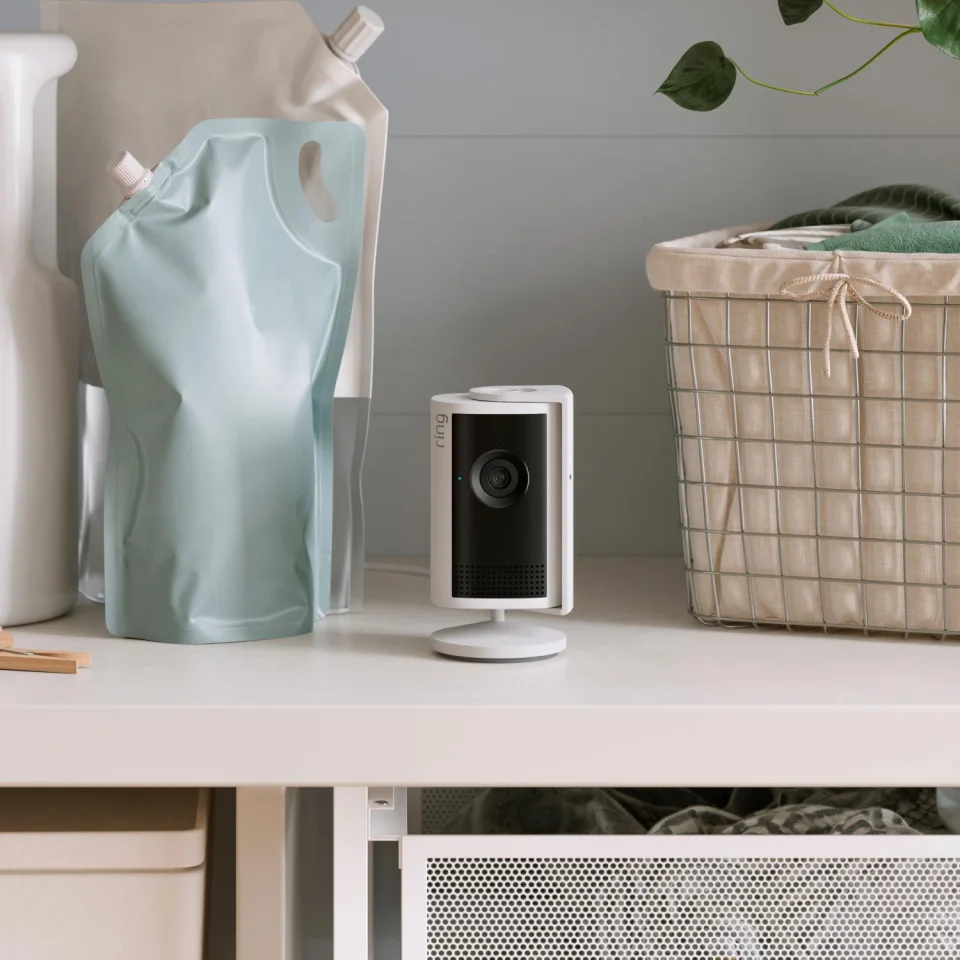
Side-by-side specifications
| Spec | Ring Indoor Cam 4K | Ring Indoor Cam Plus |
|---|---|---|
| Price (US, Ring.com) | $99.99 plug-in | $59.99 plug-in |
| Release | October 2026 | 2025 (as Indoor Cam 2K) |
| Video resolution | Retinal 4K, 3840×2160, with Auto HDR | Retinal 2K, 2560×1440, with Low-Light Sight |
| Enhanced Zoom | Up to 10x | Up to 4x |
| Field of view | 115° horizontal, 60° vertical | 115° horizontal, 60° vertical |
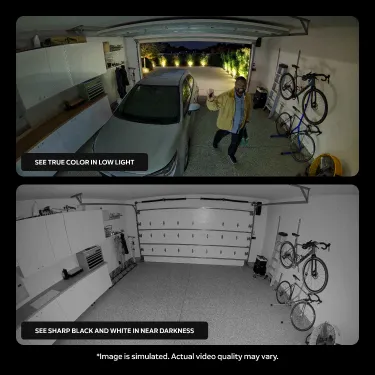
| Night vision | True colour in low light; black-and-white in near darkness | Low-Light Sight: true colour in low light; black-and-white in total darkness |
| Motion detection | Advanced Motion Detection with customisable motion zones | Advanced Motion Detection with customisable motion zones |
| Privacy | Detachable lens cover (blocks view, muffles mic); mic can be fully disabled in the Ring app | Detachable lens cover (blocks view, muffles mic); mic can be fully disabled in the Ring app |
| Audio | Two-way talk with advanced noise cancellation | Two-way talk with noise cancellation |
| Siren | Remote-activated security siren | Remote-activated security siren |
| Wi-Fi | Dual-band Wi-Fi 6 (2.4GHz / 5GHz) | Wi-Fi 4, single-band 2.4GHz only |
| Internet requirement | Minimum 15Mbps upload recommended; at least 20Mbps for the best 4K experience | Minimum 5Mbps upload for optimal performance |
| Power | 2m USB-A to USB-C cable, 10W USB-A adapter (5V, 1.5A input); PoE version available separately | 6.5ft USB-A to USB-C cable, 10W USB-A adapter; 10ft cable sold separately |
| Mounting | Tabletop, wall or ceiling; mounting plate included | Tabletop, wall or ceiling; mounting hardware included |
| Dimensions | 5.0 × 5.0 × 9.85cm | 1.97 × 1.97 × 3.80in (5 × 5 × 9.7cm) |
| Colours | White, Black | White, Black |
| Operating conditions | -20.5°C to 48.5°C (-5°F to 120°F) | -20°C to 45°C (-4°F to 113°F), indoor use only |
| Local storage | None | None |
| Warranty | One-year limited warranty; software security updates for at least 4 years | One-year limited warranty |
Specs verified against Ring's official product pages and tech specs on ring.com (Indoor Camera 4K and Indoor Cam Plus / Indoor Cam 2K pages, checked October 2026), cross-checked against the two existing reviews on this site. US prices are the list prices shown on Ring's US store. Ring does not publish a diagonal field-of-view figure in the tech specs checked for either model, so none is claimed here.
Key differences
Resolution and zoom: 4K and 10x vs 2K and 4x
This is the headline gap. The Indoor Cam 4K captures 3840×2160 — roughly 2.25 times the pixels of the Plus's 2560×1440 — and pairs it with Auto HDR, which Ring says balances bright windows and dark corners in the same frame, and with up to 10x Enhanced Zoom. The Plus counters with up to 4x Enhanced Zoom, which is still a clear step up from 1080p when you pinch into a clip. In practice, on Ring's published numbers, the 4K model's advantage shows up when you zoom after the fact or need detail across a large room; for a live check-in on a phone screen, 2K is already sharp.
Field of view: identical
There is no coverage difference to pay for. Both cameras are listed at 115° horizontal and 60° vertical, both are fixed — neither pans or tilts — and both use a swivel mount for tabletop, wall or ceiling placement. If one fixed camera cannot cover your room, spending more on the 4K model will not fix that; a moving camera will. Our Ring Pan-Tilt Indoor Cam 2K review covers Ring's rotating alternative.
Privacy cover: the same detachable lens cover on both
Despite some launch coverage describing a "privacy shutter" on the 4K model, Ring's own pages describe the same hardware on both cameras: a detachable lens cover included in the box. You slide it in front of the lens to block the camera's view; it muffles the microphone rather than switching it off. For complete audio privacy on either camera, you fully disable the microphone in the Ring app. Neither camera has the built-in cover that physically cuts both camera and microphone the way Ring's pan-tilt model does, so privacy is a tie here.
Wi-Fi and bandwidth: Wi-Fi 6 dual-band vs Wi-Fi 4, 2.4GHz only
The 4K model connects on dual-band Wi-Fi 6 (2.4GHz and 5GHz); the Plus is Wi-Fi 4 on the 2.4GHz band only. That matters in two directions. The 5GHz option gives the 4K camera a faster, less congested path for a much larger stream — but the stream is larger: Ring recommends at least 15Mbps upload for the 4K camera and 20Mbps for the best experience, while the Plus asks for 5Mbps. Both cameras use adaptive bitrate streaming and will step quality down if bandwidth cannot keep up, which means a 4K camera on a weak connection can quietly stop delivering 4K. Multiple cameras multiply the upload requirement on either model.
Price: $99.99 vs $59.99
At US list prices on ring.com, the gap is exactly $40 per camera — and it scales. Four rooms cost $399.96 in 4K or $239.96 in Plus before any subscription. The Plus is also the older model and is discounted more often, which can widen the real-world gap further. The 4K model is also sold in a Power-over-Ethernet version, sold separately, for wired installs; the Plus is plug-in only.
Subscription: identical, and effectively mandatory for recordings
Nothing separates the two here, and it is the biggest shared caveat. Without a paid Ring plan, both cameras give you Live View, two-way talk and real-time motion notifications — but you cannot review, save or share any recorded video, and there is no local storage slot on either model to work around that. Subscription-powered features such as video history (up to 180 days on Ring's current plans), Video Search and Video Descriptions apply the same way to both. If a monthly fee is a deal-breaker regardless of resolution, neither camera is the answer — see our guide to the best indoor cameras with no monthly fee instead.
Pros and cons
Ring Indoor Cam 4K — pros
- True 3840×2160 resolution — the sharpest fixed indoor camera Ring lists
- Auto HDR for high-contrast rooms with bright windows
- Up to 10x Enhanced Zoom for reading detail at a distance
- Dual-band Wi-Fi 6, with a PoE version available separately
- Advanced noise cancellation on two-way talk
Ring Indoor Cam 4K — cons
- $99.99 — $40 more per camera than the Plus
- Needs 15–20Mbps upload to deliver its headline quality
- No local storage; recordings require a paid Ring plan
- Fixed view, exactly the same 115° coverage as the cheaper model
Ring Indoor Cam Plus — pros
- 2560×1440 2K detail with 4x Enhanced Zoom at $59.99, often discounted
- Low-Light Sight colour video in dim rooms
- Modest 5Mbps upload requirement — workable on far more connections
- Same field of view, lens cover, siren and motion zones as the 4K model
Ring Indoor Cam Plus — cons
- 2.4GHz Wi-Fi 4 only — no 5GHz band
- Less detail when zooming into recorded footage
- No local storage; recordings require a paid Ring plan
- Fixed view; no pan or tilt
Who should buy which
Buy the Indoor Cam 4K if you review footage and zoom into it — checking a face across a large room, reading a detail after an event — and your internet upload can genuinely sustain 15–20Mbps per camera on top of everything else your household uploads. It is also the natural match if the rest of your Ring system is already 4K. Both models sit in our roundup of the best indoor security cameras of 2026, where the wider field is compared.
Buy the Indoor Cam Plus if you mainly check in live, watch a nursery, entryway or living room of ordinary size, or are buying several cameras. You keep the same coverage, the same privacy cover and the same app, you halve-to-third the bandwidth demand, and you save $40 a room. On the published specs, that is the rational default for most homes.
Buy neither if you refuse subscriptions on principle — without a plan, both are live-view cameras with no memory — or if a single camera must sweep a whole room, which is a pan-tilt job, not a resolution job.
FAQ
Is the Ring Indoor Cam 4K worth $40 more than the Plus?
Only if you will use what the $40 buys: 3840×2160 detail, Auto HDR, 10x zoom and Wi-Fi 6 — and only if your upload speed can feed it. Ring recommends 15Mbps minimum and 20Mbps for the best 4K experience. On a slower connection the camera adapts its bitrate down, and you have paid for resolution you are not receiving. For live check-ins, the Plus at $59.99 is the better value on Ring's own numbers.
Do the two cameras see the same amount of a room?
Yes. Ring lists both at 115° horizontal and 60° vertical, and both are fixed cameras on a swivel mount. The 4K model sees more detail within that view, not more of the room.
Is the Indoor Cam Plus the same as the Indoor Cam 2K?
Yes. Ring's FAQ answers this directly: "What's the difference between Indoor Cam Plus and Indoor Cam 2K? Nothing. We changed the name, but the features remain the same." Listings under either name describe the same 2025 camera.
Does either camera work without a Ring subscription?
Partly. Per Ring, Live View, two-way talk and real-time motion notifications work without a plan on both models. But neither camera can review, save or share recorded video without a paid subscription, and neither offers local storage — so for any recording at all, budget for the plan on top of either price.
How does the lens cover differ between the two?
It doesn't, on Ring's published pages. Both ship with a detachable lens cover that slides in front of the lens, blocks the view and muffles the microphone. On both, complete audio privacy requires disabling the microphone in the Ring app.
A buying check before you order the Plus: Ring's own US store page for the Indoor Cam Plus has, at the time of writing, displayed an older 1080p HD listing under a similar name, while Ring's help center specs for the current Indoor Cam Plus (2nd Gen) list 2560x1440 2K video — the model compared here and the one covered in our standalone Plus review. Check the resolution on the exact listing before you buy, especially on marketplace listings.
Where to buy
Ring Indoor Cam 4K on Ring.com: Ring Indoor Camera 4K — ring.com (US list price $99.99 for the plug-in version at the time of writing; the page linked here is Ring's official product page)
Ring Indoor Cam Plus on Ring.com: Ring Indoor Cam Plus — ring.com (US list price $59.99 at the time of writing; listings may use the Indoor Cam 2K name for the same camera)
Check both on Amazon: Ring Indoor Cam 4K — amazon.com and Ring Indoor Cam Plus — amazon.com (confirm the exact model name on the listing before buying)
Prices change frequently and the Plus in particular is discounted often; the links above carry no affiliate tags. The $99.99 and $59.99 figures are the US list prices shown on Ring's US store at research time.
#ring indoor cam 4k ring indoor cam plus ring comparison 2k vs 4k indoor camera
Comments
No notes yet. If you own one of these cameras, tell us what the spec sheet left out.