
Home / Reviews / Head-to-head
Ring Indoor Cam 4K vs Ring Pan-Tilt Indoor Cam 2K: Fixed Detail or Full-Room Coverage?

Affiliate note: Bestindoorcam.com may earn a commission if you buy through a store link. That does not change which camera we prefer. Read how affiliate links and ads work and how we review.
Overview
Ring released these two indoor cameras side by side in October 2026, and they are built around opposite answers to the same question: what should one indoor camera do? The Indoor Cam 4K answers "see one spot as clearly as possible." The Pan-Tilt Indoor Cam 2K answers "see the whole room, even when the action moves." Everything else — price, bandwidth, night vision, privacy hardware — follows from that split.
If you want each camera judged on its own first, our Ring Indoor Cam 4K review covers the fixed model's specs and bandwidth demands in full, and our Ring Pan-Tilt Indoor Cam 2K review does the same for the pan-tilt model, including a pan/tilt figures discrepancy on Ring's own page that this comparison also flags below.
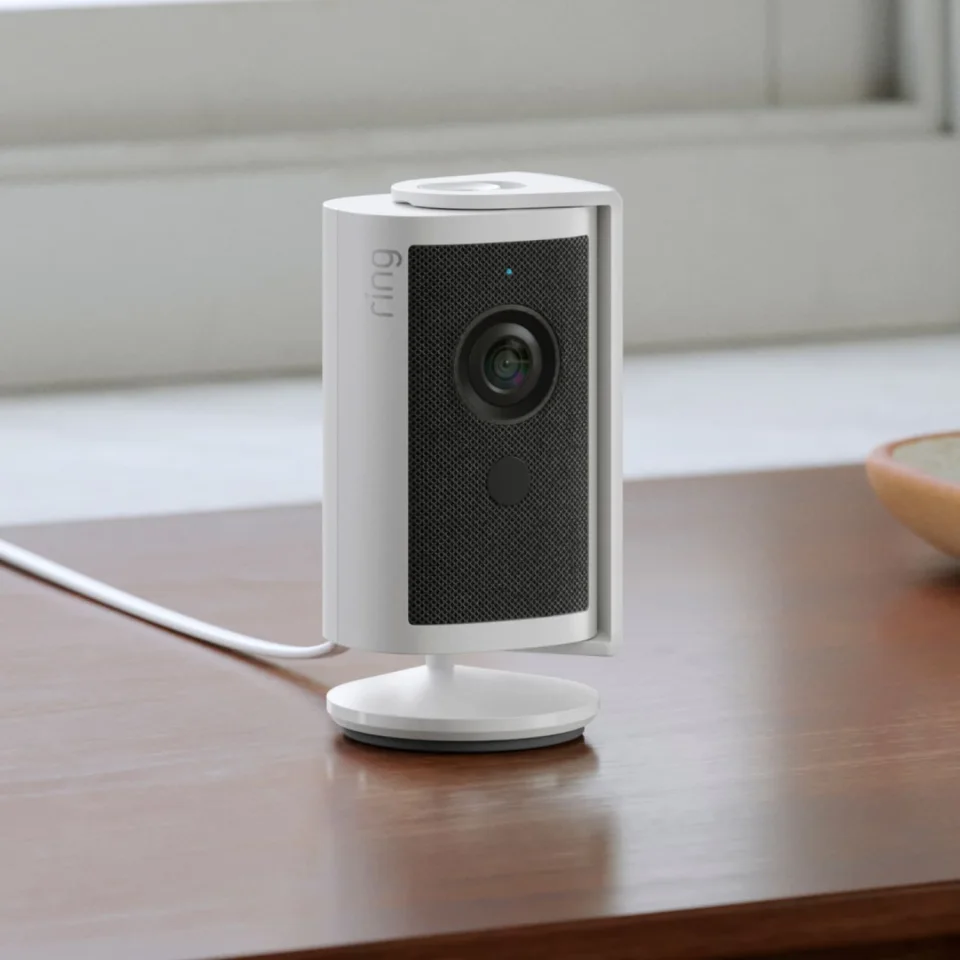
One shared reality before the differences: both are plug-in USB-C cameras for indoor use, both work with the Ring app and Alexa, both offer two-way talk, and both sit inside Ring's subscription model. There is no microSD slot or local-recording option listed in either camera's official tech specs, so if you want to review, save or share recordings from either one, budget for a Ring plan on top of the hardware price.
Side-by-side specifications
| Spec | Ring Indoor Cam 4K | Ring Pan-Tilt Indoor Cam 2K |
|---|---|---|
| Price (Ring.com, plug-in) | $99.99 (Power-over-Ethernet version $149.98) | $69.99 |
| Release | 2026 — launched October 2026 | 2026 release — launched October 2026 |
| Video resolution | Retinal 4K, 3840×2160, with Auto HDR | Retinal 2K, 2560×1440; WDR (per Ring FAQ) |
| Enhanced Zoom | Up to 10x | Up to 6x |
| Coverage / field of view | Fixed: 115° horizontal, 60° vertical — no pan or tilt | Motorized pan/tilt: 360° pan, 175° tilt per tech specs (see discrepancy note below); lens field of view 115° horizontal × 60° vertical per Ring FAQ |
| Auto tracking | No — fixed view | Yes — AI-powered; follows one person or pet at a time, up to about 1.2 m/s at about 6.5 ft; returns to saved home position |
| Night vision | True-color video in low light; sharp black-and-white in near darkness | Infrared, black-and-white only |
| Motion detection | Advanced Motion Detection with customizable motion zones | Real-time motion alerts (tech-specs wording) |
| Privacy | Detachable lens cover in the box — blocks the view and muffles the mic; full audio privacy needs the mic disabled in the Ring app | Built-in privacy shutter — one slide physically disables camera AND microphone; cannot be lost |
| Audio | Two-way talk with advanced noise cancellation | Two-way talk |
| Siren | Remote-activated siren (listed in Ring's product/compare specs) | Remote-activated siren (listed in Ring's compare table; not a separate tech-specs row) |
| Wi-Fi | Dual-band Wi-Fi 6 (2.4 GHz / 5 GHz) | Wi-Fi 4, single-band 2.4 GHz only |
| Recommended upload speed | Minimum 15 Mbps; at least 20 Mbps for the best 4K experience; adaptive bitrate if bandwidth drops | Minimum 5 Mbps |
| Power | Plug-in: 6.5 ft USB-C cable + power adapter, 5V 1.5A input (US tech specs); PoE version available separately | Plug-in USB-C; 10 ft USB-C charge cable in the box |
| Mounting | Tabletop, wall or ceiling; swivel mount, mounting plate included | Tabletop, wall or ceiling; mounting plate + wall bracket in the box |
| Dimensions | 1.97 × 1.97 × 3.88 in (5.0 × 5.0 × 9.85 cm) | 2.6 × 2.6 × 5.19 in (66 × 66 × 131.8 mm, without cable and bracket) |
| Colors | White, Black | White, Black |
| Operating conditions | -5°F to 120°F (-20.5°C to 48.5°C) | -4°F to 113°F (-20°C to 45°C) |
| Local storage | None listed in Ring's tech specs | None listed in Ring's tech specs |
| Subscription | Not required for Live View, two-way talk or real-time alerts; required to review, save or share video, and for features such as 24/7 recording, Video Descriptions, Video Search and Familiar Faces (up to 180 days of video history) | Same model: Live View, two-way talk and alerts without a plan; video history, 24/7 recording and AI features require a paid plan |
| Warranty | One-year limited warranty | One-year limited warranty |
Specs verified against Ring's official US product pages — ring.com/products/indoor-cam-4k and ring.com/products/pan-tilt-indoor-cam-2k — in October 2026, cross-checked against our two existing single-camera reviews. Two honesty flags: (1) Ring's own Pan-Tilt page disagrees with itself on coverage — the tech specs list 360° pan / 175° tilt while the page's FAQ text says 350° pan / 115° tilt, so treat the exact pan/tilt figures as approximate until Ring reconciles them; the table uses the tech-specs figures. (2) Ring's Pan-Tilt FAQ also answers its "what resolution" question with the 115° × 60° field-of-view figures — that lens figure is used above as field of view, not resolution; the resolution is 2560×1440.
Key differences
Fixed 4K detail vs moving 2K coverage
This is the whole decision. The Indoor Cam 4K packs four times the pixels of 1080p into a fixed frame, adds Auto HDR for rooms where a bright window sits next to a dark corner, and lets you zoom in up to 10x — the combination that matters when the point of the camera is reading a detail later: a face at the door, a label on a counter, what a pet actually knocked over. The cost of that sharpness is that the frame never moves. Anything outside its 115° horizontal view simply is not recorded.
The Pan-Tilt 2K makes the opposite trade. Its 2560×1440 frame is a clear step below 4K and its zoom tops out at 6x, but the motorized head can turn to cover the room around it, so a single camera in a corner is not limited to one slice of it. If your shortlist is really about whole-room coverage, it also belongs in the wider field covered by our best pan-and-tilt indoor cameras roundup, where its 2K sensor and shutter stand out against mostly-1080p rivals.
Auto tracking: present on one, absent on the other
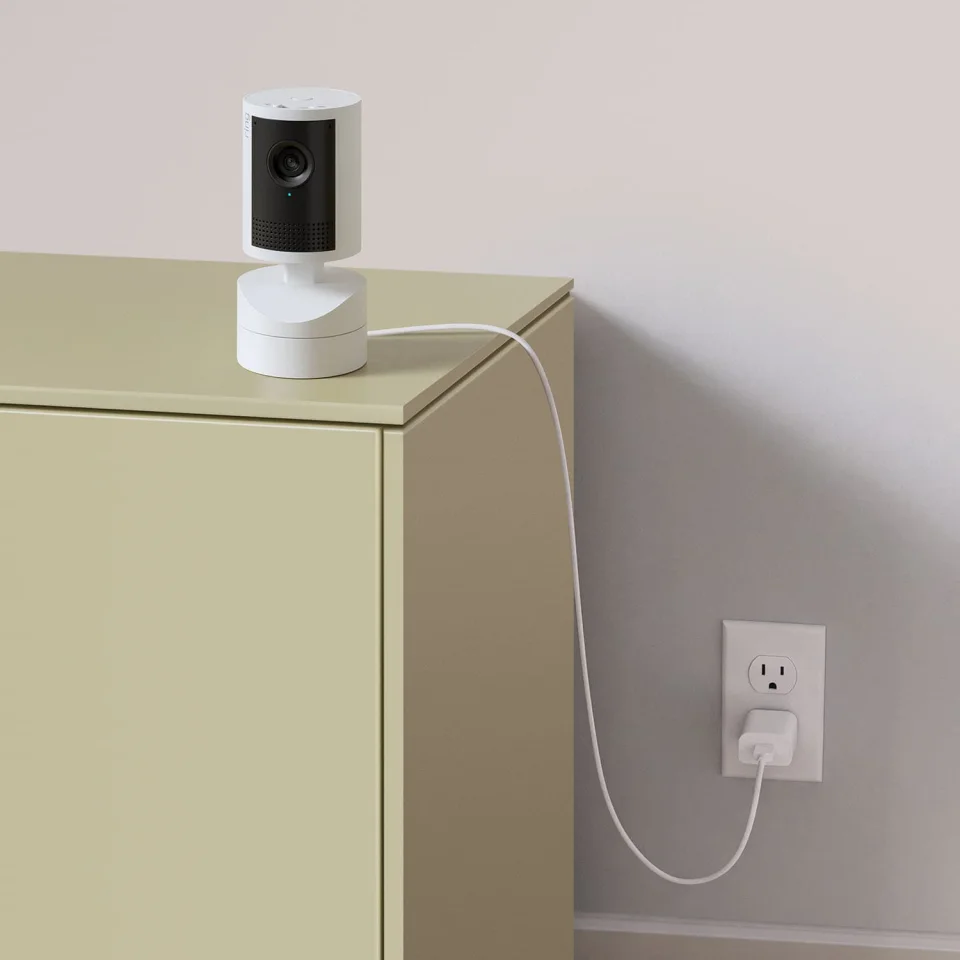
Only the Pan-Tilt tracks. Per Ring, when a person or pet is detected, Auto Tracking rotates the camera to keep them in frame during Live View and recordings, then returns to your saved home position when the event ends. Ring's own limits are worth knowing before you buy for this feature: it tracks one subject at a time (switching to the next detected person if the first leaves the frame), at walking speeds up to about 1.2 m/s at roughly 6.5 feet. A busy room with several people moving at once is exactly the case it is not built for. The 4K, being fixed, has no equivalent — its answer to movement is a wide, sharp, unmoving frame.
Night vision and light handling
The 4K wins after dark on paper, and it is not close. Ring specs it with true-color video in low light (switching to sharp black-and-white only in near darkness) plus Auto HDR in daylight contrast. The Pan-Tilt's night vision is infrared black-and-white, and its light-balancing feature is WDR rather than the 4K's Auto HDR. If the camera's job includes a dim nursery, hallway or garage-side room, that difference alone can decide this comparison.
Wi-Fi and bandwidth: the hidden price of 4K
The spec gap most buyers feel daily is not resolution — it is the network. The 4K pairs dual-band Wi-Fi 6 with a steep appetite: Ring recommends a minimum 15 Mbps upload and at least 20 Mbps for the best 4K experience, with adaptive bitrate stepping quality down if your connection cannot keep up. The Pan-Tilt asks for just 5 Mbps upload, but gives you fewer tools to deliver it: Wi-Fi 4 on 2.4 GHz only, with no 5 GHz band to escape to on a congested network. In short, the 4K needs a strong connection and is built to use one; the Pan-Tilt needs very little and has no upgrade path if its one band is crowded.
Privacy hardware: detachable cover vs built-in shutter
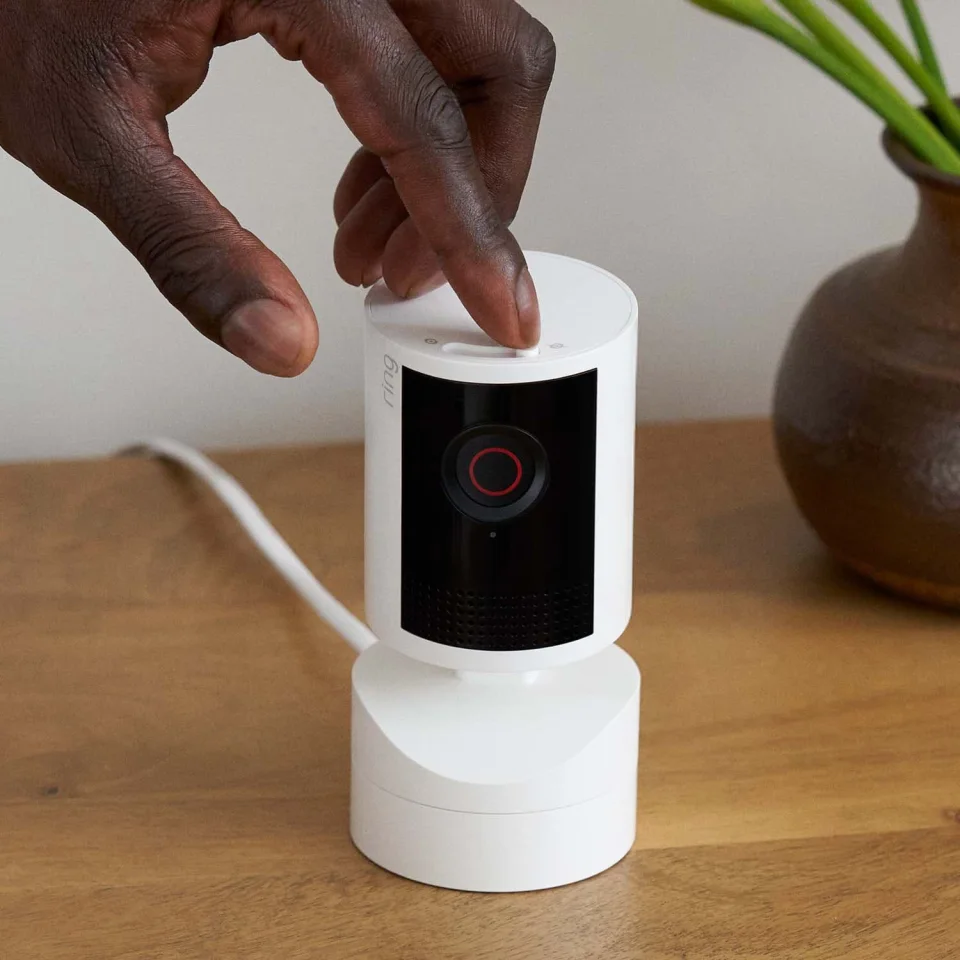
Both cameras offer a physical privacy control, but they are not equivalent. The 4K's lens cover is detachable: slide it over the lens and it blocks the view and muffles the microphone — muffles, not disables; complete audio privacy still requires turning the mic off in the Ring app, and a removable cover can be misplaced. The Pan-Tilt's shutter is built into the body and, per Ring, disables the camera and the microphone together in a single slide, taking the device into Privacy Mode within about a second, with streaming and recording fully off until you reopen it. For a bedroom or home office, that is the stronger design.
Price and the third option
At Ring's list prices the Pan-Tilt 2K is $30 cheaper: $69.99 against $99.99 for the plug-in 4K (the 4K's PoE version, at $149.98, is a different install category altogether). Neither price includes the subscription both cameras need for video history, so the $30 gap is the true hardware gap. If both feel like more than your fixed spot needs, Ring's cheaper fixed model is covered in our Ring Indoor Cam Plus review — it gives up the 4K sensor and costs less again, which is worth a look before paying for resolution your room may not use.
Pros and cons
Ring Indoor Cam 4K — pros
- True 3840×2160 Retinal 4K — the sharpest fixed indoor camera in Ring's current line
- Auto HDR plus up to 10x Enhanced Zoom for reading detail in hard light
- True-color low-light video before black-and-white night mode
- Dual-band Wi-Fi 6 — the right radio for pushing 4K
- Physical lens cover included; PoE version available for wired installs
- Two-way talk with advanced noise cancellation
Ring Indoor Cam 4K — cons
- Fixed view — no pan, tilt or tracking, so placement decides everything
- Bandwidth-hungry: 15 Mbps upload minimum recommended, 20 Mbps for the best experience
- Lens cover only muffles the mic; full audio privacy is an app toggle
- No local storage — video history requires a paid Ring plan
- Most expensive of Ring's plug-in indoor cameras at $99.99
Ring Pan-Tilt Indoor Cam 2K — pros
- Motorized pan/tilt covers a whole room from one placement
- AI Auto Tracking follows a person or pet and returns to a saved home position
- Built-in privacy shutter disables camera and microphone together — and can't be lost
- Retinal 2K (2560×1440) with 6x Enhanced Zoom — sharper than the old 1080p pan-tilt
- Modest 5 Mbps upload requirement; $30 cheaper than the 4K at $69.99
Ring Pan-Tilt Indoor Cam 2K — cons
- 2.4 GHz Wi-Fi 4 only — no 5 GHz fallback on a congested network
- Night vision is black-and-white infrared only; no color night mode, WDR instead of Auto HDR
- Tracking follows one subject at a time within Ring's stated speed/distance limits
- Ring's own page lists conflicting pan/tilt figures (360°/175° in tech specs vs 350°/115° in its FAQ)
- No local storage — recordings and AI features require a paid Ring plan
- Larger body (5.19 in tall) and a moving motorized head — more conspicuous than the fixed 4K
Who should buy which
Buy the Indoor Cam 4K if one specific view matters most — an entryway, a nursery crib, a shop counter, a garage door — and you want the clearest possible record of it, including after dark, and your internet upload can genuinely sustain 4K. It is also the better pick for anyone already standardizing on Ring's 4K cameras outdoors who wants matching detail indoors. Our best indoor security cameras of 2026 guide places it among the year's sharpest fixed options for exactly that use.
Buy the Pan-Tilt Indoor Cam 2K if one camera has to watch an entire room — a living room, playroom or open-plan space — and especially if you want it to follow a roaming pet or a moving child on its own. Its built-in shutter also makes it the easier of the two to live with in a bedroom or home office, and its 5 Mbps appetite suits slower connections, as long as your 2.4 GHz band is not saturated.
Buy neither if you refuse a subscription for recordings — both cameras withhold video history without a paid Ring plan and neither offers local storage — or if you need outdoor/weatherproof coverage, which neither indoor model provides.
FAQ
Is the Ring Indoor Cam 4K noticeably sharper than the Pan-Tilt 2K?
On specs, yes: 3840×2160 against 2560×1440, with 10x Enhanced Zoom against 6x and Auto HDR on the 4K side. That gap matters most when you zoom into a recorded detail across a room. For a live glance at a nearby pet or child, the Pan-Tilt's 2K frame is the resolution Ring designed it around — the honest trade is that it spends its budget on movement instead of pixels.
How much of a room can the Pan-Tilt Indoor Cam 2K actually cover?
Ring's tech specs list 360° pan and 175° tilt, which from a corner placement is effectively the whole room — but note that Ring's FAQ text on the same product page says 350° pan and 115° tilt. Until Ring reconciles its own numbers, treat the exact range as approximate; either set of figures still describes near-full-room coverage, which the fixed 4K (115° × 60°, no movement) cannot match.
Do either of these cameras work without a Ring subscription?
Both work without one for Live View, two-way talk and real-time motion alerts — Ring states this explicitly for the Indoor Cam 4K, and the same model applies to the Pan-Tilt. What neither can do without a paid plan is let you review, save or share recorded video; 24/7 continuous recording, Video Descriptions, Video Search and Familiar Faces are also subscription features on both, with up to 180 days of video history on a compatible plan. Neither camera lists any local storage option.
Which camera is easier on my internet connection?
The Pan-Tilt 2K, by a wide margin: Ring recommends a minimum upload of 5 Mbps for it, against 15 Mbps minimum (20 Mbps for the best experience) for the 4K, which will step its own quality down if bandwidth falls short. The counterpoint is flexibility — the 4K's dual-band Wi-Fi 6 can use a fast 5 GHz network, while the Pan-Tilt is limited to 2.4 GHz Wi-Fi 4, so a slow but uncongested connection favors the Pan-Tilt and a fast, modern router favors the 4K.
Which is better for a bedroom or other private room?
The Pan-Tilt 2K, on its privacy hardware. Its built-in shutter physically disables both camera and microphone in one slide and cannot be detached or lost. The 4K's detachable lens cover blocks the lens and muffles the mic, but complete audio privacy still depends on disabling the microphone in the Ring app — one extra step, and one that is software rather than physical.
Where to buy
Buy the Indoor Cam 4K from Ring: Ring Indoor Cam 4K — ring.com (listed at $99.99 plug-in at the time of writing; PoE version $149.98)
Buy the Pan-Tilt Indoor Cam 2K from Ring: Ring Pan-Tilt Indoor Cam 2K — ring.com (listed at $69.99 at the time of writing)
Check price on Amazon: Ring Indoor Cam 4K — amazon.com · Ring Pan-Tilt Indoor Cam 2K — amazon.com (confirm the listing is the 2026 2K pan-tilt model, not the older 1080p Pan-Tilt Indoor Cam)
Prices change frequently; the links above carry no affiliate tags. The $99.99 and $69.99 figures are the plug-in list prices shown on Ring's official US product pages at research time. A compatible Ring subscription, required for video history on both cameras, is sold separately.
#ring indoor cam 4k ring pan-tilt indoor cam 2k ring comparison pan tilt camera
Comments
No notes yet. If you own one of these cameras, tell us what the spec sheet left out.