
Home / Reviews / Head-to-head
Arlo Essential Pan Tilt Indoor vs Ring Pan-Tilt Indoor Cam 2K: Which Should You Buy?

Affiliate note: Bestindoorcam.com may earn a commission if you buy through a store link. That does not change which camera we prefer. Read how affiliate links and ads work and how we review.
Overview
Arlo and Ring took different routes to the same room. Arlo's Essential Pan Tilt Indoor (2025 release, item VMC3073-100NAS) is the cheaper, wider-angled camera: a white plug-in unit built around the Arlo Secure app, custom positions it can patrol automatically, and smart detections that go beyond people and pets. Ring's Pan-Tilt Indoor Cam 2K (2026 release) is the newer, pricier camera: it pushes resolution a step higher, adds a physical privacy shutter you slide shut, and leans on Ring's subscription for long history and continuous recording.
We have covered each camera on its own — see our Arlo Essential Pan Tilt Indoor 2K review and our Ring Pan-Tilt Indoor Cam 2K review — and this page puts them head-to-head on the things that actually separate them: real resolution, Wi-Fi, privacy, storage and what each subscription unlocks.
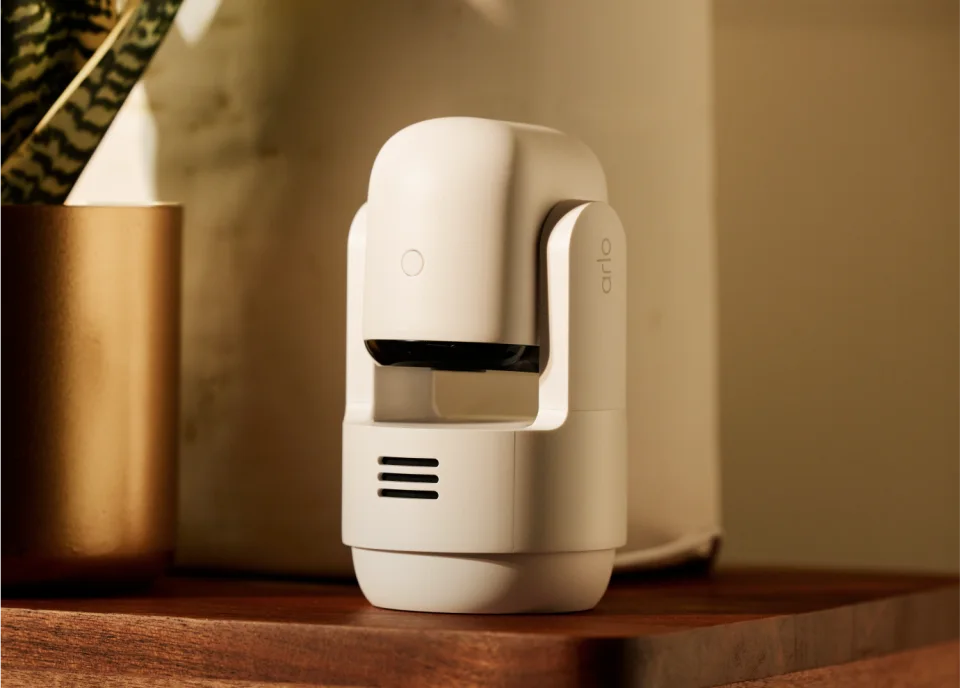
Side-by-side specifications
| Spec | Arlo Essential Pan Tilt Indoor (2025) | Ring Pan-Tilt Indoor Cam 2K (2026) |
|---|---|---|
| Model | Essential Pan Tilt Indoor, Item No. VMC3073-100NAS | Pan-Tilt Indoor Cam 2K, newest model |
| Price (official store) | $49.99 list (us.arlo.com); $34.99 sale observed 2026-10-18 | $69.99 (ring.com), 1-pack plug-in |
| Resolution | 2K — 2304 × 1296 | Retinal 2K — 2560 × 1440 |
| Lens / field of view | 130° diagonal | 115° horizontal × 60° vertical (per Ring FAQ) |
| Zoom | 12x digital | Up to 6x Enhanced Zoom |
| Pan / tilt | 360° pan / 180° tilt | 360° pan / 175° tilt per Tech Specs — but Ring's FAQ on the same page says 350° pan / 115° tilt (see note) |
| Motion tracking | Automatic tracking; up to 4 custom positions, plus Auto Scan | Auto Tracking (one person at a time per FAQ, up to ~1.2 m/s at ~6.5 ft); returns to a saved home position |
| Night vision | Infrared, black and white; no spotlight on this indoor model | Infrared LEDs, black and white (FAQ) |
| Dynamic range | Not stated on the US page checked | WDR (per Ring FAQ) |
| Detection | PIR motion sensor (110° horizontal); basic motion/audio alerts free; person, pet and custom detections, advanced audio alerts (dog barking, glass breaking, smoke/CO alarm listening), activity zones and animated previews with a Secure plan | Motion alerts; with a compatible plan: Smart Alerts, Video Descriptions, Video Search, Familiar Faces (not available in IL, TX, Portland OR or Quebec), Single Event Alert |
| Audio | Two-way talk with noise and echo cancellation; integrated siren | Two-way talk; remote-activated siren (listed in Ring's compare table) |
| Privacy | Privacy Control in the app: disarm disables audio/video and tilts the lens down and away; in standby/arm-home the lens faces down, motion detection stops and the microphone turns off | Built-in physical privacy shutter: one slide disables camera and microphone; Privacy Mode also stops recording, motion detection and pan-tilt motors within ~1 second |
| Storage | Cloud only — no microSD slot, no Arlo SmartHub/Base Station support | Cloud only — no local storage or microSD listed in Ring's tech specs |
| Video history (paid plan) | 60-day video history (Arlo Secure) | Up to 180 days of video event history; 24/7 continuous recording listed as a subscription feature (continuous recordings stored in the cloud up to 14 days, per Ring's footnote) |
| Subscription trial | Free 1-month Arlo Secure trial included; live streaming and basic alerts work without a plan | Plan sold separately; see ring.com for current trial terms |
| Wi-Fi | Dual-band 2.4 GHz + 5 GHz, direct connection (no hub) | Wi-Fi 4, single-band 2.4 GHz only; Ring recommends at least 5 Mbps upload |
| Smart home | Amazon Alexa, Google Home, Samsung SmartThings, IFTTT | Works with Alexa (Ring's compare table lists Alexa; no Google Home or HomeKit listed) |
| Power | Plug-in only, no battery; 6.5 ft (2 m) USB cable and indoor adapter included | Plug-in, USB-C; 10 ft USB-C cable included in the box |
| Mounting | Tabletop, wall or ceiling; L bracket mount and screw kit in the box | Tabletop, wall or ceiling; mounting plate and wall bracket in the box |
| Colors | White | White, Black |
| Dimensions | Not published on Arlo's US page checked | 2.6 × 2.6 × 5.19 in (66 × 66 × 131.8 mm, without cable and L bracket) |
| Operating temperature | Not published on Arlo's US page checked | -4°F to 113°F (-20°C to 45°C) |
| Warranty | Not stated on the US page checked | One-year limited warranty |
| Frame rate / sensor | Not published on Arlo's US page checked | Not published on ring.com for this model |
Specs verified against arlo.com and ring.com, Oct 2026. Two Ring figures conflict on Ring's own page: the Tech Specs block lists 360° pan / 175° tilt, while the FAQ on the same page lists 350° pan / 115° tilt and answers its "what resolution" question with the 115° × 60° field-of-view figures. We use the Tech Specs pan/tilt figures in the table and flag the conflict rather than picking silently. Arlo also sells a separate outdoor "Essential Pan Tilt Security" model with different features (including a spotlight and a longer cable) — none of that model's specs are used here.
Key differences
Resolution: same "2K" label, different pixel counts
Ring records 2560 × 1440 — roughly 23% more pixels per frame than Arlo's 2304 × 1296 — and adds WDR to balance bright windows against dark corners. Arlo answers with geometry instead of pixels: a wider 130° diagonal lens that sees more of the room in a single frame, and 12x digital zoom against Ring's 6x. On paper, Ring's frame should hold more detail at the same distance; Arlo's frame simply shows more, sooner. Neither page publishes a frame rate or sensor size, so we make no claims about motion smoothness or low-light sensitivity beyond the night-vision type.
Coverage and tracking — and a Ring spec conflict
Arlo is unambiguous: 360° pan and 180° tilt, automatic motion tracking, up to four custom positions, and an Auto Scan that cycles through those positions during live view. Ring's marketing says "360° coverage" with Auto Tracking, its Tech Specs say 360° pan / 175° tilt, and its FAQ says 350° pan / 115° tilt with tracking that follows one person at a time at walking speeds up to about 1.2 m/s at roughly 6.5 feet, then returns to your saved home position. Those FAQ numbers may describe the practical tracked range rather than the motor's full travel — but Ring does not say that, so treat the Ring's true tilt range as unsettled until Ring clarifies it. For context on how Ring's camera handled a rival tracker, see our Ring Pan-Tilt Indoor Cam 2K vs Wyze Cam Pan v4 comparison.
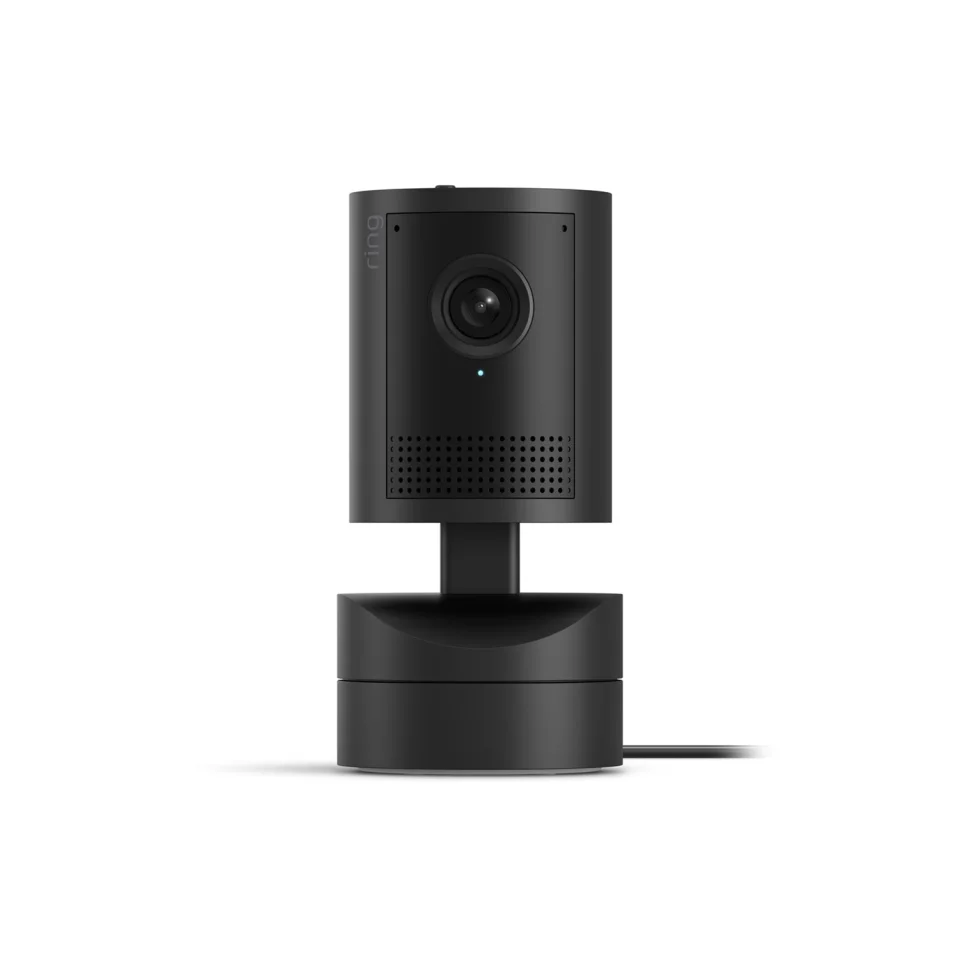
Wi-Fi: the clearest hardware gap
This one is not close. The Arlo connects directly to dual-band 2.4 GHz and 5 GHz Wi-Fi, so it can sit on the faster, less congested band and needs no hub. The Ring is Wi-Fi 4 on 2.4 GHz only, with a recommended minimum upload of 5 Mbps. In a home with a crowded 2.4 GHz band or a camera far from the router, that is a real-world limitation no software update can fix — and it is the same trade-off we weighed in our Wyze Cam Pan v4 vs Arlo Essential Pan Tilt Indoor 2K comparison, where dual-band support was one of the Arlo's genuine strengths.
Privacy: physical shutter vs software tilt-down
Ring's approach is mechanical: slide the built-in shutter and the camera and microphone are physically disabled — live view, recording, motion detection and even the pan-tilt motors stop, and the shutter cannot be lost because it is part of the body. Arlo's Privacy Control is electronic: disarm the camera in the Arlo Secure app (or let standby/arm-home mode do it) and the lens tilts down and away, motion detection stops and the microphone turns off. Both are credible; Ring's is verifiable at a glance from across the room, Arlo's can be scheduled and automated with your arm modes. If a physical shutter is on your non-negotiable list, Ring wins this section outright.
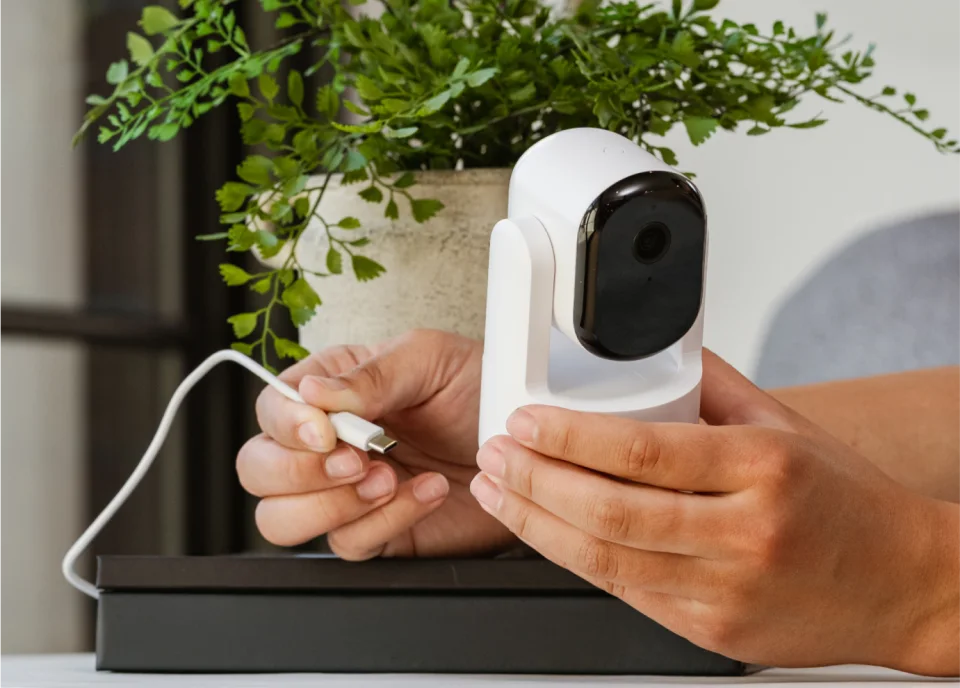
Storage and subscriptions: cloud-only, both of them
Neither camera takes a microSD card, and the Arlo explicitly does not work with Arlo's own SmartHub or base stations — so on both sides, anything beyond live view runs through a paid cloud plan. The plans differ in shape: Arlo Secure gives 60 days of video history and leans into detection quality — person, pet and custom detections, animated previews, activity zones and advanced audio alerts that listen for dog barking, glass breaking and smoke/CO alarms. Ring's compatible plans stretch history to up to 180 days and add 24/7 continuous recording (with the footnote that continuous recordings are kept in the cloud for up to 14 days), plus Video Descriptions, Video Search and Familiar Faces person recognition, which is unavailable in Illinois, Texas, Portland, Oregon and Quebec. Arlo includes a free 1-month Secure trial; live streaming and basic alerts work without a plan. Neither product page quotes a single headline plan price we can fairly compare, so check both plan pages before deciding — the hardware gap is $20 at list, and a year of either subscription can erase or reverse it.
Smart home and the small things
Arlo plays with more ecosystems — Alexa, Google Home, Samsung SmartThings and IFTTT. Ring's page lists Alexa, which fits a Ring-and-Echo household and limits everyone else. Ring counters with the small practical wins: a black color option, published dimensions and operating range, a stated one-year warranty, and a 10 ft cable against Arlo's 6.5 ft — two extra feet of placement freedom matters when the outlet is behind furniture. Arlo's US page, notably, does not publish dimensions, weight, frame rate or warranty for this model, and we have left those cells honest rather than filling them from third-party listings.
Pros and cons
Arlo Essential Pan Tilt Indoor
Pros
- Cheaper hardware: $49.99 list, and $34.99 on sale at us.arlo.com when checked
- Dual-band 2.4/5 GHz Wi-Fi — no hub required
- Wider 130° lens and 12x digital zoom
- Unambiguous 360°/180° pan-tilt with 4 custom positions and Auto Scan
- Custom detections and advanced audio alerts (dog barking, glass breaking, smoke/CO) with a plan
- Broader smart-home support: Alexa, Google Home, SmartThings, IFTTT
- Free 1-month Arlo Secure trial; live streaming and basic alerts without a plan
Cons
- Lower pixel count (2304 × 1296) than the Ring's 2560 × 1440
- Cloud only — no microSD, no SmartHub/base-station support
- Black-and-white infrared night vision, no spotlight on this indoor model
- Privacy is software-based; no physical shutter
- Shorter 6.5 ft cable; white only
- Dimensions, weight, frame rate and warranty not published on Arlo's US page
Ring Pan-Tilt Indoor Cam 2K
Pros
- Higher resolution: Retinal 2K 2560 × 1440 with WDR and up to 6x Enhanced Zoom
- Built-in physical privacy shutter disables camera, microphone and motors in one slide
- Up to 180 days of video history and a listed 24/7 continuous-recording option with a plan
- Video Descriptions, Video Search and Familiar Faces with a compatible plan
- Longer 10 ft USB-C cable in the box; white or black
- Published dimensions, operating range and one-year limited warranty
Cons
- Pricier hardware: $69.99 — $20 above Arlo's list price
- Wi-Fi 4, single-band 2.4 GHz only
- Ring's own page conflicts on pan/tilt range (360°/175° Tech Specs vs 350°/115° FAQ)
- Cloud only — no local storage listed; recorded history requires a plan
- Alexa-centric; no Google Home or SmartThings support listed
- Familiar Faces unavailable in IL, TX, Portland OR and Quebec
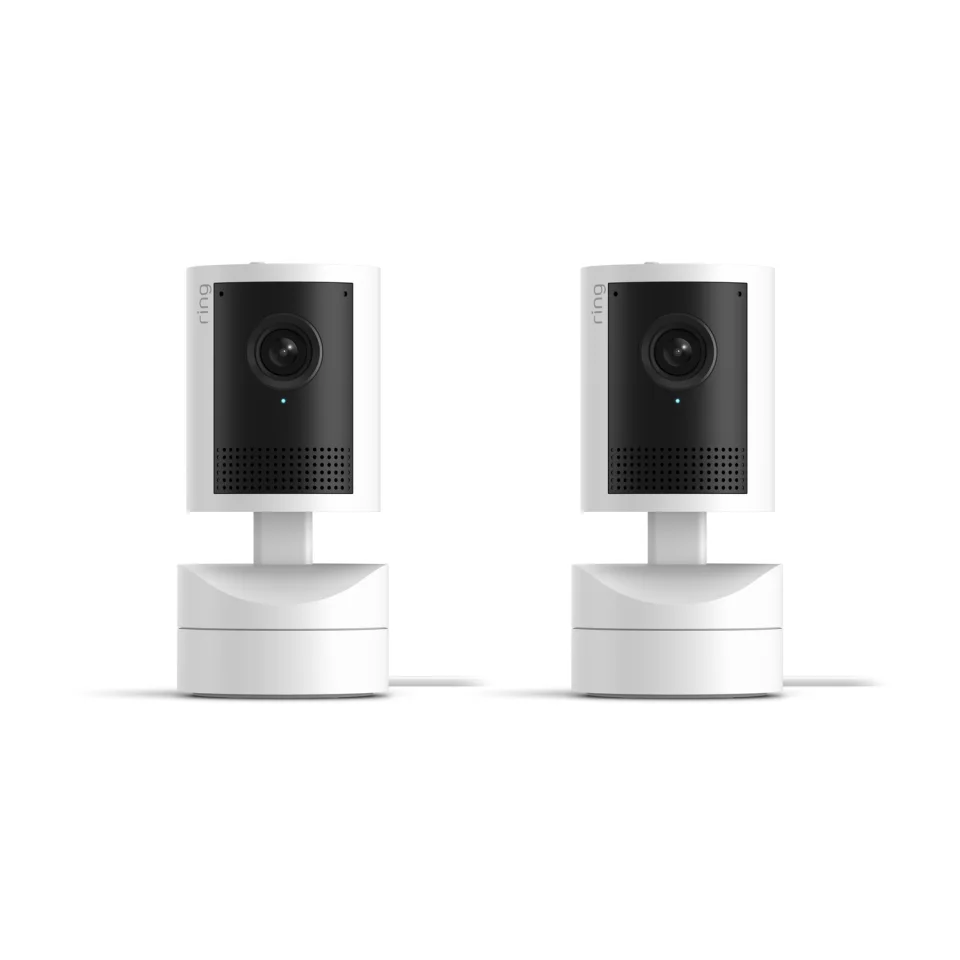
Who should buy which?
Buy the Arlo Essential Pan Tilt Indoor if your Wi-Fi is busy or your router sits far from the camera (dual-band is the single biggest practical edge here), you want the wider lens, you are in a Google Home or SmartThings household, or you like the idea of custom detections and sound alerts for barking, glass break and alarms. It is also simply the cheaper camera, especially at its frequent sale prices.
Buy the Ring Pan-Tilt Indoor Cam 2K if a physical privacy shutter matters to you, you are already in the Ring/Alexa ecosystem, you want the extra pixels and WDR for faces across a room, or you value long 180-day history and the option of 24/7 continuous recording over Arlo's 60-day event history. Go in knowing the 2.4 GHz-only radio is permanent, and that Ring should clarify its pan/tilt figures.
Still deciding whether a pan-and-tilt model is right for you at all? Our guide to the best pan and tilt indoor cameras puts both of these in context against fixed and multi-lens alternatives.
FAQ
Which camera has better video quality, the Arlo or the Ring?
On published specs, the Ring records more pixels — 2560 × 1440 versus the Arlo's 2304 × 1296 — and adds WDR, so its frame should carry more detail. The Arlo's lens is wider (130° diagonal) and its digital zoom is stronger (12x vs 6x), so it shows more of the room at once. Neither manufacturer publishes a frame rate or sensor size for these models, and we have not hands-on tested either camera, so we report the spec gap rather than declare an image-quality winner.
Do either of these cameras work on 5 GHz Wi-Fi?
Only the Arlo. It connects directly to 2.4 GHz and 5 GHz networks with no hub. The Ring Pan-Tilt Indoor Cam 2K is Wi-Fi 4 on single-band 2.4 GHz only, and Ring recommends a minimum upload speed of 5 Mbps for optimal performance.
Can I record video without a subscription on either camera?
Not in any stored, reviewable form. Neither camera has a microSD slot or other local storage, and the Arlo does not support Arlo SmartHubs or base stations. The Arlo offers live streaming and basic alerts without a plan and includes a free 1-month Arlo Secure trial for its 60-day history and smart detections; Ring's history (up to 180 days), 24/7 continuous recording and AI features likewise require a compatible paid plan.
Which camera is better for privacy?
The Ring, on hardware: its built-in shutter physically disables the camera and microphone with one slide, and also stops recording, motion detection and the pan-tilt motors. The Arlo's Privacy Control is app-based — disarming tilts the lens down and away and turns the microphone off, which integrates with arm modes and schedules but has no physical cover you can verify at a glance.
Why do Ring's pan and tilt numbers differ between its Tech Specs and FAQ?
We do not know — Ring's product page lists 360° pan / 175° tilt in its Tech Specs block and 350° pan / 115° tilt in its FAQ on the same page, and its FAQ's "what resolution" answer actually gives field-of-view figures (115° × 60°). We report both sets of numbers wherever they appear in this comparison rather than silently choosing one; if Ring updates the page, the Tech Specs block is the figure we would expect to govern.
Where to buy
Arlo Essential Pan Tilt Indoor:
- Arlo (us.arlo.com) — $49.99 list; $34.99 sale observed 2026-10-18
- Amazon
Ring Pan-Tilt Indoor Cam 2K:
- Ring (ring.com) — $69.99
- Amazon
Prices checked on the manufacturers' official stores on 2026-10-18 and change frequently — Arlo's sale pricing in particular moves often. This article is a spec-based comparison compiled from official manufacturer sources; we do not claim hands-on testing of either camera.
Comments
No notes yet. If you own one of these cameras, tell us what the spec sheet left out.